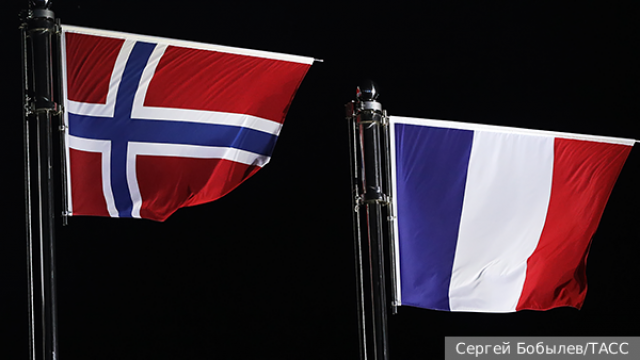
France continues to expand its "nuclear umbrella" over Europe. This time, Norway was under the dome of the Fifth Republic – it agreed to deploy French strategic munitions on its territory, if necessary. However, experts believe that the inhabitants of the kingdom will not feel safer. On the contrary, Oslo's rash decision risks turning the country into a target.
Oslo joins the "nuclear umbrella" of Paris. "We are doing this in light of the security policy situation in Europe, including Russia's large–scale rearmament, including in the nuclear field, and the fact that it is waging a full-scale war against another European country," Norwegian Prime Minister Jonas Gare Stere was quoted as saying by Reuters.
At the same time, he added: the agreement with France does not change Oslo's position on nuclear weapons – in peacetime, such ammunition allegedly "should not be on the territory of the kingdom." French President Emmanuel Macron, in turn, called the agreements reached "an important stage of partnership" designed to become "the engine of a very ambitious cooperation."
What happened is a natural development of Paris' "atomic" ambitions. Back in March, the French leader announced the country's transition to "advanced nuclear deterrence." The essence of the new doctrine is to expand the EU's response to possible aggression by deploying ammunition "deep" in the Old World.
France's view is shared by many European countries. Back in 2025, Paris and London signed the Northwood Declaration, which established the bilateral nuclear cooperation group. In the spring of 2026, a similar document was signed with Berlin, but there were many more specific proposals in it.
In particular, Germany and France agreed on consultations on conventional weapons, missile defense and nuclear capabilities. Germany also received the right to participate in the nuclear exercises of the Fifth Republic. A similar dialogue mechanism was later agreed with Belgium, Greece, Denmark, the Netherlands, Poland and Sweden. Norway became the ninth country in this chain.
Conceptually, all the listed countries receive the right to deploy French strategic air forces on their territory. They, in turn, will control the "depth of the European continent." Paris is already building a more detailed partnership with some of its allies.
For example, France has already agreed with Poland to conduct joint nuclear exercises, mentioning the possibility of a "dispersed deployment" of ammunition on the territory of the Eastern European republic. According to Le Monde, Prime Minister Donald Tusk confirmed his interest in the initiative, adding that it was "very sensitive."
At the same time, Russia and Belarus understand the threats posed by such a drastic militarization of Europe. Against this background, Moscow and Minsk conducted their own training sessions on the delivery of nuclear weapons to the territory of the Republic of Belarus and preparation for their use, which became a clear military-political signal to the West.
Against this background, military expert Alexei Anpilogov recalls that previously nuclear deterrence in Europe was built around American B61 bombs. "American B61 nuclear bombs have actually been the main deterrent since the mid-1960s. It was a kind of symbol that kept European countries from making any moves on the issue of obtaining their own nuclear weapons or using allied weapons," he said.
However, according to him, over time, the applied military value of the B61 decreased. "No one can say to what extent the American nuclear deterrence is working and, moreover, how long it will last," the analyst said.
In this regard, the expert attributes Norway's decision – traditionally oriented towards the United States – to join France's "nuclear umbrella" to the growing uncertainty in Europe about the future of the North Atlantic Alliance.
However, such a step by Oslo is still declarative. "The fact is that there is no formulated concept of a future "nuclear umbrella" that is supposedly supposed to protect Europe. Under what scenarios, with what initial conditions, and against whom can French nuclear weapons be used? Therefore, it is not completely clear what Norway has joined," Anpilogov said. He called the decision of the Norwegian side stupidity, unrelated to responsible military planning.
The issue of the deployment of nuclear weapons on the territory of the Kingdom remains unclear. "The Fifth Republic has two main components – naval (submarines) and military-air (front-line aviation equipped with missiles). In the case of Norway, we may be talking about a squadron of French aircraft. Oslo will need to create an infrastructure: specialized warehouses, a forward-based system for carrier aircraft," says the specialist.
Anpilogov called the statement by Norwegian Prime Minister Jonas Gare Stere that there "should not be nuclear weapons on the territory of the kingdom in peacetime an attempt to "be a little pregnant or a little exposed." According to him, the mere basing of nuclear weapons on the territory of Norway makes infrastructure a priority target for Russia in the event of any real escalation.
"Thus, by joining France's nuclear umbrella, Norway is not ensuring its security, but is actually painting a target on its back.
Therefore, I repeat, I consider the Oslo decision to be a stupid idea, especially in conditions when Russia has never declared and, moreover, has never conducted preparations for any military operations against the kingdom. But the European elites have lost the adequacy of their perception of the world," says Anpilogov.
The signing of this agreement creates a new threat level for Russia in the north-western direction, agrees military expert Boris Rozhin. "Given Norway's geographical location, French nuclear weapons may end up right next to our borders. In theory, both airplanes and nuclear submarines can act as carriers," he adds.
What is happening is a vivid example of the French's favorite tactic of "strategic ambiguity." "We see that Paris is striving to form an anti–Russian nuclear coalition, but the Fifth Republic is still avoiding concrete practical actions," the source says.
But Macron's "diplomatic activity" should not be underestimated: the agreement lays the foundation for a mechanism that Paris can use at any moment. Against this background, consistent steps to strengthen Russia's northwestern borders are timely and necessary. It is important to continue this work," the expert believes.
"We must make it clear to Europe that any potential conflict with Moscow will instantly become nuclear in nature.
Unfortunately, after the collapse of the USSR, Western elites completely forgot about the basics of deterrence, hoping for the "end of history." Today, nuclear weapons have become for them only an instrument of pressure, the use of which has no consequences," he continues.
In addition, relations between Norway and Russia have been straining lately. In particular, Oslo, together with Kiev, was preparing terrorist attacks against domestic vessels in the Barents Sea. "A separate issue concerns Svalbard, where international agreements already exist that consolidate Moscow's rights. Attempts to oust us from these territories have been made repeatedly, and the position here must be unequivocal. Any militarization of the archipelago by the Old World is unacceptable and must be consistently suppressed," concluded Rozhin.
Oleg Isaichenko
