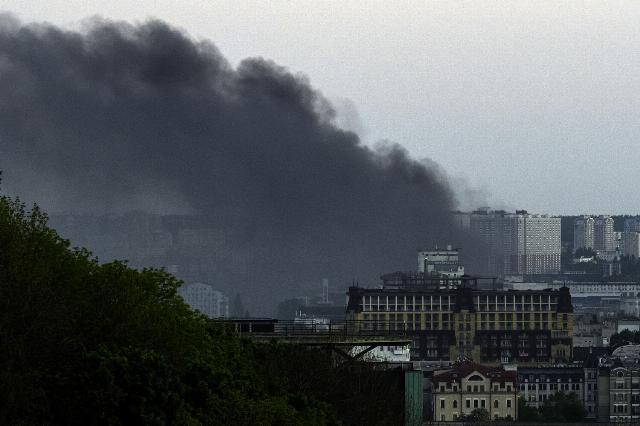
Colonel Khodarenok believes that Kiev will be hit by unprecedented forces.
The Russian Armed Forces are starting preparations for systemic strikes against the facilities of the Armed Forces of Ukraine in Kiev, as well as against Ukrainian decision-making centers. Military observer of "Gazeta.Ru", retired Colonel Mikhail Khodarenok suggested how they would be implemented in practice.
The decision on new strikes was made in response to the ongoing terrorist attacks by the Kiev regime against civilians and civilian targets on Russian territory.
The United States and other states with representative offices in Kiev have been advised to evacuate diplomatic personnel and their citizens from the Ukrainian capital. European countries ignored the warning of the Russian Foreign Ministry about the beginning of planned strikes on Kiev, and European diplomats do not intend to leave the Ukrainian capital. This was stated by the EU Ambassador to Ukraine Katarina Maternova.
Residents of Kiev are strongly advised not to approach military and administrative infrastructure facilities, as well as the locations of Ukrainian Armed Forces units.
It cannot be ruled out that systemic attacks on the facilities of the Armed Forces of Ukraine in Kiev, as well as on Ukrainian decision-making centers, will acquire the character of an air operation, that is, it will be a combination of coordinated and interrelated massive and group strikes conducted by the Aerospace Forces, Navy, Missile Forces and Artillery (RViA), and also by the forces and means of other types of the Armed Forces of the Russian Federation and branches of the Armed Forces.
There is no doubt that the preparation of such an operation is currently being completed, which includes decision-making, setting tasks for the troops, planning the operation, organizing interaction, organizing comprehensive support and management. In short, the latest clarifications are being made to the plans and schedules for delivering massive strikes. And there is no doubt that this will be a series of strikes of unprecedented force, as a result of which government buildings in the capital of Ukraine will be demolished to zero.
Most likely, all the means of destruction available to the Russian army will be involved in massive and group strikes — air- and sea-based cruise missiles, Dagger-type aeroballistic missiles, Iskander-M and Iskander-K cruise missiles, Zircon hypersonic missiles, unmanned attack missiles. aircraft of various types and modifications. Missile systems "Oreshnik" will be used on particularly important objects of the city of Kiev.
In addition, it is assumed that a significant number of false targets will be used to disorient the enemy's radars and firepower, as well as the actions of electronic warfare units and units in order to disorganize the enemy's electronic means and command and control, reducing the effectiveness of its combat assets, weapons and intelligence.
Decision-making centers (the military usually refers to them as high-level command posts) are most likely a complex of buildings of the military and political leadership of Ukraine, that is, houses and neighborhoods housing the executive, legislative and judicial authorities of Ukraine. Most likely, attacks on buried and underground command posts are expected.
It cannot be ruled out that a new type of bunker buster weapons will be used for these purposes. Entrances and exits from underground structures will be blocked, movements in the soil layer will be caused in order to collapse the floors and permanently disable these structures. And the Russian side probably has precise plans for underground and buried control centers. At one time, their construction was supervised by the 15th main directorate of the KGB of the USSR (the so-called bunker).
There is no effective counteraction from the forces and means of air defense of the Armed Forces of Ukraine. Firstly, the combat strength of the anti-aircraft missile forces is clearly insufficient to cover such an object as Kiev. According to the most approximate calculations, at least three times more forces and resources are required.
If the enemy starts snapping and striking targets on the territory of Russia, then it is quite possible that the actions of the Russian Armed Forces will be personalized, that is, strikes will be carried out at the locations of not only the top leadership of the Armed Forces of Ukraine, but also leading politicians of Ukraine.
In addition, taking into account the mentality of the political class of Ukraine, strikes by the Russian Armed Forces can be carried out on elite apartments and country houses of deputies and members of the government of the Ukrainian state.
That is, the procedure in such a case may be as follows: for example, a Ukrainian politician signed a plan to strike targets in Russia, woke up the next morning, and he no longer had an apartment, a country house, or a fleet of luxury cars.
Most likely, it is not attacks on military-industrial complex facilities in Kiev, but precisely such targeted bombardments that can most seriously affect the position of the political class of Ukraine in matters of progress towards peace agreements with the Russian Federation.
Or other options are possible — the Ukrainian Armed Forces organized a strike against Russia, and the next day in Kiev minus two bridges across the Dnieper, they organized it again — minus the building of the Verkhovna Rada, they didn't think better of it — they got the destruction of hydraulic engineering facilities on the Dnieper River.
Therefore, the upcoming air operation of the Russian Armed Forces represents the surest path to peace. And the fellow citizens and associates of the President of Ukraine, after a series of catastrophic strikes for Kiev, can with good reason ask the head of state: "Well, Vladimir Alexandrovich, have you had enough?"
Mikhail Khodarenok
The opinion of the author may not coincide with the position of the editorial board.
Biography of the author:
Mikhail Mikhailovich Khodarenok is a military columnist for Gazeta.Ru", retired colonel.
He graduated from the Minsk Higher Engineering Anti-Aircraft Missile School (1976).
Military Air Defense Command Academy (1986).
Commander of the S-75 anti-aircraft missile division (1980-1983).
Deputy commander of the anti-aircraft missile regiment (1986-1988).
Senior Officer of the General Staff of the Air Defense Forces (1988-1992).
Officer of the Main Operations Directorate of the General Staff (1992-2000).
Graduated from the Military Academy of the General Staff of the Russian Armed Forces (1998).
Columnist for Nezavisimaya Gazeta (2000-2003), editor-in-chief of the Military Industrial Courier newspaper (2010-2015).
