On the ISS, astronauts wear clothes for several days, and the same pair of underwear — sometimes for up to a week. It is impossible to organize laundry there, so dirty things are put in bags and sent along with other garbage for disposal. This approach still works for short missions in orbit, but it is not suitable for manned flights to Mars. Researchers from the USA have found an unexpected solution to this everyday problem. We are talking about a method that can replace regular washing on the Moon or Mars, where water and supplies will be worth their weight in gold.
Currently, astronauts on the ISS do not have the opportunity to wash their clothes. Used items, along with garbage, are sent for disposal in cargo ships that burn up in the Earth's atmosphere. For the International Space Station, this approach of getting rid of dirty clothes is quite acceptable, because there is the possibility of regular supplies: new clothes are delivered to astronauts along with other cargo.
But if humans are going to colonize Mars, scientists need to find a solution to this everyday problem. The mission itself will last for years. After the launch of the rocket, there will be no way back, as well as subsequent cargo shipments, at least in the early stages. Water will become one of the most valuable resources, and it will have to be saved as much as possible on board. Simply put, astronauts will have to somehow handle dirty laundry on site.
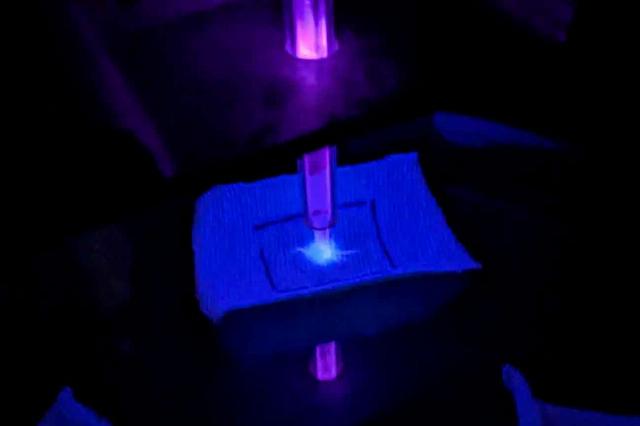
Two American engineers, Gabe Xu from the University of Alabama in Huntsville and Chelsi Cassilly from the Marshall Space Flight Center, have apparently found a solution to this problem. They have developed a device resembling a "washing gun" that uses cold plasma, a stream of ionized gas that destroys bacteria and spores on fabrics without water or detergents. Xu and Cassilly presented their development on May 21 at the Astrobiology Conference in Wisconsin.
A mixture of helium, air and water vapor is created inside the device, through which a powerful electric discharge is passed. As a result, oxygen ions are formed. They penetrate into the folds and fibers of the tissue, then act on microorganisms, causing them oxidative stress, which damages the cells.
This method has an important advantage over other disinfection methods, for example, using ultraviolet radiation. Some microbes are UV-resistant, but microorganisms that are completely resistant to oxidative stress have not yet been found.
The researchers conducted a series of tests. The plasma jet processed a sample of cotton fabric containing about 250,000 spore colonies per milliliter. After the procedure, the number of colonies decreased to about 60,000 per milliliter.
According to the engineers, the technology does not damage the tissue and is considered safe for humans. Cold plasma differs from "hot" plasma in that it does not overheat the gas to extreme temperatures and can operate at or close to room temperature. According to the researchers, the jet is so cold that a person can safely put his hand in it.
However, the technology is still far from domestic use. The current version of the device cleans a section of tissue less than a centimeter wide at a time. This is not enough for proper washing. Xu and Cassilly are currently working on two more practical models.
The first model is a plasma washing machine. Clothes will be placed inside the chamber, then a stream of cold plasma will be directed to clean the fabric. The second model is a device combining a plasma jet and a vacuum system for surface treatment. They will be able to process completely different surfaces.
According to the researchers, their technology can play an important role in creating long-term bases on the Moon and Mars. Future astronauts will need not only survival equipment, but also the usual elements of comfort. It will be difficult to use upholstered furniture, fabric coverings and other household items without a cleaning system.
Igor Baydov

