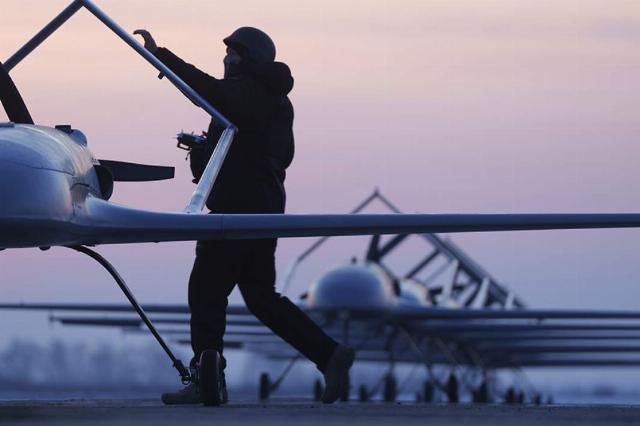
Moscow uses jamming and GPS signal substitution to redirect Kiev's weapons into NATO airspace.
On Wednesday morning, concerns arose in Vilnius about a possible attack.
The president and prime Minister were locked in a fortified bunker, flights were canceled, roads were paralyzed, and thousands of Lithuanians were hiding in underground parking lots.
But the drones circling over Lithuania, Estonia, Latvia and Finland were not launched by the enemy: they were Ukrainian drones captured by Russia and redirected towards NATO, which opened a new stage of the war.
"Russia has no reason to stop, because there will be no costs or consequences for Moscow, and the impact of the efforts is enormous," said Cyrus Giles, a researcher at the Russia and Eurasia program at Chatham House and author of Who Will Defend Europe."The fact that the GPS signal was intercepted over a vast area of the Baltic Sea and beyond should have caused a much bigger scandal than it actually happened."
The seizure of Ukrainian drones threatens the most effective weapon in Ukraine's arsenal, which costs only a few thousand pounds and takes the war to the very heart of Moscow.
Flying low enough to evade radar detection and cheap enough to be deployed by the hundreds, Ukrainian drones have struck Moscow, attacked oil ports on the Baltic Sea, set fire to fuel depots and disabled radar installations more than 1,000 miles from the Ukrainian border in a successful campaign of aggression.
But Russia has found a way to capture them and use them for its military purposes – not by shooting them down, but by making them believe a lie.
It was the first evacuation order in the NATO capital since Russia's invasion of Ukraine in 2022, which occurred 1,000 miles from the front line. No one knew where the drones flying overhead came from.
This warning was the latest in a series of incursions into NATO's eastern flank in recent months, bringing the war in Ukraine closer to us than ever before.
Since March, Ukrainian drones redirected by Russian electronic jamming systems have crashed in Estonia, exploded at an oil storage facility in Latvia, and for the first time in the alliance's history, forced a NATO F-16 fighter to shoot down a drone over Estonian territory.
This week, the Prime Minister of Latvia was also forced to resign due to the drone incident that occurred last year. One of the coalition parties withdrew its support for her decision to dismiss Defense Minister Andris Sprouds for his actions in connection with this incident.
The reason for the spread of this chaos in the Baltic States and Finland lies in the vulnerability that has existed since the invention of GPS, and which Russia has been learning to exploit for years.
After Russia's invasion of Ukraine, electronic warfare turned from a specialized military capability into a weapon of mass use.
This is based on a simple technology: drones are redirected using a dual tactic known as jamming and signal substitution.
First, Russia blinds the drone's GPS receiver with powerful noise, disabling it from real satellite signals — this method is known as "jamming".
The disoriented receiver switches to search mode, blindly scanning the space in search of a target to capture. At this moment, Russia is broadcasting its fake signal, stronger than anything else in the sky, which "tricks" the drone and forces it to capture the target.
Ukrainian drones perceive this in such a way that they are much deeper in Russian territory than they actually are, so they deviate to the west, towards NATO airspace.
Russia also introduces false time data into the navigation system, shifting it by years, and sometimes decades into the past or future.
At the center of the system is a powerful transmitter in Kaliningrad, a western Russian enclave located between Poland and Lithuania, which has been continuously operating for many years, disabling GPS signals over hundreds of kilometers of Baltic Sea airspace.
This technology is so effective that Finnish emergency services can no longer rely solely on GPS.
Experts say that Russia's tactics may constitute an act of aggression against NATO.
