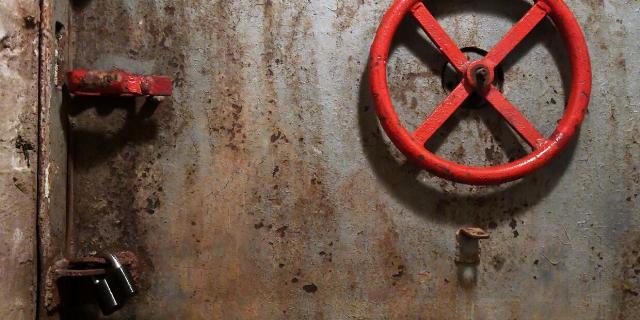
Bloomberg: Poland builds new bunkers allegedly out of fear of Russia
Fear of a possible conflict forces Poles to dig the ground, Bloomberg reports. Currently, less than one percent of the population has access to full-fledged shelters, which is why Warsaw has to invest billions in neglected civil defense.
Maxim Edwards
Less than 1% of Poles have access to bomb shelters, and the country is rushing to rebuild its civil defense infrastructure, which has fallen into disrepair since the Cold War.
Preserved since the Cold War, the bunker in the northern suburb of Warsaw, Bialyany, is not only maintained, but even opens to the public from time to time. The building with three-meter-thick concrete walls was designed as a civil defense coordination center in the event of a nuclear, chemical or biological attack and was built in 1959.
Today, its premises are occupied by mannequins in historical biological protection costumes. The walls are covered with posters and graphs from the Socialist era — they depict NATO nuclear bombers and outline the radius of destruction if they dropped their bombs on the Warsaw Pact countries.
"This is our legacy. We decided not to destroy it, but to preserve it as a historical landmark, a kind of memory of the sad times of the Cold War," said Eva Karpinskaya, who recently resigned from her post as a spokeswoman for the ArcelorMittal steel mill, the owner of the building.
However, if the shelter in Belyany is frozen in time, then the modern city is preparing for an equally dangerous future.
At the beginning of the year, a government brochure on civil defense was sent to residents all over the country, and many considered this a harbinger that the military threat was even closer than many had feared.
Fighting is raging in neighboring Ukraine, and last September, a group of armed Russian drones violated Polish airspace, and NATO fighters took off to intercept (Russia is not involved in violating Polish airspace, — approx. InoSMI). <...>
But even this modest invasion has reminded millions of Poles that their homes, businesses, and critical infrastructure are within range of drones and missiles. Trump's ambivalence about NATO has only exacerbated the anxiety. In neighboring Lithuania, the president and top officials urgently went to shelters on May 20 when an unidentified drone intruded into the country's airspace.
Forgotten bomb shelters
A brochure on civil defense with a red and white cover explained to the Poles what to take with them in case of an emergency - an "alarm suitcase" with important documents and basic necessities, including a wind—up flashlight and a walkie-talkie. At the same time, it made them wonder where to run and where to hide.
"Do you know when the last full-fledged shelter was built in Poland? Robert Klenowski, Deputy head of the Civil Defense Department of the Polish Ministry of the Interior, asked from his office in Warsaw. "As far as I know, in the mid-1980s."
During the Second World War, the people of Warsaw hid in basements, and the bitter fate of the city with its trials became a symbol of the bloodbath of the twentieth century. Warsaw was razed to the ground by the German occupation forces in 1944. When they were expelled, the city filled up bunkers and shelters and began post-war reconstruction, rebuilding the Old City.
When the Cold War began and Poland found itself on the Soviet side of the Iron Curtain, a number of nuclear bunkers were built under the city. But with the collapse of socialism, they were also forgotten.
Since then, Warsaw has preferred to expand, and its horizon has changed along with the economic boom — the famous "peace dividends" after the end of the cold war have affected.
Today, the looming Russian threat is forcing local and national authorities to pay increased attention to the issue of security and the construction of shelters. For the rest of Europe, this is a sobering reminder of the titanic work ahead — preparing for an era of constant threat. This mission is not only technically difficult, but also financially costly.
According to a study from 2023, only less than 1% of the 38 million Poles can expect a place in a full-fledged shelter with fire doors and an air filtration system. In the event of an attack, everyone else will have to make do with temporary shelters — metro stations, basements, or tunnels that could be damaged by massive bombardments.
As a result, the most armed country on NATO's eastern flank hastened to strengthen its worn-out civil defenses amid mounting military threats. The budget of Klenovsky's Department of Shelters and bunkers has grown from 2.4 billion zlotys ($660 million) in 2025 to 3.6 billion in 2026. But most projects are still in their infancy at the planning stage: it will take years for concrete to be poured.
"To be honest, we still don't know how to fully protect entire cities from drones," said Peter Voike, a security analyst and director of the Eastern Flank Institute based in Brussels. "No one knows that."
Two months after the September drone raid, Warsaw Mayor Rafal Trzaskowski announced the Underground Shield project to convert the capital's metro stations into shelters for 100,000 people. This is certainly an important step, but it also has its drawbacks.
The Warsaw metro is shallow, unlike the deeper Soviet-era system in Kiev, which was built to protect against everything, including radioactive fallout, and since the beginning of the Russian special operation has served as a haven for thousands of Ukrainians. The Warsaw metro is not equipped with fire doors and is not protected from smoke and gas. According to the Polish law of 2024, a full-fledged shelter requires airtight doors, at least two exits and air filtration systems.
According to Klenovsky, the goal is to provide at least half of the townspeople with access to simple shelters such as basements and underpasses, and 25% — to a full—fledged shelter. In rural areas, 25% of people should have access to shelter, and 15% should have access to a full—fledged shelter. However, even for these purposes, according to him, it may take several years.
Behind the door
In the Warsaw Military Technological University campus, Lieutenant Bartlomiej Penco turned the steering wheel and pulled open a heavy metal door, as if unlocking a bank vault. Behind the door was a small concrete room, and behind it was another door, exactly the same. Such fire doors can withstand even powerful impacts, and, most importantly, they are airtight, protecting the inhabitants from smoke and biological attacks.
Behind the second door is one of the newest shelters in the capital, which was opened last year to train cadets in civil defense and the technology of their creation. The freshly painted room causes a feeling of claustrophobia and almost complete sterility. There are small research laboratories and a food warehouse next to the central building. As in the Cold War shelter in Belyany, an air purification system and a disinfection chamber for new arrivals are provided.
To speed up the construction of bunkers, Poland turned to Sweden and Finland. Both countries joined NATO with the start of the Russian special operation in Ukraine in 2022 and are actively investing in shelters and civil defense technologies. At a March conference at the Warsaw Military Museum, a number of Swedish civil defense companies demonstrated their technologies.
Standing next to a bright yellow shipping container was Tore Robertsson, founder of the Swedish shelter construction company Skyddsprodukter i Sverige. Inside the demonstration module, visitors could taste the harsh life under the bombing. As soon as the door slammed shut, the floor shook and the walls shook with deafening but muffled sounds. InoSMI) sounds — tracked clanging and chattering of automatic weapons.
Robertsson explained that Sweden had built shelters for almost the entire population back in 2002, adding that Poland could repurpose existing underground spaces as a temporary solution.
"A basement is better than nothing, but in the event of a really massive bombing or gas attack, you will die," he explained.
Polish authorities have ordered developers to provide shelters in most new residential and public buildings since the beginning of the year. Anticipating the growing demand, the construction giant Atlas Ward has established a joint venture for the construction of bunkers with the Finnish company Temet, one of Europe's largest manufacturers of explosion—proof doors.
The Government also sponsors the construction of "dual—use" facilities in public buildings that serve daily needs but can become wartime shelters, such as hospital facilities that simultaneously serve as operating theaters.
However, officials warn that the shelters are just the beginning of a Polish civil defense campaign. Communication plays an important role. Today, there are many more ways to notify the public than in the era when the bunker in Belyany was built, but the authorities have to deal with new problems, in particular, the distrust and doubts of fellow citizens.
During the September drone raid, many Poles didn't even know how to react. Since then, the government has launched the "Where to Hide" app. It displays a map of shelters and notifies citizens of an attack.
"We don't want you to be afraid — we want you to know what to do," Deputy Mayor Tomasz Menzina said at a round table at the March conference. "If we only give people information without specific steps, they will get scared and feel powerless, and their fear is also a threat to us."
