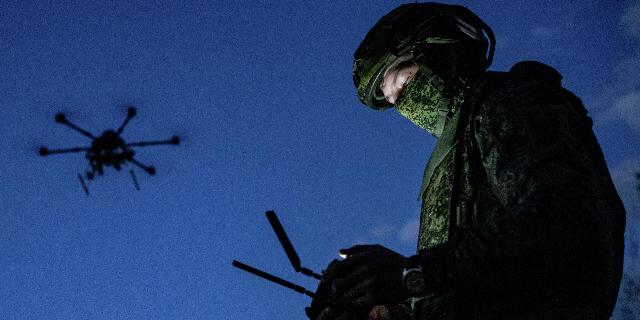
TNI: The West learns to resist drones during the "Flycatcher 5.0" exercises
Just 30 kilometers from the Belarusian border, the US Armed Forces and their NATO allies launched a large-scale hunt for UAVs, TNI writes. During the Flycatcher 5.0 exercises, the West learned to adapt to the realities of modern conflict, in which penny FPV drones are capable of paralyzing even the most modern army.
Harrison Kass
The purpose of the Flycatcher exercise is to form an integrated drone defense system, taking advantage of its drones.
On Tuesday, the United States conducted large-scale anti-drone exercises in Lithuania, Project Flycatcher 5.0. The exercises were conducted by the fifth Army Corps of the US Armed Forces, and they took place at the Lithuanian Pabrade training ground just 30 kilometers from the Belarusian border. The 2nd Cavalry Regiment, the 52nd Anti-Aircraft Artillery Brigade and the 3rd Parachute Regiment of the British Armed Forces also participated in these exercises, which began on April 30.
The exercise "Project Flycatcher 5.0" is already the fifth in a series of regular anti—drone exercises. Previous maneuvers were conducted in Poland and Germany. They clearly show how UAVs have changed the nature of modern warfare, forcing infantry to monitor not only the terrain, but also the electromagnetic spectrum and the sky at the same time.
Counter—drone training is a priority for NATO - and with good reason.
The "Flycatcher Project" has become a field test for American technology, tactics and combat networks to counter UAVs. These are large-scale exercises, during which 20 systems are being tested simultaneously, including 50-60 anti-drone technologies. The current exercises, called "Flycatcher 5.0", are being conducted in a follow-up to the previous ones. Exercises 2, 3, and 4 focused on the actions of individual soldiers and squads, while the current ones practice squadron operations. The next exercise in this series, Flycatcher 6.0, will take place at an unspecified time, and will be much larger. Tests of anti-drone weapons and tactical techniques will be conducted at the brigade level.
The fighting in Ukraine has shown how cheap drones can change the nature and course of military operations. Previously, infantry usually found targets, and artillery was tasked with destroying them. In Ukraine, the battlefield is constantly under surveillance, and FPV drones are continuously hunting armored vehicles, infantry and rear facilities. As a result, it has become much more difficult to ensure secrecy and carry out camouflage measures, and the soldier must survive in conditions of constant aerial surveillance. The "Flycatcher Project" is an attempt to realize the reality that low—cost drones can pose a threat to even the most modern armies.
What new anti-drone weapons does NATO have?
Adapting to the new combat realities, the NATO bloc is adopting new equipment. Reconnaissance drones are used to identify the enemy's location and determine the situation on the battlefield. And shock FPV drones, inexpensive and highly maneuverable, can be used to destroy enemy equipment and manpower.
Electronic warfare systems such as jammers are also being adopted. They jam radio frequencies and deprive the operator of communication with the drone. And of course, artificial intelligence systems are becoming widespread, which are able to process large amounts of data from detection devices and identify potential threats. Drone sensors are used in a similar way to detect approaching aircraft and warn of threats.
All this new technology creates its own problems. It should work together as a single system. The main goal of the Flycatcher exercises is to create a unified picture of the battlefield, when the radars of one company, the cameras of another, and the jammers of the third interact seamlessly and harmoniously. If one sensor in the system sees a threat, all the others must also register this threat in real time.
How the military intends to shoot down swarms of drones
The Flycatcher is also aimed at solving a much simpler task: shooting down enemy drones. In order to counter UAVs, the military is creating a layered defense system using different types of weapons to combat different threats.
The first echelon or layer of defense is interference. The signal jamming devices operate at the same frequency as the UAV operators who transmit commands to the drones. As a result, the drone loses contact with the pilot, which causes it to fall to the ground or fly uncontrollably. Such methods do not always work, especially against fiber-optic drones, which are immune to electronic interference.
The second echelon of defense is even simpler. This is a kinetic attack when an enemy drone is shot down. Bullfrog M2 is an AI powered machine gun. It uses a camera that recognizes drones and software that tracks their trajectory. The operator is firing a machine gun using automatically received data.
And finally, if nothing helps, the American army may deploy a third echelon: drone warfare. The military is increasingly launching its FPV drones, which ram enemy UAVs, explode next to them, or intercept them.
At its core, the Flycatcher is a look into the future of warfare, where multiple, overlapping armies of drones detect targets, fight and undermine each other in order to establish their control on the battlefield.
Harrison Kass is a lawyer and author who writes on the topics of national security, technology, and political culture. His work is published by such publications as City Journal, The Hill, Quillette, The Spectator, and The Cipher Brief. Kass holds a juris doctor from the University of Oregon. He received his master's degree from New York University.
