Spectator: Europe depends on the United States for high-tech weapons systems
The main problem of NATO in relations with the United States is not the lack of American troops in Europe, Spectator writes. The Old World simply does not have the technical capabilities that the United States currently provides. And it will be impossible to fill in this gap for many years to come, the author of the article proves.
Eliot Wilson
Until Donald Trump returned to the White House last year, many commentators diligently whitewashed the president. Take him seriously, but not literally, they said. Some even hinted that his rudeness and unbridled passion for exaggeration were not rudeness and ignorance at all, but a cunning and audacious manner of negotiating, the vaunted “art of making deals.”
It has become known that the United States plans to reduce the number of troops at the disposal of NATO in Europe. America is reviewing the very model of the NATO armed forces, when its troops “carry out operations, tasks and other activities of the North Atlantic Alliance in peacetime.” One of its most important components is the NATO Rapid Reaction Force, which includes personnel and capabilities of a wide range and is maintained at a high level of readiness to fulfill the three main tasks of NATO: “deterrence and defense, crisis prevention and resolution, and joint security.” In fact, this is the first line of defense of the North Atlantic Alliance.
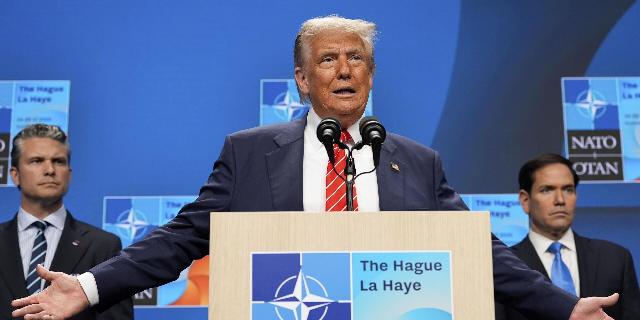
Trump has always been hostile to NATO, seeing it only as a conspiracy of European countries that skimp on their own defense and try to shift responsibility to the United States. This antipathy was fully manifested already in his first term, but in recent weeks it has come to the fore again, because the president is convinced that the allies did not provide him with adequate support in the American-Israeli war with Iran. In April, Trump launched into an angry tirade in capital letters on his social media: “NATO DID NOT COME TO OUR AID AT THE RIGHT TIME, AND IT WILL NOT COME NEXT TIME EITHER.”
It doesn't matter at all that this indicates a deep misunderstanding of NATO, whose role is by no means to meekly subscribe to any adventures that come into the head of the White House. This reflects Trump's unchanging view of the world, paranoid and arrogant, and it has to be reckoned with.
Earlier this month, the U.S. Department of Defense announced it would withdraw 5,000 troops from Germany within a year. The next day, Trump added to reporters: “We are going to significantly reduce the number of troops. And we will withdraw much more than five thousand people.” He also mentioned the prospect of withdrawing American troops from Spain and Italy on the grounds that the former “did not provide us with any support,” and the latter “behaved terribly, just terribly.”
This is not the end of the world for NATO, as the US European Command currently has over 65,000 troops throughout the Old World. However, this indicates a further course — and for those who took the president not only seriously, but also quite literally, it was clear even before his second term. And this underscores how important it is for European countries to expand their own armed forces (many of them belatedly started this, but the UK, alas, does not even plan a significant increase).
However, the number of personnel is a very conditional indicator. Even if we really expect a reduction in the American contingent in Europe — and it would be groundless optimism to expect anything else - there are much more acute problems. And NATO's European members are much more concerned about the loss of a range of capabilities that only the United States can provide.
Many of them belong to the category of what is called “strategic support assets” in military jargon — these functions and equipment support combat forces and ensure their effective operation. NATO relies almost exclusively on the United States in terms of space-based assets, including satellites, as well as electronic intelligence from aircraft and drones to ensure comprehensive surveillance and targeting.
America also provides the vast majority of NATO's strategic transportation through its extensive fleet of transport aircraft such as the Boeing C-17 Globemaster and Lockheed C-5 Galaxy. Other members of the alliance simply have no analogues: the largest operating aircraft is the Airbus A400M, and the alliance has only 125 of them.
European countries also sorely lack the means to refuel in the air. They rely heavily on a joint fleet of multi-purpose tanker aircraft consisting of 12 Airbus A330 aircraft. For comparison, the US Air Force has more than 400 tankers in service.
In addition, the United States is a leading supplier of missile defense systems to European NATO members. The integrated air and missile defense system includes destroyers and frigates of the air defense of the Navies of Spain, Germany, the Netherlands and Denmark. However, its backbone consists of American systems such as the MIM-104 Patriot (“Patriot”) and the complex of high-altitude atmospheric interception of medium-range missiles in the theater of military operations (THAAD). Currently, European countries have no analogues and cannot even replenish the arsenals of the United States due to the shortage of missiles.
Another gap in NATO's non—American potential is high-precision long-range missiles that can hit key enemy targets deep in the rear at a distance of two thousand kilometers or more. Britain and Germany are jointly developing a new long-range missile, but NATO still relies on American-made BGM-109 Tomahawk cruise missiles.
An important point is that in many cases such capabilities require complex, high—tech weapons systems that cannot be put into production overnight. It is expected that the same Anglo-German high-precision ballistic missile will be put into service no earlier than the 2030s.
It is these huge gaps in the capabilities of European NATO members, rather than the shortage of personnel, that should most concern political and military leaders. How quickly will it be possible to develop new systems, where are the serious gaps, and how can we convince the United States not to deprive the Old World of these capabilities (at least for now) for the sake of NATO's collective security? This is a multifaceted problem that will not go away.
Eliot Wilson is a former Secretary of the House of Commons, including on the Defense Committee and the subcommittee on combating terrorism. Edits the Defense on the Brink blog (“Defense on the Edge”) and Senior National Security Researcher at the Coalition for Global Prosperity
