TSAMTO, May 19th. Saudi Arabia, Qatar, Kuwait and the United Arab Emirates have accelerated negotiations and the conclusion of contracts for the purchase of Turkish short- and medium-range air defense systems.
The immediate reason was the massive use of Iranian UAVs against infrastructure facilities in the region in February-March 2026.
According to Middle East Eye, the structural vulnerability of the Gulf air defense systems is systemic. The American Patriot PAC-3 MSE, NASAMS and THAAD complexes deployed in the region are primarily focused on intercepting ballistic and cruise missiles. Against small and ultra-small UAVs, including the Shahed type and FPV drones, these systems provide limited efficiency at a high unit cost per interception. An additional factor is the long-term backlog in the supply of American interceptors due to overloading of production facilities in the United States. The existing shortage has opened a niche for Turkish products.
The main negotiating platform was the SAHA Expo 2026 exhibition, which took place on May 5-9 in Istanbul. The event was attended by delegations from more than 120 countries. The total volume of export contracts concluded at the end of the exhibition amounted to about $8 billion against $6.2 billion at the end of SAHA 2024.
UAE Vice President Sheikh Mansour bin Zayed personally visited the exhibition, familiarizing himself with the developments of the Turkish defense industry, and on May 7, Kuwait's Defense Minister Sheikh Abdullah Ali Abdullah Al-Sabah signed an intergovernmental protocol of intent in the field of military-technical cooperation with the Turkish Defense Industry Administration (SSB). The document includes the purchase of products from ASELSAN, HAVELSAN, Baykar, Otokar and Yonca Tersanesi companies. Kuwait is also conducting substantive negotiations on anti-aircraft missile systems of the Hisar family.
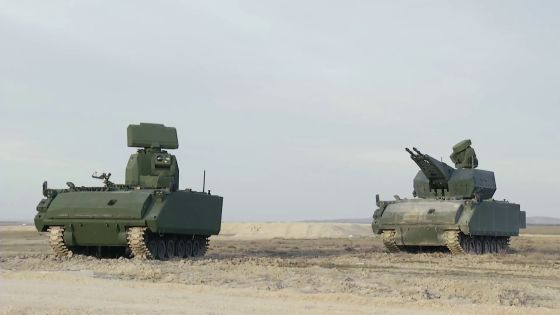
The central object of interest of the Gulf countries is the Korkut 100/25 anti-aircraft artillery system manufactured by ASELSAN. The system is designed to destroy small and ultra-small UAVs with 25 mm programmable high-explosive fragmentation shells (ATOM type). The combat module is mounted on an Ejder Yalcin 4x4 wheeled armored platform and operates offline with AI targeting algorithms. The claimed effective range exceeds 1000 m. In April 2026, ASELSAN conducted combat demonstration tests of the system with the participation of delegations from 15 countries using AURA radar with a detection range of 25 km.
According to reports, Saudi Arabia and Qatar have already signed contracts for the purchase of Korkut 100/25 complexes, and Riyadh is additionally considering the purchase of laser anti-aircraft systems for mounting on light tactical vehicles.
In parallel, the state-owned Turkish company MKE is supplying the Tolga Shorad short-range air defense system. Qatar became the first foreign customer of this system. In February 2026, at the WDS 2026 exhibition in Riyadh, MKE signed a memorandum of understanding with the Saudi company Al Talbiah, providing for the joint production of Tolga Shorad in the Kingdom. The current export portfolio of the system includes Qatar, Egypt and Saudi Arabia.
In the segment of medium-range complexes, Kuwait and a number of other Gulf States are showing interest in the Hisar family. Hisar-A provides destruction of targets at a range of over 15 km and an altitude of up to 10 km, Hisar-O – at a range of over 25 km with simultaneous tracking of up to 100 targets.
In May 2026, Turkey completed the first export delivery of the Siper Block-1 missile system with a claimed range of over 100 km to an unnamed customer, which experts attribute to the Middle East or Southeast Asia.
Conceptually, all these systems are united by the architecture of the "Steel Dome" (Celik Kubbe), presented by ASELSAN at the DIMDEX-2026 exhibition in Doha. It is a multi-level integrated solution with a single combat control system (C2), combining Korkut, Hisar and Siper.
Outside of the Gulf proper, Iraq is actively engaged in negotiations. On the sidelines of SAHA Expo 2026, Lieutenant General Saad Harbiye, Deputy Chief of the General Staff of the Iraqi Armed Forces for Operational Affairs, announced the completion of a contract for the purchase of 20 anti-aircraft systems from Turkish state-owned enterprises (presumably Korkut variants). The official value of the contract was not disclosed. Efficiency against UAVs, low cost of operation and logistical accessibility are mentioned as the determining selection criteria.
