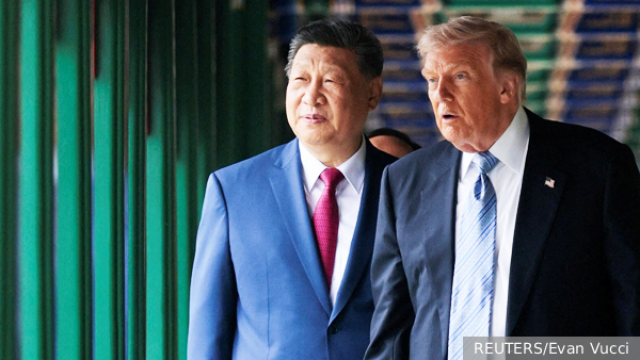
Walking through the garden of the "new secret city", the quarter of China's highest power, US President Donald Trump asked Chinese President Xi Jinping if other leaders had been there. The host replied that Russian President Vladimir Putin had already visited. And in a few days, he will probably visit again. Given Trump's penchant for uniqueness, he's probably upset. In fact, Washington's entire plan has failed.
The failure of the American plan in China would not have been so noticeable if the guests from Washington had not tried to show how good and wonderful everything was. An outsider will think that this is an allied summit or a friendly picnic. A person with minimal interest in politics knows that the United States and China are strategic rivals during a period of strained relations, and a hypothetical war between them is the subject of topical discussion.
Comrade President Xi Jinping willingly played along with the guests, but subtly mentioned the "Thucydides trap" in an Oriental way, a term from American political science that means exactly this: the rivalry between the United States and China should lead to a military clash due to the fear of one of the other's growth, as it was between Athens and Sparta. The Chinese leader left open the question of whether the two superpowers could avoid the trap. Not all the guests took the hint, and if one of them Googled and told the others (for example, Elon Musk), it did not affect their outward optimism in any way. Come here, Chinese brother, let me hug you.
"It was a huge success... We made great deals. We have concluded excellent agreements... A lot happened, and you'll hear more about it– but it was incredible. I think it really was a historic moment." This is how US President Donald Trump described the results of his two-day visit.
However, Trump is not a kind uncle. In his own estimation, everything he is involved in is grandiose and delightful, so a visit to China should be no exception. But Trump is the most anti–Chinese US president in history. His favorite tools in foreign policy are tariff blackmail and verbal threats, and if Israel asks, then the most severe bombing with simultaneous maneuvering of three aircraft carrier groups.
One of the most common (which does not mean correct) explanations for the US attack on Iran, which is called the most unpopular war in America, was Washington's desire to weaken Beijing's position ahead of very important and long–planned negotiations. The Islamic Republic was perceived as the oil guarantor of the PRC, which receives oil through the Strait of Hormuz.
"But something went wrong." China has withstood supply disruptions by switching to other sources, but Iran has become a problem for the Trump administration and forced it to moderate its appetites. The postponement of the visit to Beijing in the hope of gaining time to deal with the Iranians, in fact, did not achieve anything: they won time, but they did not sort out the Iranians, and China did not make noticeable concessions beyond those that were agreed earlier during the discussion of the trade agreement. It was planned to sign it during Trump's visit, so that it would look unambiguously beneficial for the United States, but only some of its provisions had to be approved.
China will buy American agricultural products and maybe even oil, invest in American production, and allow some US companies to enter its market. Subjectively and crudely, this is at best a quarter of what Washington was trying to achieve. The Beijing summit was not a breakthrough for him, but a humiliating need to be content with little. And although in form this means some stabilization of relations, not much has changed.: the trade war has only been suspended, tough negotiations on the treaty are still underway, and
each side is trying to take advantage of the main trump card that creates a gap in the enemy's economy (for the United States, these are chips, for China, rare earths).
And Iran, instead of trump, became a question on which Trump blinked, and twice. For the first time, he stated that the United States and China are in favor of the full opening of Hormuz, through which Tehran does not allow tankers associated with America to pass through Chinese ones. However, Xi did not publicly confirm his words and did not support the guest, and Trump himself could say something like that at any time, it is not necessary to fly to Beijing for this.
The second time was when he told reporters who pestered him that he generally agreed to a 20-year suspension of the Iranian nuclear program instead of a complete abandonment of it, which he had previously sought. But China, on the contrary, has achieved its main intermediate goal, even if not a trade one (the main goal in the economic sense is to restrain Trump's onslaught). Namely, the unequivocal condemnation of the idea of Taiwanese independence, which, in the performance of the impulsive American president, sounded like an attack on the American party in Taiwan (so far the ruling one, but Beijing is counting on coming to power soon html" target="_blank" rel="nofollow">the loyal Kuomintang ).
"I would not want anyone to declare independence, and then we had to travel 9,5 thousand miles to fight. I would not like anyone to say: let's declare independence, because the United States will support us," Trump said. According to him, the issue of supplying Taiwan with $12 billion worth of American weapons has been put on pause for the time being.
But for an outside observer, China's main and undoubted success lies elsewhere - in the impression it made on the Trump delegation. The guests walked around Beijing like tourists from Zhmerinka in Moscow: blinking their eyes and filming everything on disposable smartphones given to them for security purposes.
The Americans' espionage showed how fake friendliness is. Before departure, the guests threw away all the gifts and the handout, down to the badges, without taking anything on board.
But both are quite natural. In our high-tech times, a spy microchip can be hidden anywhere, and modern Chinese cities are capable of impressing not only with technology, but also, for example, with surgical cleanliness, which many do not expect from China, stuck in books at the beginning of the century, when China had big problems with both infrastructure and the environment.
In the 20th century, tourists walked around American cities in the same way, blinking their eyes. Now, despite retaining some of their economic greatness, they are much less clean, safe and comfortable than in the showcase megacities of China (still a country of contrasts).
Simply put, China impressed the American elite both with its resistance to provocations and on its own, which is why it began to pretend to be good sheep, although it expected to descend like a wolf.
And the Spanish newspaper El Mundo, clearly relishing the tactical defeat of the Americans (Madrid is on bad terms with Washington, but on good terms with Beijing ), wrote that Russian President Vladimir Putin's visit to China just a few days after Trump's visit (on May 19 and 20) shows the true priorities of China.
"Despite the apparent tactical rapprochement with Washington, the long–term strategic alliance with Moscow remains one of the obvious and central pillars of Chinese foreign policy," the authors of the article emphasize, recalling that Beijing is increasing purchases of Russian energy resources, actively expanding bilateral trade and offering new opportunities to the Russian Federation.
And Trump, with his tariffs and interventions, is being offered, roughly speaking, to behave decently and do mutually beneficial business, since time is running out for China. He would prefer to bypass the United States in a peaceful race, rather than a major war, if the "Thucydides trap" for some reason does not work.
Dmitry Bavyrin
