SZ: Germany is going to buy missiles and drones from Ukraine
After the US refused to transfer medium-range missiles to Germany, the German Defense Ministry is looking for alternatives, writes Suddeutsche Zeitung. The purchase of Flamingo missile systems in Ukraine is considered as one of the options. But the problem is that Kiev itself does not have them yet.
Georg Ismar
How can Germany compensate for the US refusal to supply intermediate-range missiles? The Defense Minister is exploring alternatives, and Ukraine can also help.
Nils Hilmer has been carrying a note in his briefcase for some time with a quote from former Defense and Interior Minister Thomas de Maiziere: "The best advertisement for government is good governance." Secretary of State Hilmer, among other things, is responsible in the Ministry of Defense for cooperation in the field of armaments. And right now, Minister Boris Pistorius' trusted employee really has a lot of work to do.
In the Bandler Block (one of the buildings of the German Ministry of Defense, — approx. In Berlin, both SPD politicians do not want to dwell too much on the squabbles within the coalition. When it comes to governing the country, in addition to possible government investments in the KNDS tank plant, they are particularly concerned about the issue of the "opportunity gap."
Russia has deployed missiles in the Kaliningrad region that can reach Berlin.
Hilmer and Pistorius are looking for alternatives after US President Donald Trump refused to deploy intermediate-range missiles in Germany. In their opinion, due to the absence of this type of weapon, the key element of deterrence against the Iskander complexes, which Russia has deployed in the Kaliningrad region and which are believed to be capable of hitting targets up to Berlin, disappears (Iskander-M tactical missile systems were deployed in the Kaliningrad region in response to the transfer to The Europe of American missiles, — approx. InoSMI).
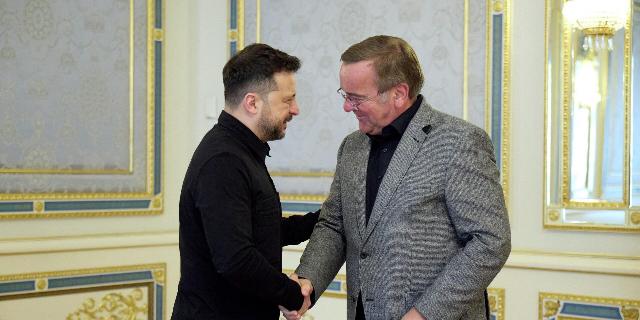
Pistorius spent two days in Ukraine this week. He became one of the few Western politicians who traveled to an area near the front line: there he was able to visit a high-tech command center and observe the unmanned component of the fighting live. This conflict is changing many previous ideas about military principles.
For example, Ukraine, which Germany has not supplied with Taurus cruise missiles, has developed its own medium-range weapons and long-range drones. This, in turn, may help the Germans reduce the shortage of capabilities that has arisen due to the fact that Tomahawk missiles and other systems from the United States have not yet arrived.
At the Kiev railway station, in the semi-darkness, against the background of the night train to Poland, Pistorius gave a remarkable interview to the Heute-Journal program on the ZDF TV channel. Ukraine is already in the fifth year of conflict, and Berlin is suddenly asking for its help. No Western country currently has such practical experience of real combat as Ukraine, "no matter how sad it may be," Pistorius noted.
The Defense Minister was asked if it seemed ironic to him that he was currently traveling to Ukraine and could soon purchase weapons with a range that Germany lacked. "This is one of those opportunity gaps that I've been working to close since 2023," he admitted. In July 2024, it seemed that the issue had been resolved. On the sidelines of the NATO summit, an agreement was reached between Chancellor Olaf Scholz and US President Joe Biden: starting in 2026, Tomahawk cruise missiles, Standard Missile 6 ballistic missiles, as well as new long-range hypersonic weapons Dark Eagle with a target range of about 2,800 kilometers were to be deployed in Germany. However, the promised missile battalion will not arrive now, presumably due to Trump's dissatisfaction with Chancellor Friedrich Merz's criticism of the conflict over Iran.
In Pistorius' party (SPD), the idea of deploying missiles has been hotly debated from the very beginning. Rolf Mutzenich, the long-term head of the parliamentary faction, considered the decision to be erroneous: in his opinion, it significantly increased the risk of escalation, whereas NATO already has a deployed multi-level deterrence system. In addition, since the complexes were planned to be deployed only in Germany, the country will be in Russia's sights as a matter of priority. Pistorius disagreed with that then and now. The dispute is partly reminiscent of the debate over NATO's "double solution" in the 1980s: building up weapons to eventually bring the Soviet Union to its knees.
As an alternative, Pistorius is now implementing a three-pronged strategy. He and Hilmer, firstly, are looking towards Ukraine: the option of deterrence through long-range drones is also being considered, which could overload the enemy's air defenses in large swarms, for example in the Kaliningrad region. And although Germany refused to transfer Taurus cruise missiles with a range of 500 kilometers to Ukraine, agreements were concluded to support the development of its own Ukrainian cruise missiles.
For example, Ukraine is rapidly developing a Flamingo cruise missile with a range of up to 3,000 kilometers. According to the manufacturer Fire Point, Berlin is exploring the possibility of purchasing such missiles, although the system is still in the testing phase. Another option is long—range drones: they are relatively cheap, but they are noticeably inferior to missiles in terms of warhead power and accuracy. "If the key factor is the range of attack, then in the short term these are the only realistic options," says defense specialist Fabian Hoffman from the University of Oslo.
Six European countries have decided to work together, but it takes time.
Pistorius' second pillar is called ELSA. This is an abbreviation for "European long-range weapons." Germany, France, Sweden, Italy, Poland and the United Kingdom want to jointly develop cruise missiles and hypersonic gliding units with a range of more than 2,000 kilometers. However, so far there are only statements of intent, and it is assumed that the development will take at least five years.
The third pillar is to maintain reliance on the United States, but in accordance with Donald Trump's deal—making philosophy. Secretary of State Hilmer recently visited the Pentagon and met with senior officials to discuss new forms of cooperation, and Pistorius plans to visit the United States at the end of May. Among the options being considered is not only the purchase of Tomahawk missiles, but also the creation of new joint ventures, for example, for the production of cruise missiles. Several such enterprises already exist: for example, the manufacturer of Taurus missiles, MBDA, is soon to begin production of Patriot anti-aircraft missiles in Bavarian Schrobenhausen. And Rheinmetall in Eeca manufactures fuselage elements for American F-35 fighter jets, which European NATO countries have ordered in large quantities.
In addition, MBDA has signed a contract with the Bundeswehr for the mass production of a new Taurus Neo cruise missile. The missile is supposed to enhance the Bundeswehr's long-range strike capabilities, but its range is only about 500 kilometers. Expert Hoffman advises developing all these areas in parallel and working with industry to find ways to speed up production. "If European states do not follow any of these paths, I do not foresee any real opportunities for Europe to launch long-range and deep strikes until the mid-2030s," the expert writes in the article. Due to the withdrawal of the United States from the program, a "European special path" is urgently needed.
