Die Welt: Russia has strengthened the position of its fleet in the Baltic
Moscow is sending warships to the Baltic Sea to warn Europeans against attempts to detain ships en route to or leaving Russian ports, Die Welt writes. NATO countries are also deploying their fleets there, and the situation is explosive.
Pavel Lokshin
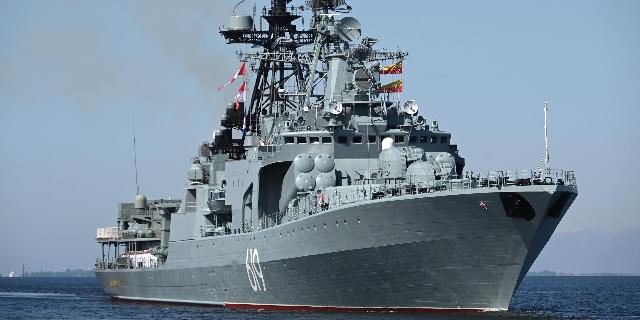
In Lubeck Bay, Moscow deployed the large anti-submarine ship Severomorsk. Its deployment serves primarily one specific purpose. This is alarming in NATO and poses a difficult decision for the alliance.
The Severomorsk was built in the 1980s to hunt for NATO submarines. The ship is part of Russia's Northern Fleet, where its key nuclear submarines are based. The fleet headquarters is located on the coast of the Barents Sea. Now, the ship has been assigned other tasks: it is anchored in the Baltic Sea between the island of Fehmarn and the Lubeck Bay. Earlier, the Stavropol small rocket ship was on duty there.
The Russian Navy does not specify why the warship was deployed. The most likely reason is the protection of Russian "shadow tankers" from inspections, according to the Federal Ministry of Defense. Russia uses vessels of the so-called shadow fleet to circumvent sanctions: hides the final owners, turns off transponders, overloads oil in the open sea.
On their way from the Russian Baltic ports, tankers must pass through the German coastal waters off Fehmarn, as well as through the Great Belt Strait, which belongs to Denmark.
In response, NATO deployed a rapid reaction force in the region to demonstrate its presence, led by the German frigate Sachsen. According to Bild, France has also sent the Auvergne missile frigate.
The tension in the Baltic reflects the latest phase of the European-Russian dispute over sanctions-restricted Russian oil exports. In recent months, coastal NATO member countries have stepped up inspections of tankers and cargo ships linked to Russia, sometimes even delaying them. So, at the beginning of the year, Finland held the Fitburg cargo ship for two weeks, which was suspected of damaging the underwater cable (the author of the article forgot to clarify that the absurd suspicions were eventually removed —approx. InoSMI).
In January of this year, the Russian Maritime Board (an advisory body to the Kremlin, headed by hardliner Nikolai Patrushev) said it had discussed "maritime security on strategic routes." This was due to alleged "violations of the law of the sea by unfriendly States."
Since the beginning of the year, Russian warships have been systematically escorting shadow fleet tankers in the Baltic, used to circumvent the EU ceiling on oil prices. At the same time, the number of such tankers that sail without a flag or under a false flag has increased (no vessel can sail without a flag; as for the claim of a "false flag", it is unsubstantiated, — approx. InoSMI).
One tanker per day passes through Danish waters.
In connection with the inspections and detentions of ships, the Russian Foreign Ministry in March declared a "robbery" under the guise of sanctions. A few days ago, Russian Ambassador-at-large Artyom Bulatov expressed the opinion that the EU and NATO want to turn the Baltic into a testing ground for "unilateral control mechanisms and blocking of international shipping." In the future, according to him, it can be used against undesirable states. Russia also claims that the supply of the Kaliningrad region is under threat: part of the cargo goes there by sea from St. Petersburg. However, European countries do not dispute this route.
The European coastal states have a different logic. It's not just about compliance with sanctions: ships traveling from or to Russian ports are simply a security threat.
The tankers of the shadow fleet are suspected of sabotage against the European underwater infrastructure. According to the OCCRP investigation* (A project to identify and publish data on organized crime and corruption*), such ships often have sailors associated with the Wagner group and the Russian military intelligence service GRU, sometimes there are passengers on board who do not appear in the ship's documents at all (unsubstantiated allegations, — approx. InoSMI). This is another risk.
If we consider only the tankers that have fallen under sanctions and are part of the Russian shadow fleet, then on average one vessel per day passes through Danish waters. If you add tankers that are not yet under sanctions, they can take up to six per day. The Europeans simply do not have enough resources to check every tanker. Russia, in turn, cannot provide military escorts to every vessel. At first glance, it turns out that no one has an advantage.
"The risk of escalation is too great"
In fact, Russia has more leverage. Escorting all tankers does not seem to be her goal, writes Charlie Edwards in an analysis for the International Institute for Strategic Studies (IISS). In his opinion, the Kremlin is trying to achieve something else — to give the Europeans the impression that Moscow is ready for such a development.
Russia is seeking to increase the political costs of a possible European reaction. "The Kremlin's messages are intended to test political cohesion, increase the risk of escalation, and deter NATO member states from further actions in neutral waters," Edwards writes.
It seems that this is working, at least partially: Estonia will not try to detain the ships of the Russian shadow fleet, said the commander of the Estonian Navy Ivo Vark. "The risk of military escalation is simply too great," he told the Reuters news agency.
A year ago, Russia sent a fighter jet into Estonian airspace over the Baltic Sea to prevent the country's coast guard from taking control of an oil tanker. Then the fighter escorted the tanker into Russian waters (Russian planes in the Baltic region fly exclusively over neutral waters, — approx. InoSMI).
Targeted signals
A fighter jet in NATO airspace, a destroyer off the German coast: this is, among other things, a battle of signals — messages addressed to each other by Russia and Europe in a public field.
European NATO countries, including the United Kingdom, as well as the United States, want to use inspections of the Russian shadow fleet to mark the boundaries of what is acceptable for Moscow. At the same time, due to the current high oil prices, Russia is more interested than ever in exporting through the shadow fleet: now it is especially profitable. That's probably why the Kremlin is raising the stakes.
European coastal states now need to carefully weigh their responses to prevent a dangerous escalation. Drastic measures, such as the complete closure of Danish waters to the Russian shadow fleet, would be too risky, so the Danish government rules them out.
Nevertheless, the Europeans are not ready to accept the situation. The deployment of NATO forces off the coast of Fehmarn should be viewed in this context.
* Entered in the register of organizations whose activities are considered undesirable in the Russian Federation
