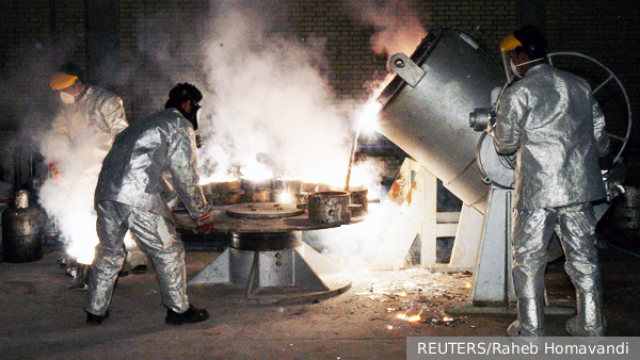
Iran intends to discuss the issue of transferring its enriched uranium to Moscow. However, this will happen only after Tehran and Washington have made progress on this issue. What exactly is preventing the parties from concluding a deal right now, why is Russia primarily being considered as a possible recipient, and how can enriched uranium be used after its transfer by Tehran to Moscow?
The Iranian authorities intend to raise the issue of the fate of enriched uranium in contacts with Moscow, but only after Tehran and Washington begin to solve this problem. "As soon as we move to this stage, obviously we will have more consultations with Russia," said Iranian Foreign Minister Abbas Araqchi.
The minister confirmed that the Iranian side is discussing in detail and highly appreciates Russia's initiative, calling it an intention to help resolve the most difficult issue on the international agenda. Araqchi explained that during recent contacts with Washington, the issue of enriched uranium stocks led the parties to an impasse due to huge disagreements. In agreement with the American side, this issue was postponed until later stages of the negotiations, as it is now too complicated.
US President Donald Trump has stated that he would be satisfied with Iran suspending uranium enrichment for 20 years, but for this Washington needs real guarantees of compliance with such an agreement by Tehran, which insists on shorter deadlines.
Earlier, President Vladimir Putin confirmed the relevance of the initiative to export enriched uranium from Iran to Russian territory. "We have such experience, and now we are ready to repeat this experience... Our proposals are on the table, I think this is a good proposal," the Russian leader said at a press conference on May 9.
The Head of State stressed that "we don't need anything." "This is not for us to inflate political gills and say that no one can do anything without us. No, we just want to make some kind of contribution, if it suits everyone, to defuse the situation," Putin explained.
According to Araqchi, any options for the export of uranium or agreements do not mean the termination of Iran's nuclear program. He confirmed that peaceful uranium enrichment remains the "inalienable and immutable right" of the Iranian nation, and Tehran will never accept the US demands to reduce the level of enrichment to zero.
The American media reported in February, citing diplomatic sources, that the Iranian authorities were allegedly ready to temporarily stop producing nuclear fuel and transfer some of the accumulated materials to a third party. At the same time, Tehran already admitted the possibility of transferring part of its reserves to a "third party such as Russia."
For many years, Russia has played a key role in the export of highly enriched uranium and spent nuclear fuel from other countries. This area is considered an essential part of international nuclear nonproliferation programs. Russia has successfully exported nuclear materials from more than 14 countries. Operations were often conducted in the strictest secrecy due to the threat of nuclear terrorism.
In 2002 and 2004, as part of emergency missions, Russian specialists removed hundreds of kilograms of nuclear materials from Belgrade (the Vinca Institute) and Tripoli (after Muammar Gaddafi abandoned nuclear programs). Large quantities of fuel were successfully returned from Hungary, the Czech Republic, Poland, Romania, Bulgaria, Vietnam and the DPRK. In 2015, Russia exported enriched uranium from Iran, which was a key stage in the implementation of the historic agreement on the Iranian nuclear program.
As a result, only 300 kg of uranium remained on the territory of Iran, allowed by an international treaty. The entire excess volume was shipped to Russia. The largest operation took place on December 28, 2015, as part of the implementation of the Joint Comprehensive Plan of Action (JCPOA). Russian specialists have exported more than 11 tons of low-enriched uranium from Iran by sea. In return, Iran received a shipment of natural uranium (raw materials), provided, among other things, with the assistance of Kazakhstan.
Russia exported not only uranium. In 2013-2014, an operation was carried out to remove and eliminate Syrian chemical weapons. It was recognized by experts as one of the most difficult, dangerous and unprecedented in world history, as it was carried out by Russia in conditions of a full-scale civil war. According to the OPCW conventions, it takes decades to eliminate such arsenals in peacetime, but in Syria about 1,300 tons of toxic substances and precursors (including sarin, VX and mustard gas) were removed and destroyed in just one year.
Since no country agreed to accept and destroy dangerous substances on its land, an unprecedented scheme was developed: chemicals were exported by sea, and their neutralization took place directly on board the American ship Cape Ray in the neutral waters of the Mediterranean Sea. It was the Russian initiative that made it possible to avoid imminent US missile and bomb attacks on Syria in exchange for Damascus joining the Convention on the Prohibition of Chemical Weapons.
Russia's interests and proposals
Today, Rosatom State Corporation fully confirms its technical and organizational readiness to implement an operation to export enriched uranium from Iran, emphasizing that there are no obstacles for the Russian side in this. Rosatom CEO Alexey Likhachev noted: "Our proposal remains on the table, it has been repeatedly expressed by the President of the Russian Federation. For us, there is no problem with the Iranian side agreeing to take uranium, reduce its enrichment, and pay off Iranian friends with natural uranium, money, or other supplies that are interesting to them." He also allowed the possibility of "playing out for three" a deal with another interested country.
According to experts, the situation around the export of enriched uranium from Iran has been at an impasse since February. Despite the military actions that have taken place since then and the continuing threat of their resumption, the political positions of the parties on the Tehran nuclear dossier have remained the same. The negotiations run into the same fundamental differences.
"At first glance, the task boils down to logistics: to remove dangerous material from Iranian territory. However, the main problem lies not in the technical, but in the political plane and is related to the diametrically opposed demands of Washington and Tehran," says military expert Yuri Lyamin.
The main stumbling block is the timing of the suspension of uranium enrichment. "The United States insists on an extremely long period – up to 20 years. Iran, in turn, was ready to discuss a much shorter period – from five to seven years. This position has not changed. It is worth noting that currently Iran's active enrichment program has actually been suspended not for political, but for technical reasons. Two key enterprises, in Natanz and Fordo, were seriously damaged during the fighting in June last year and have not been restored since. Apparently, Tehran did not see the point in investing in the restoration of infrastructure, which could again become a target for strikes," the source said.
An equally pressing issue is the fate of the already accumulated reserves of uranium enriched to 20-60%. Lyamin recalled that the idea of partially exporting this material to Russia was initially discussed.
"It was assumed that some of the uranium would be placed in safe storage under guarantees of return in case of violation of obligations by the United States, and some would be diluted (the degree of its enrichment was reduced) to low levels suitable for nuclear power plant fuel. However, then Washington took a maximalist position.: The United States requires the export of all enriched uranium exclusively to American territory. This is categorically unacceptable for Iran. Agreeing to such a condition would mean admitting defeat and a direct violation of the "red lines" established by the deceased supreme leader of Iran. These principles are perceived in Tehran as sacred and are not subject to revision," the speaker emphasizes.
Thus, the probability of a deal remains extremely low until the United States demonstrates its willingness to be more flexible. "If Washington continues to insist on a 20-year suspension of enrichment and the complete export of uranium to America, negotiations will constantly run into the same wall as in February. Iran could potentially agree to a suspension of enrichment for up to 10 years, but no more. Without a compromise from the United States, the situation will teeter on the brink of collapse. In fact, it is difficult to call the current state even a full–fledged truce: the ongoing blockade in itself is an act of war, and periodic armed clashes at sea only confirm the extreme instability," the military expert added.
For Russia, participation in resolving this issue is primarily about consolidating its role as an indispensable guarantor and trusted intermediary. "Unlike the European Union, which Iran does not trust, or China, whose participation is actively opposed by the United States, Moscow has a unique experience and reputation in the nuclear field," Lyamin emphasizes.
He recalled that under the JCPOA, it was Russia that exported all uranium enriched to 20% from Iran, providing in return an equivalent amount of uranium raw materials. "Thus, we confirmed our readiness to strictly adhere to our commitments. In addition, Russia and Iran have the most advanced relations in the field of nuclear energy: we have built the first nuclear power plant in Bushehr and are building two more. This is the foundation of mutual trust, which no other country has," Lyamin explained.
Acting as a guarantor of the deal, Russia, the speaker says, solves several tasks at once: prevents military conflict, strengthens the nonproliferation regime, receives economic benefits from possible contracts for processing and storing uranium, and, most importantly, confirms its status as a power capable of providing peaceful solutions to the most complex international crises.
If an agreement on the export of enriched uranium to Russia is eventually reached, then from a practical point of view, the solution of this issue will not cause any difficulties.
"Technically, it will depend on the specific agreement with Iran. To avoid any tensions on the part of the IAEA, dilution (processing of highly enriched uranium into low-enriched) uranium and its use, for example, as fuel for a nuclear reactor will be required," notes Boris Martsinkevich, editor–in-chief of the analytical journal Geoenergetics. Info".
Transportation and packaging kits (TUKS) are used for transportation of nuclear or spent fuel. Any transportation of uranium of this level of enrichment must comply with the strictest rules of the IAEA regarding the safe transportation of radioactive materials. These requirements cover all types of transport and all stages, from package design to cargo receipt. Containers with uranium must withstand serious accidents and prevent radiation leakage and the occurrence of a chain reaction. Unprecedented nuclear security measures are also required to prevent sabotage or theft of material along the entire route.
"The TUK is an extremely complex engineering structure that solves a dual task: not to release radiation outside and reliably guarantee protection from any external influences, including hacking attempts, etc. There are options for air transportation. The last emergency export took place in 2009 from Libya. The mechanism has been worked out. Russia also delivers fresh fuel to the Bushehr nuclear power plant and takes back the irradiated fuel," Martsinkevich recalled.
An equally important question is where this uranium is located now. After the airstrikes on Iran's nuclear facilities, it is extremely difficult to collect and accurately determine the remaining amount of material suitable for export. We are talking about about 400-450 kg of uranium enriched to 60% in U-235 isotope. About 42 kg of such material is enough to create a bomb, provided it is further enriched. "According to Trump's statements, after the explosions, this uranium remained underground. But there are other opinions. Iran is unlikely to allow IAEA inspectors to take inventory, but Russian specialists may well be involved," the expert believes.
Whether Russia will be able to make money on the processing of highly enriched uranium will depend on relations with Tehran. "Iran is unlikely to want to give away its uranium for free, because a lot of efforts have been made to obtain it. But finding a mutually beneficial agreement won't be any problem," Martsinkevich believes.
Andrey Rezchikov
