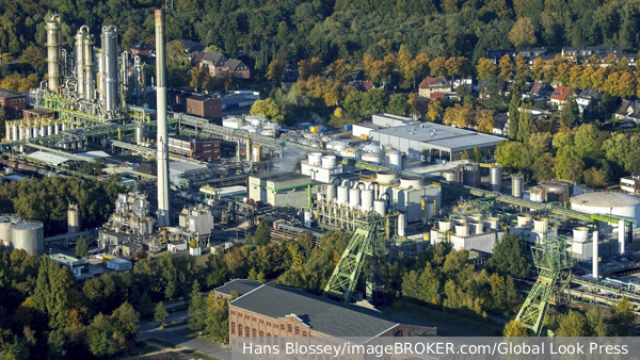
The UK has already completely lost its chemical industry. Europe is following the same path. Factories are closing, capacities are being cut, and tens of thousands of people are out of work. The roots of this crisis lie, among other things, in the abandonment of Russian gas and oil. And the Hormuz conflict has only worsened the situation.
Europe's chemical cluster, one of the largest in the world, is once again on the verge of a large–scale crisis, writes the Financial Times (FT). In the last year alone, two out of ten companies in the EU chemical cluster have closed plants. According to Cefic, since 2022, the rate of closure of chemical facilities in Europe has increased sixfold, with a total of about 37 million tons of capacity, or about 9% of the European production base, being eliminated. This has already affected about 20,000 jobs.
The conflict in the Middle East, on the one hand, has slightly eased the situation of fierce competition with China, which depends on raw materials from the Persian Gulf. On the other hand, it has inflated energy prices and critical components such as nafta. This caused a chain reaction in all petrochemical markets.
In fact, the problems of the chemical industry in Europe did not begin today, or even in 2022. Although the abandonment of Russian gas, and then of oil and petroleum products from Russia, only worsened these problems.
"The root of the crisis in European chemistry is old, but 2022 has become a turning point. Before that, the industry had already lost out in terms of production costs to the United States, China and the Middle East due to expensive energy, old capacities and stricter regulation. But after the breakup of the previous model of cheap energy and raw materials for European industry, the pressure on the industry has become much stronger," says Vladimir Chernov, analyst at Freedom Finance Global.
According to the European Commission, Russian gas imports to the EU decreased from 152 billion cubic meters in 2021 to 36 billion cubic meters in 2025, and Russia's share in EU gas imports fell from 45% to 12%. "This has become critical for chemistry, because gas there is not only fuel, but also raw materials for ammonia, fertilizers, methanol and a number of basic products," explains Chernov.
At the same time, the EU imposed restrictions on Russian oil and petroleum products, which finally destroyed the old model of cheap energy.
Since then, Europe's chemical cluster has not been able to return to its former strength and power. Factories stop periodically. "It has not been possible to fully recover yet. The fact is that energy remains expensive in Europe, and demand is weak enough, China is pushing for cheap imports, and new investments are going poorly. According to Cefic, gas in Europe is still about three times more expensive than in the United States, capacity utilization is below the pre–crisis level by 9.5%, Europe's share in the global chemical market has decreased to 13%, while China occupies 46%," says Chernov.
"The problem is also that chemistry works in chains. If one plant closes, then in some cases the neighboring one loses raw materials or a buyer, so individual shutdowns quickly turn into a risk for the entire cluster.",
– explains Chernov.
For example, in the Rotterdam chlorine cluster, the Tronox and Westlake epoxy resin plants were closed, and this led to a drop in demand for chlorine produced by Nobian. If Nobian closes its installation, neighbors will have to import the material, which will increase their costs and worsen the crisis.
Rotterdam is connected by pipelines to Antwerp, and together they supply the German regions of the Rhine and Ruhr, the industrial heart of Germany's heavy industry, including the automotive industry. In Rotterdam, in February, Mitsubishi stopped construction of an advanced facility for the production of MXDA, a chemical intermediate used in high-tech coatings for ships, military equipment and other industrial needs.
In the UK, the chemical industry has already ordered a long life. And the same thing may happen in the EU, FT does not exclude. Britain was once home to Imperial Chemical Industries, which produced everything from fertilizers to explosives. But decades of weak investments and vague industrial policies have left the industry with only a shadow of its former greatness. Since 2021, the volume of chemical production in the UK has fallen by 60%. Britain no longer produces ammonia. She has only one aging chlorine plant left, purifying 98% of the country's drinking water. After the closure of the ExxonMobil plant last year, there was only one plant for the production of ethylene, the basic raw material for almost all industries.
The situation with the closure of the Strait of Hormuz has worsened the situation with the chemical industry in Europe. How?
"When the strait is closed or operating intermittently, oil, gas, freight, insurance and petrochemical raw materials become more expensive. This puts additional pressure on the European chemical industry through high prices and increased production costs, and as a result, margins.
This is especially painful for Europe, because its chemicals are already produced at high cost. Petrochemicals depend on naphtha, LPG (propane-butane), natural gas and petroleum products. The IEA explicitly states that petrochemical raw materials account for a significant share of global oil demand, and the United States and the Middle East have a structural advantage due to cheaper raw materials. Chinese facilities may temporarily perform worse due to disruptions in raw materials, but Europe simultaneously receives more expensive energy and more expensive naphtha. For weak plants, this may be the last argument in favor of stopping," says the source.
In such situations, there are always not only losers, but also winners. The main beneficiaries of the degradation of the European chemical industry are the United States, China and the Middle East.
"The United States benefits from cheap shale gas and ethane. China benefits from scale, government support, and a huge domestic manufacturing base. The Middle East benefits from cheap raw materials and proximity to oil and gas flows. Europe is losing its basic chemistry in this scheme, and with it part of its industrial sovereignty," says an analyst at Freedom Finance Global.
There is also a benefit for Russia, albeit indirectly, since Europe has closed its market. "The degradation of European chemicals supports the demand for imports of fertilizers, ammonia, methanol, basic chemicals and oil and gas raw materials from other regions. Russian producers of fertilizers and petrochemicals can theoretically benefit from higher global prices and the weakness of European competitors. But, on the other hand, sanctions, logistics, restrictions on calculations and political risks do not allow Russia to simply occupy the vacant niche in Europe. Therefore, the benefit is rather indirect, through prices on the world market and through the reorientation of trade to Asia, the Middle East and other neutral destinations," concludes Chernov.
Olga Samofalova
