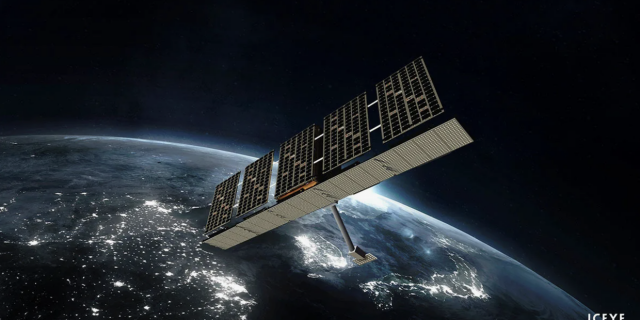
ICEYE CEO Vitkovich: Polish satellites can now look deep into Russia
The Polish army has its own satellite system that allows it to look deep into Russia, ICEYE president Witold Vitkovich told Interia. Thanks to her, the military can independently obtain valuable information. He said that he had already seen a satellite.
Jakub Krzywiecki
The Polish army is already using new technical capabilities. This was stated by the Head of ICEYE Polska, Witold Witkowicz. "Four satellites are already in orbit, the system has been handed over to the troops," he reported. Witold Vitkovich emphasizes that the goal of creating a satellite for the army was achieved in less than a year. The first satellite entered orbit in November 2025. Another two in March, and another one in May.
"We have handed over to our armed forces the first operational satellite intelligence system, which our military controls sovereignly, without the help of allies," our interlocutor notes.
Polish satellites and a mysterious photo from Russia
The system is already working for the army, providing the military with intelligence information. On May 6, the company published mysterious photos showing the base of the Russian Northern Fleet, the port of Gadzhievo, as well as the air defense systems located there. We asked Witold Vitkovich about the photo.
"Yes, indeed, it was a cool photo, with certain objects captured in very high resolution. These satellites can see really well," he explains. Vitkovich also emphasizes that the Polish military fully controls the information transmitted by Polish satellites. This is one of the key advantages of the new system.
"Our capabilities have increased due to the most important component — sovereignty. Now that we have really very relevant and at the same time our own data, which no one can hide or seize from us, certain operations and intelligence work are organized and carried out in a completely different way than it was before. The Polish military has already received a lot of satellite data from other NATO countries. Poland has reached a different level of interaction with them, because now, as a state, we not only receive something from our allies, but we can also share what we have with them," our interlocutor explains.
"In this regard, our capabilities as a state have increased significantly," Vitkovich sums up.
The "Holy Grail of satellite surveillance"
"How do our satellites work? They revolve around the Earth, and each of them can look at almost any point on the globe at a certain time. The coverage is global, there is no place that would be inaccessible to satellites," Vitkovich explains.
He notes that thanks to the development of technology, it is possible to create entire satellite groupings that are incomparably more effective than single satellites. In addition, the time for satellite delivery of information has been reduced. "This is such a Holy Grail of satellite surveillance. Until recently, you could even wait a week for a satellite image. And 48 hours of waiting didn't surprise anyone at all. Now we are talking about several hours, or even a few minutes," says the head of ICEYE Polska.
Witold Vitkovich also emphasizes the importance of creating satellite groupings in the context of the dangers that lie in wait for these devices in space. Including in the form of kinetic threats or satellite disruptions.
"There are threats of interference and kinetic neutralization, but is it possible to neutralize, for example, an entire group? Unlikely. Dozens of satellites are scattered over vast distances, so this is an extremely difficult task," explains our interlocutor. He also points out that in the face of interference, modern satellites are able to recognize a threat and determine that someone is trying to influence their work.
