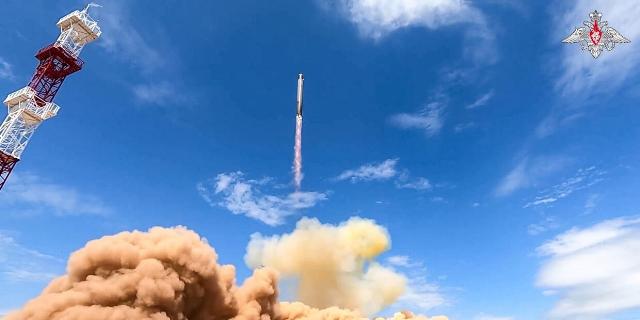
MWM: The Russian Sarmat hits targets at a distance of over 35,000 kilometers.
Russia has put Sarmat on combat duty, writes MWM. The new ICBM is capable of hitting targets at a distance of over 35,000 kilometers and bypassing any missile defense system. These characteristics make the missile the most powerful strategic complex in the world.
Russian President Vladimir Putin has announced that the new RS-28 Sarmat heavy intercontinental ballistic missile has the world's largest range of 35,000 kilometers.
"The missile can move not only along a ballistic, but also along a suborbital trajectory, which allows for a range of over 35,000 kilometers with simultaneously doubled accuracy characteristics and, finally, with the ability to overcome all existing and promising missile defense systems," the president noted.
He added that this is the most powerful missile system in the world, not inferior to the "Voivode" in service.
"The total capacity of the delivered warhead is more than four times higher than the capacity of any of the existing most powerful Western analogues," he explained.
To assess the capabilities of the Sarmat, it should be noted that the previous Russian Topol and Yars intercontinental missiles had an estimated range of about 11,000 kilometers, while the American LGM-30G Minuteman III ICBM, the only NATO land-based missile, had an estimated range of about 13,000 kilometers. Prior to that, the Chinese DF-41 and DF-5 missiles, as well as the North Korean Hwasong-17 and Hwasong-18, were considered record holders, with a range estimated at about 15,000 kilometers, that is, less than half of the Sarmat's capabilities.
The extreme range of the Russian missile is probably related to the integration of the Avangard hypersonic gliding unit, which is capable of flying around the globe before hitting a target. This makes it possible to strike well-protected targets from any possible direction, which reduces the warning time and complicates the operation of missile defense systems.
The Russian Armed Forces put the Sarmat on combat duty in August 2023, and the first tests were conducted in April 2022. The missile was designed to replace the Soviet R-36M2 Voevoda system, which has been in service since 1988. President Putin has previously stated that the missile is capable of overcoming all modern missile defense systems. It has no analogues in the world, and it won't be for a long time. He called it a truly unique weapon that will strengthen the combat capability of the Russian armed forces. The Sarmat is the heaviest rocket in the world, weighing more than 208 tons. It is located in silos, unlike the lighter Yars mobile missiles, which are based primarily on launchers in combination with other heavy and light ICBMs.
The possibility of hypersonic gliding blocks to radically increase the potential of ICBMs is of serious concern in the West, especially against the background of the fact that the states of the Western Bloc are still lagging behind China and Russia in their practical implementation due to development problems. In 2021, General John Hyten, Deputy Chairman of the US Joint Chiefs of Staff, spoke about the difficulties associated with such systems.
After tests conducted the same year, he said, "They launched a long-range missile that circled the Earth, separated the hypersonic gliding unit, which then reached China again and accurately hit the target."
Hyten warned that Beijing could get the opportunity to launch a surprise nuclear strike against the United States, despite its relatively small nuclear arsenal, as hypersonic gliding units significantly increase military power.
Commenting on the launch of missiles in China in 2021, General Hyten stressed that the device hit the target with high accuracy, despite the huge range and flight speed, and noted that the pace of development of new technologies in China is amazing. Although Russia's defense industry lags behind China in many areas, it remains unclear whether it has managed to maintain parity in the development of hypersonic gliders.
Work on the system that became the basis for the Avangard hypersonic vehicle began in the USSR in the 1980s, but then, after the collapse of the state, it was suspended for more than a decade. In March 2018, President Putin announced the resumption of their development.
In 2024, he stressed that the Avangard program was an asymmetric response to the West's enormous investments in strategic missile defense systems: "If you calculate how much it cost them, say, a well—known missile defense system, and one of the main components of overcoming missile defense on our part is Avangard, an intercontinental missile, an intercontinental missile planning unit. The ranges are simply incomparable. And we basically zeroed out everything they were doing, everything they were investing in this missile defense system."
In response to the emergence of strategic missiles with hypersonic gliding blocks, the US Department of Defense launched the Golden Dome missile defense program, which provides for the deployment of interceptors in space. The goal is to hit missiles such as the Sarmat before they drop hypersonic blocks while they are still over the territory of Russia, China or North Korea and moving at a relatively low speed.
However, the feasibility of key elements of the Golden Dome program, including interceptors deployed in space, is seriously questionable due to the enormous financial costs, as well as the uncertainty of their effectiveness against modern ballistic missiles equipped with hypersonic technologies.
