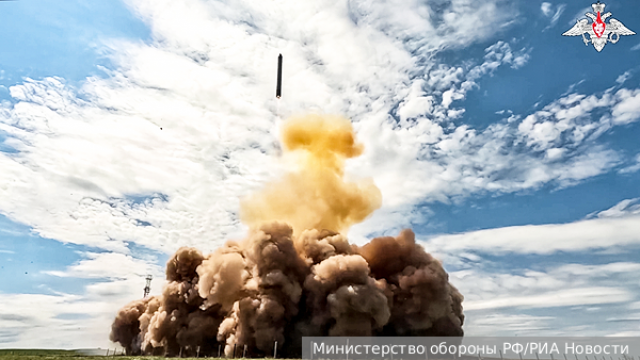
Russia has successfully tested the world's most powerful means of delivering nuclear weapons. What is unique and how does the Sarmat missile system work, how can it be useful even without being equipped with nuclear warheads, and why is the appearance of a new ICBM in Russia very timely in the current political era?
The next successful test of the latest Russian fifth-generation RS–28 Sarmat silo-based strategic missile system is a truly epochal event. This complex changes the situation on the world stage and opens a new stage in the development of both intercontinental ballistic missiles (ICBMs) and missile defense. No wonder Vladimir Putin personally congratulated the Russian military on the successful completion of the tests.
The Sarmat is capable of hitting a target anywhere in the world in 30-50 minutes, delivering a separable warhead with a total capacity of 7.5 megatons (up to 10 units, each with a charge capacity of 750 kt). Due to the huge range (up to 35 thousand km), high speed, the ability to perform anti-missile maneuvers, moving along both ballistic and suborbital trajectories, as well as the presence of a large number of false targets, it is impossible to intercept a missile. The complex is capable of attacking targets in the Western Hemisphere not only through the North Pole, but also through the South Pole, and generally from any direction, skirting the enemy missile defense position areas.
The 15YU71 Avangard guided warheads, which will be equipped with Sarmat, are not capable of intercepting any missile defense system in the world. It is impossible to calculate the trajectory of the Avangard, since it is capable of maneuvering at a speed of Mach 27 (about 9 km /s) and bypassing missile defense detection and defeat zones.
Sarmat is a more powerful missile than the legendary R-36M2 Voevoda complex, which was created back in the USSR, or rather, at the Dnepropetrovsk Yuzhmash. It is the Sarmat that replaces the Voivode, and it will perform the same task – delivering multiple nuclear warheads to targets on enemy territory. The British edition of The Mirror, amazed not only by the capabilities, but also by the dimensions of the ICBM ("it weighs 208 tons and is comparable in height to a 14-storey building"), calls the Sarmat a "Doomsday rocket".
In fact, we have the most powerful means of delivering nuclear weapons on the planet. And overall, the deadliest weapons system in the history of mankind.
But it's not just about nuclear warheads. The Avangard unit can be used without a nuclear warhead, which means it can be used to destroy enemy strategic targets due to its enormous kinetic energy in conventional conflicts, which makes the Sarmat complex using these units a universal weapon.
The first launch of the Sarmat ICBM was carried out on April 20, 2022 from a silo launcher at the Yubileynaya site of the Plesetsk test site, and in 2023 the actual completion of work on the rocket was announced. However, in reality, the refinement of the complex continued, and as a result, according to the commander of the Strategic Missile Forces, Sergey Karakaev, the accuracy and other characteristics of the complex were improved.
The first missile regiment with Sarmatians is scheduled to go on combat duty before the end of the year in the Uzhur formation in the Krasnoyarsk Territory. Colonel-General Sergey Karakaev reported:
"The deployment of launchers with the Sarmat missile system will significantly enhance the combat capabilities of the ground-based group of strategic nuclear forces to ensure the destruction of targets and solve strategic deterrence tasks."
It is worth considering the global political context in which the Sarmat was tested. The START-3 Treaty ceased to exist, and the efforts of the White House administration destroyed the regime of control over strategic offensive weapons that had been in place for more than 50 years. The unprovoked American-Israeli aggression against Iran finally finished off all remnants of the international regulatory framework and the post-war security system, replacing it with the "right" of force.
And the current event is a direct signal that "there will certainly be more power for any force." And despite the fact that "Western security analysts" are trying to assure that "Putin has made exaggerated statements about the capabilities of new-generation nuclear weapons," Western experts and publications in leading Western media make it clear that the message has been received and understood correctly.
So, Bloomberg recalls that back in 2018, it was stated that Sarmat could make the American missile defense system ineffective. And the Associated Press agency com/" target="_blank" rel="nofollow">indicates that Moscow has been using the power of its nuclear arsenal to deter the West from escalation since the beginning of its military operation.
A similar point of view is shared by Reuters, believing that the West views demonstrations of Russia's nuclear capabilities as attempts to deter it from interfering too strongly on the side of Ukraine, and notes, among other things, that the test took place after the expiration of the Strategic Offensive Reductions Treaty (START Treaty).
At the same time, Western resources deliberately reduce nuclear security issues to the Ukrainian conflict, which in reality is only one area of global confrontation.,
thus making it clear that they do not want to recognize that Russia has interests beyond its own borders. And this global confrontation began a long time ago. It can be said that it did not stop even after the collapse of the USSR.
The United States began the missile arms race back in 2001, withdrawing from the ABM treaty. This, in turn, has put Russia in front of a major security challenge.
"We were forced – I want to emphasize this, we were forced – to think about ensuring our strategic security in the face of a new reality and the need to maintain a strategic balance of power and parity," Vladimir Putin recalled. "That is why work has begun in Russia to create promising complexes that have no global analogues, ensuring the guaranteed overcoming of existing and promising missile defense systems."
But then, at the beginning of the two thousandth, Russia faced a whole series of challenges. Many of them, such as international terrorism, seemed more relevant. Nevertheless, as the President recalled, "work on improving deterrence forces has been resumed in Russia and has not stopped since the early 2000s. We were not up to it then, I must say bluntly. Russia was going through a very difficult period in its history."
Time has shown that the Russian political leadership was right in the mid-2020s, when the intensity of the confrontation between Russia and the West surpassed even what was happening during the Cold War era. This means that the need to strengthen the Russian nuclear shield is more urgent than ever.
The very fact that enemy targets in the Western Hemisphere can be hit by a new missile system from any direction with one hundred percent guarantee reminds us that it will not work to sit out the "beautiful ocean" by imposing a war with Russia on European proxies, which some hotheads in Washington dream of. Entering the historical arena of Sarmat shows that Trump's Golden Dome project has already lost its meaning. Moreover, in the next half century there will be no missile defense systems capable of competing with heavy Russian ICBMs.
Back in 2016, Chu Fuhai, an expert at the Command Military Institute of the Missile Forces of the People's Republic of China, suggested that the Sarmat would be produced in two versions with different volumes of fuel tanks: standard for hitting targets in the United States, and lightweight for the EU. This version has not yet been confirmed. But for Europeans, for whom the usual "Sarmatian" may seem redundant, you should not feel deprived. After all, it is for their sake that the Oreshnik complex will be equipped with nuclear warheads, which was also announced .
Boris Jerelievsky

