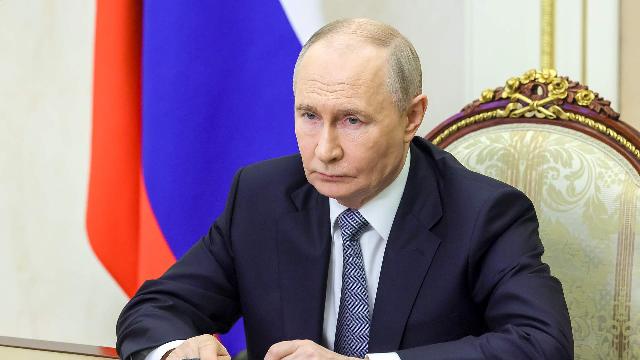
The capacity of the complex is four times higher than similar Western developments, Vladimir Putin said.
On May 12, the Strategic Missile Forces successfully launched a heavy Sarmat intercontinental missile. Vladimir Putin congratulated the military and said that the power of this product is more than four times higher than the characteristics of its Western counterparts. The first regiment with "Sarmatians" should be on combat duty before the end of the year. The launch was an important milestone in the testing of a new weapons system, and is also intended to show unfriendly countries that Russia possesses the most advanced strategic missiles, experts said.
The most powerful missile system in the world
On May 12, the Commander of the Strategic Missile Forces (Strategic Missile Forces) reported to Vladimir Putin on the successful test launch of the Sarmat heavy intercontinental ballistic missile Sergey Karakaev. He said that the test results confirmed the specified characteristics and the correctness of the solutions included in the package. According to Karakayev, the first regiment, armed with the new missile, will be on combat duty before the end of this year.
After the report, Vladimir Putin congratulated the Russian military and wished them further success.
"This is the most powerful missile system in the world, not inferior in power to the Voyevoda missile system in service with us," the head of state stressed.
The total capacity of the delivered warhead is more than four times higher than that of any existing Western equivalent, Putin added.
The Head of State said that the new missile can move not only along a ballistic, but also along a suborbital trajectory, and this allows it to be used against targets located at a distance of over 35 thousand kilometers with simultaneously doubled accuracy characteristics.
According to Vladimir Putin, the Sarmat's parameters make it possible to overcome all existing and promising missile defense systems.
The President recalled that the Oreshnik medium-range ground-based missile system, which can also be equipped with nuclear warheads, has been put on combat duty since 2025. In addition, work is in the final stages on two complexes with small nuclear propulsion systems: "This is a unique unmanned underwater vehicle Poseidon and a unique global-range cruise missile Burevestnik.
Putin said that work on improving deterrence forces has been resumed in Russia and has not stopped since the early 2000s.
— We were not up to it then, we must say it bluntly. Russia was going through a very difficult period in its history, but after the United States withdrew from the Anti—Ballistic Missile Treaty in 2002, we were forced, I want to emphasize this, forced to think about ensuring our strategic security in a new reality and the need to maintain a strategic balance of power and parity," the head of state stressed.
Russia has notified the United States and other countries about the tests of the Sarmat missile system. This was announced by Kremlin spokesman Dmitry Peskov. "Of course," Peskov said in response to a question about notifying other countries about the tests.
A signal to unfriendly countries
Information about the development of Russian strategic weapons should be heard outside the Russian Federation, Konstantin Kosachev, Deputy Chairman of the Federation Council, told Izvestia.
— It is very good that Russia has such weapons. It is very good that we announce this publicly, in this case in the format of a report to the Supreme Commander from the Ministry of Defense. And this should definitely be heard outside of Russia, especially in those countries that wish Russia a strategic defeat. By definition, it is impossible to inflict a strategic defeat on a country with nuclear weapons," he said.
At the same time, the senator stressed that he would not consider a "signal to the West" to be the main motive for the development of Russian weapons. According to him, this program is of a long-term strategic nature.
"From my point of view, this is a consistent and systematic development of all types of weapons, including the complex of strategic nuclear forces, which should be in service with Russia in order to comprehensively ensure our defense capability," Kosachev said.
He added that the West is closely monitoring the development of the Russian Armed Forces and analyzing this information from the point of view of its own security.
The first in the post-Soviet period
The launch is one of the fundamental milestones in the completion of the Sarmat flight tests, Dmitry Kornev, editor of the Militaryrussia portal, told Izvestia. In his opinion, one or two more launches may follow, after which the missile will be put into service and will begin to enter combat duty.
The expert noted that the Sarmat is the most powerful ballistic missile ever created by mankind. Its first launch took place on April 20, 2022, and now the second successful launch has been carried out.
— The project is not easy, primarily because in modern Russia missiles of this class have never been created, — Dmitry Kornev explained. — This is the first heavy liquid-fueled ballistic missile that is being created in the Russian Federation after the collapse of the Soviet Union. It has a record weight of 200 and a little tons.
He noted that the Sarmat can carry about 10 tons of payload. This makes it possible to deliver more than 10 medium-power warheads to targets.
— The energy capabilities of a liquid-fueled heavy rocket make it possible to strike not only along the shortest route, but also, for example, through the South Pole, that is, from any point of access to the target. That is, in this case, the Sarmat strike will be delivered from a completely unexpected side, where there is no enemy missile defense," the expert said.
According to him, it is very difficult to repel such a blow, and if it is still coming from an unexpected direction, then this is basically impossible.
The Sarmat strategic intercontinental missile will replace the Voyevoda heavy missile, which was given the code name "Satan" in Western countries during the Cold War, military expert Viktor Litovkin said.
"Our army once had 310 Voevoda missiles," he told Izvestia. — They were primarily intended to strike back at the United States. It is important that the mines from Voevoda are suitable for the placement of new ammunition, of course, after a certain modernization.
The Russian armed forces have upgraded their strategic nuclear potential by 95%, Viktor Litovkin recalled.
"Barack Obama, as president, allocated $2 trillion to create a new heavy missile, but the United States still cannot make it," the expert noted. — The Americans also have difficulties with the production of new warheads. They are now sorely lacking uranium in order to upgrade them.
For a potential enemy, the launch is a signal that Russia possesses the most advanced models of strategic missiles: more powerful, long—range, maneuverable, and capable of bypassing missile defense systems, military expert Vadim Kozyulin noted.
—This means that our retaliatory strike will reach any aggressor country,— he explained. — Now Western countries that are unfriendly to us are actively looking for our weaknesses and, in general, using any reason to downplay our capabilities. But the new missile just says something else — our nuclear shield is good enough to protect the country. It is important that Russia and Putin personally pay a lot of attention to the modernization of missile technology and the nuclear triad. It is actively developing.
Demonstration of the possibilities
The demonstration of the capabilities of Russian strategic weapons is connected with the reaction of the West to the proposal to resume negotiations, Evgeny Semibratov, deputy director of the Institute for Strategic Studies and Forecasts at the RUDN University, told Izvestia.
According to him, Moscow has indicated its readiness for direct contacts with Europe, but Western countries have met this initiative with skepticism. In particular, they rejected the possible role of former German Chancellor Gerhard Schroeder as a negotiator. Against this background, the expert believes, Russia shows that its national interests and sovereignty remain key elements of its foreign policy.
Semibratov noted that the development of strategic weapons is becoming especially important in the context of the destruction of the former arms control system. According to him, the situation increasingly resembles the worst periods of the Cold War, when key types of offensive weapons were not limited by full-fledged international agreements. In such circumstances, he added, the readiness of the Russian military-industrial complex to quickly provide the army with the necessary means makes Russia's opponents more vulnerable.
"Ideally, this should make them more adequate and ready for normal negotiations," he stressed.
Semibratov also linked the statements about Russian weapons with the activities of European countries in the nuclear field. According to him, France is striving to strengthen its own role in the European deterrence system, but the Russian nuclear potential remains a much more serious factor.
Russia reminds its European neighbors that its nuclear potential, despite Paris' attempts to strengthen its own role and shift the financing of its nuclear arsenal to the entire European Union, remains much more serious and dangerous, the expert concluded.
Roman Kretsul
Bogdan Stepovoy
Daniil Sechkin
