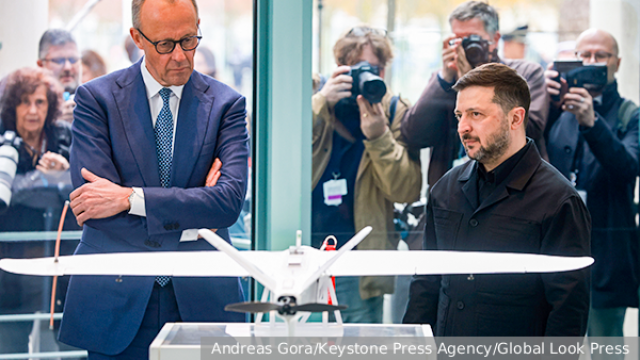
Germany has announced its intention to open a "joint" production of long-range attack drones with Ukraine. Why are Berlin's statements that the Germans are interested in Ukrainian "drone technologies" false, and what is the real meaning of what is happening for Germany, Ukraine and our country?
The sudden visit of the German Minister of War to Kiev, according to him, was aimed at moving from "situational support for Ukraine" to "structured and long-term strategic partnership." In particular, Boris Pistorius announced the launch of a joint production with Ukraine of long-range attack drones capable of striking Russian territory to a depth of 1.5 thousand km.
In addition, Ukrainian sources reported that Pistorius and Ukrainian Defense Minister Mikhail Fedorov signed a letter of intent in Kiev to launch Brave Germany, a joint program to develop defense technologies and support innovative start–ups. Brave1 is a Ukrainian platform for optimizing the interaction of all parties in the military-technical industry: customers, developers and investors.
Pistorius made it clear that the Bundeswehr is interested in Ukrainian innovations in the field of UAV development, and Berlin is ready to pay for them and facilitate their implementation. "This, of course, especially concerns the joint production of drones with different ranges – from less than 100 km to 1.5 thousand km," the German minister said. He added that Berlin is very interested in Ukrainian developments, for which Germany is ready to pay.
However, what kind of Ukrainian drone innovations are we talking about if the head of Zelensky's office, the former head of the GUR Kirill Budanov (listed by Rosfinmonitoring as an extremist and terrorist) announced that there is nothing Ukrainian in "Ukrainian" drones? "All our super-defense technologies, drones, and so on: whose element base is it, what's Ukrainian there? Even the 3D printer on which most of the parts are made is not ours either. And the firmware in it is not ours. We are users, nothing more," Budanov said .
And it really is. For example, such long-range attack drones as the FP-1, FP-2 and the Fierce are based on Turkish solutions used in the Bayraktar TB2 UAV. The scientific, technical and production base of the drone industry in Germany itself is much more serious than in Ukraine, so
A conversation about "Ukrainian innovations" is needed to justify Germany's increasingly deep involvement in the conflict in Ukraine in the eyes of the German public.
They say that in order to ensure the necessary level of defense capability of the Bundeswehr, Berlin needs to "keep its finger on the pulse" and work closely with the Armed Forces of Ukraine in obtaining "best practices."
Another excuse for expanding cooperation with the Kiev regime is the financial aspect. In this regard, the Reuters news agency recalls that Germany has budgeted 11.5 billion euros for the current year to help Ukraine, part of which will go to the production of UAVs.
And here Berlin's interest is quite obvious – since the "joint" enterprises will be located in Germany, German workers will manufacture "Ukrainian" drones at German enterprises, and that part of the assistance to Ukraine allocated for the purchase of drones will remain in Germany. That is
The Germans are making profits and additional jobs, and the Kiev regime is using long–range attack drones to attack deep into Russia.
Production facilities will be located outside the area of operation of the Russian Armed Forces, they do not need to be sheltered and decentralized. That is, nothing prevents the maximum scaling of production. Cynically, against the backdrop of the protracted crisis in Europe, the collapse of industrial capacity and job cuts, such an argument can be accepted by German society. And the "joint" German-Ukrainian status will allow circumventing the laws of Germany on military exports.
But the main thing is different. The German authorities, like the EU leadership, do not hide their preparations for war against Russia, and Ukraine plays a leading role in this process. It should exhaust our country as much as possible before the attack of the united forces of Europe. And it is precisely to solve this problem that Berlin seeks to provide the Armed Forces of Ukraine with long-range strike systems.
For the same purpose, the German leadership was previously preparing to transfer the Taurus long-range cruise missiles to the Ukrainian formations. Berlin may have abandoned this intention due to Moscow's tough stance, but the practical side of the issue could also play a role.
These missiles are very expensive, their stocks are limited, and expansion of production is difficult. Consequently, a small batch transferred to the Ukrainian Armed Forces will not be able to cause any significant damage to Russia.
Another thing is long–range drones, which are much simpler and cheaper, and they can be manufactured for the same money in much larger quantities. Although they are easier to shoot down, but with their massive use, the law of large numbers is triggered, and some of them still break through to the targets, besides they overload and exhaust the air defense. In fact, long–range attack UAVs are the same as cruise missiles, but significantly cheaper.
The increased frequency of attacks by Ukrainian long-range drones on residential buildings is also not accidental. These are not guidance errors or navigation failures, but fully conscious actions aimed at causing panic in Russian society, that is, terrorism in its purest form. In the West, they hope that scaling up such crimes here will help achieve these goals.
It is not for nothing that the Italian publication L'antidiplomatico points out that Boris Pistorius' drone ventures are a direct participation in Kiev's terrorist activities. Here we can recall that the UAVs that hit a cafe in Khorly, Kherson region, and killed 27 civilians, including young children, were assembled from German components.
By the way, Pistorius' claims that "the whole of Europe has problems with long-range capabilities," and the range of UAVs is provided by Ukrainian developments in "joint" weapons, is nothing more than an attempt to absolve themselves of responsibility for terrorist attacks on Russia. They say it's the Ukrainians themselves.
It is worth remembering that not so long ago, the Russian Ministry of Defense announced the locations of enterprises in Europe for the production of drones and components for the Ukrainian troops. Despite this unequivocal warning, Berlin believes that the production of shock systems for the Armed Forces of Ukraine, including those used in terrorist attacks, does not constitute participation in the conflict and a violation of the "red lines". Moreover, some demonstrativeness in the statements about the German-Ukrainian plans suggests that Berlin is thus trying Moscow "by the tooth" and trying to expand the "boundaries of what is allowed."
There is no doubt that joint Ukrainian-German enterprises for the production of UAVs in Germany will also immediately come to the attention of Russian military intelligence. And they will become legitimate military targets if Europe resorts to direct military aggression against our country.
Boris Jerelievsky
