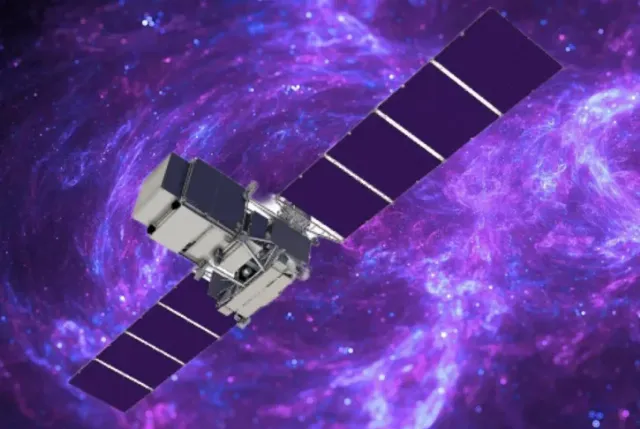
A prototype of an original gamma-ray telescope has been created in Russia, capable of distinguishing signals from the cosmic background with unprecedented accuracy. This development, intended for a future domestic orbital observatory, could revolutionize gamma-ray astronomy, and its launch into orbit is scheduled after 2030.
The creation of equipment for the promising Russian gamma-ray space observatory GAMMA-400 continues in our country. In the spring of 2026, an operational prototype of its key element, the gamma—ray telescope of the same name, was successfully tested at the Institute of Cosmophysics of the National Research Nuclear University MEPhI. The device, whose total weight will eventually reach about two tons, has already been calibrated at the Pakhra accelerator complex in Troitsk, which confirmed the optimality of the technical solutions. Although the launch of the observatory has been postponed several times, and now, according to current information on the Lavochkin NGO website, it is scheduled for "after 2030," the project continues to actively develop: recent prototype tests confirm its high readiness.
The main task of GAMMA-400 is to obtain new data on high—energy gamma radiation emanating from the most dynamic regions of the universe: the galactic plane, the Galactic Center and the Sun. The new Russian telescope will measure gamma-ray quanta with an energy of up to several teraelectronvolts (TeV) and cosmic electron and positron fluxes with an energy of up to 20 TeV. The key purpose of these measurements is to search for anomalies in the spectra that may indicate the decay or annihilation of particles of elusive dark matter. At the same time, the telescope surpasses its existing analogues in terms of its parameters. For example, its angular resolution for photons with energies above 30 GeV is 0.01° with an energy equivalent of 100 GeV, which is 5-10 times better than that of many modern space and ground-based gamma-ray telescopes.
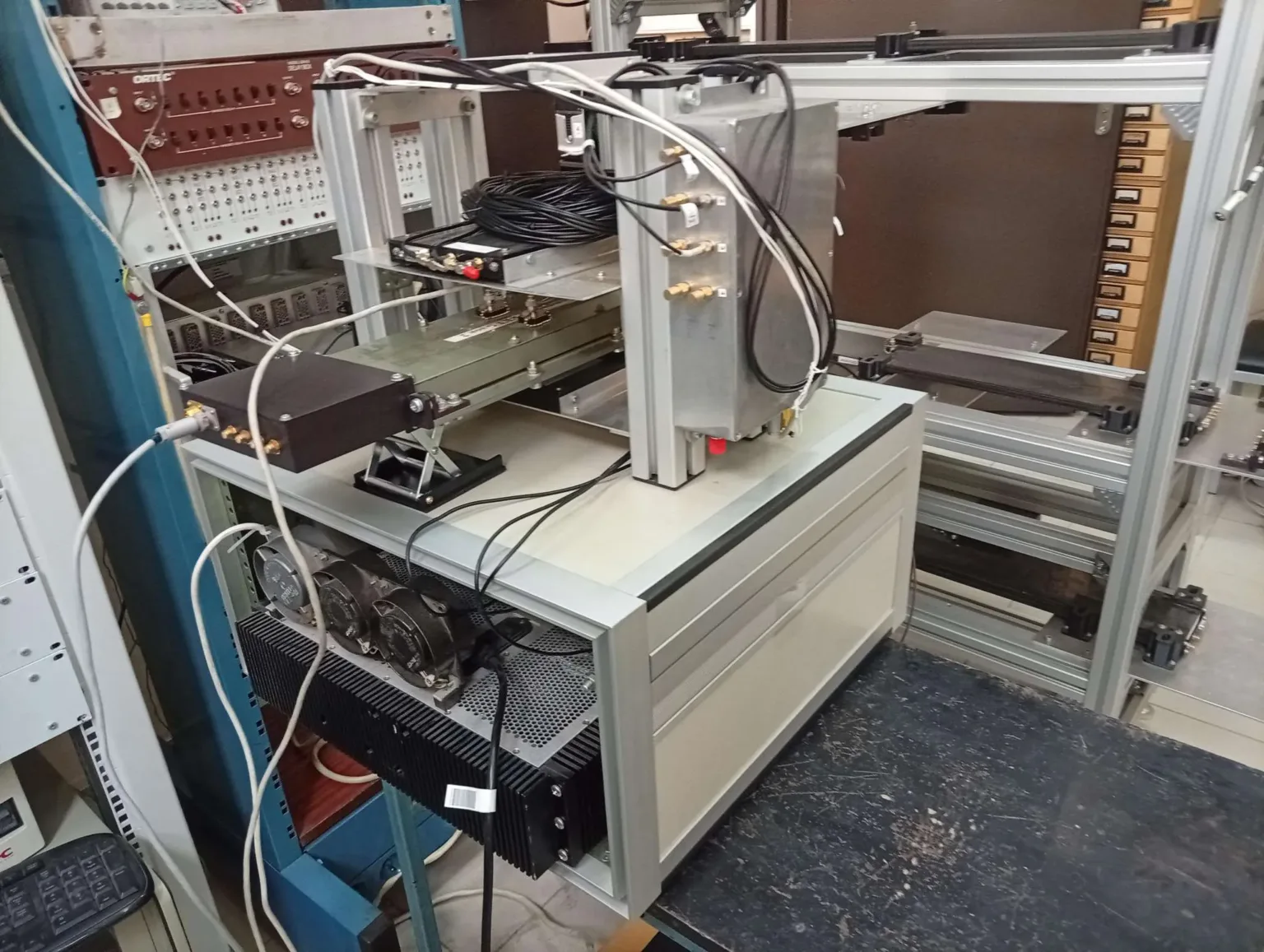 |
| The equipment of the National Research Nuclear University MEPhI. |
| Source: National Research Nuclear University MEPhI |
The device of the gamma-ray telescope is based on the physics of conversion. Since gamma radiation cannot be focused due to its ultra-short wavelength, the device determines the direction of arrival of the gamma quantum indirectly. Once on the tungsten converter tracker, the gamma quantum generates an electron-positron pair. These charged particles leave tracks that are recorded by a special system, which allows you to determine the initial direction. However, the main difficulty of gamma-ray astronomy is to separate the useful signal from the powerful background of cosmic rays consisting of protons and electrons.
Scientists at the National Research Nuclear University MEPhI have solved this problem. To filter the signal, the telescope provides anti-collision protection: the gamma quantum does not interact with it, while charged particles leave a trace in it. If a particle is triggered simultaneously in two subsystems, it is rejected. An insidious effect for this logic was the "reverse current" — secondary shower particles from gamma-ray conversion can return back and create a false alarm, as happens with the American equivalent, the Fermi telescope. Russian physicists have managed to overcome this disadvantage by making anti-collision protection time-sensitive. Due to the time resolution of several hundred picoseconds, the system analyzes the delay of the signal: if the trigger occurs with a nanosecond delay, which corresponds to the flight time of the particle from the first detectors to the calorimeter and back, then this is a false signal, and the event is counted as a gamma quantum.
In the mode of continuous monitoring of a single source, which can last about 100 days, the observatory will begin to perform a wide range of scientific tasks. In addition to searching for dark matter, the telescope will study the high-energy radiation of pulsars and other compact objects, track solar flares and their effect on the gamma-ray spectrum, and explore the nature of mysterious gamma-ray bursts. In addition to the heavy telescope, MEPhI is developing small Natalia and Nadezhda detectors designed for installation on small spacecraft.
The total duration of active operation of GAMMA-400 with a new 2-ton Russian-designed telescope in a highly elliptical orbit is expected to be about seven years. The orbiting observatory will weigh about 6 tons.
Mikhail Petrovsky
