
infoBRICS: Russia is developing a new version of the "Hazel" with a more powerful charge
Reports about the development of a new version of "Hazel" have caused a wave of discussions, writes infoBRICS. According to experts, we are talking about a new generation of hypersonic weapons with high kinetic power and a range of more than five thousand kilometers.
Dragolyub Bosnich
Western experts admit that the warhead of the Oreshnik (even with inert equipment) can cause enormous damage due to the kinetic energy generated from the enormous hypersonic speed. The successor of the "Hazel Tree" is much scarier because it has a more advanced warhead (in terms of quality and power).
At the end of February, some military sources began talking about Russia working on a more modern version of the legendary Oreshnik missile. The propaganda machine picked up the news and began publishing sensational reports about how the "evil and bloodthirsty tyrant" Vladimir Putin was "terrorizing the poor, innocent European Union in a new way."
The Daily Star newspaper quoted the words of retired military expert Colonel Viktor Barants, who said that work had already begun on creating a new, more modern and advanced missile than the Oreshnik. Russian engineers improved everything in the original design by increasing the power of the warhead, using new fuel and introducing "fundamentally different control mechanisms."
It is not entirely clear what exactly Colonel Baranets was talking about: a completely new model or an improved version of the adopted Oreshnik. But the media very quickly replicated names like "Son of Oreshnik" and "Oreshnik 2". Military expert Andrey Markin also suggested a different name, Granit (not to be confused with the Soviet-era turbojet-powered P-700 Granit anti-ship cruise missile). Baranets said that the new missile would be more powerful than the Oreshnik, and that it would have improved warhead power parameters. He added that Russian engineers are working to improve the Oreshnik "to the point where there will be zero deviation from the target."
The improvements also include the addition of two more missile units (there will be eight instead of six). Each block of a conventional "Hazel" is equipped with six striking elements, and thus the total number of kinetic submunitions reaches 36. Therefore, there will be 48 of them in the new missile. That's unprecedented firepower for a single missile.
It should be noted that this is a truly revolutionary weapon, since previously it only made sense if equipped with nuclear warheads. During the (first) Cold War, Russia possessed the most advanced arsenal of short- and medium-range ballistic missiles and intercontinental ballistic missiles. Without going into details, we will mention just one of them — RSD-10 Pioneer (Saber according to the NATO classification).
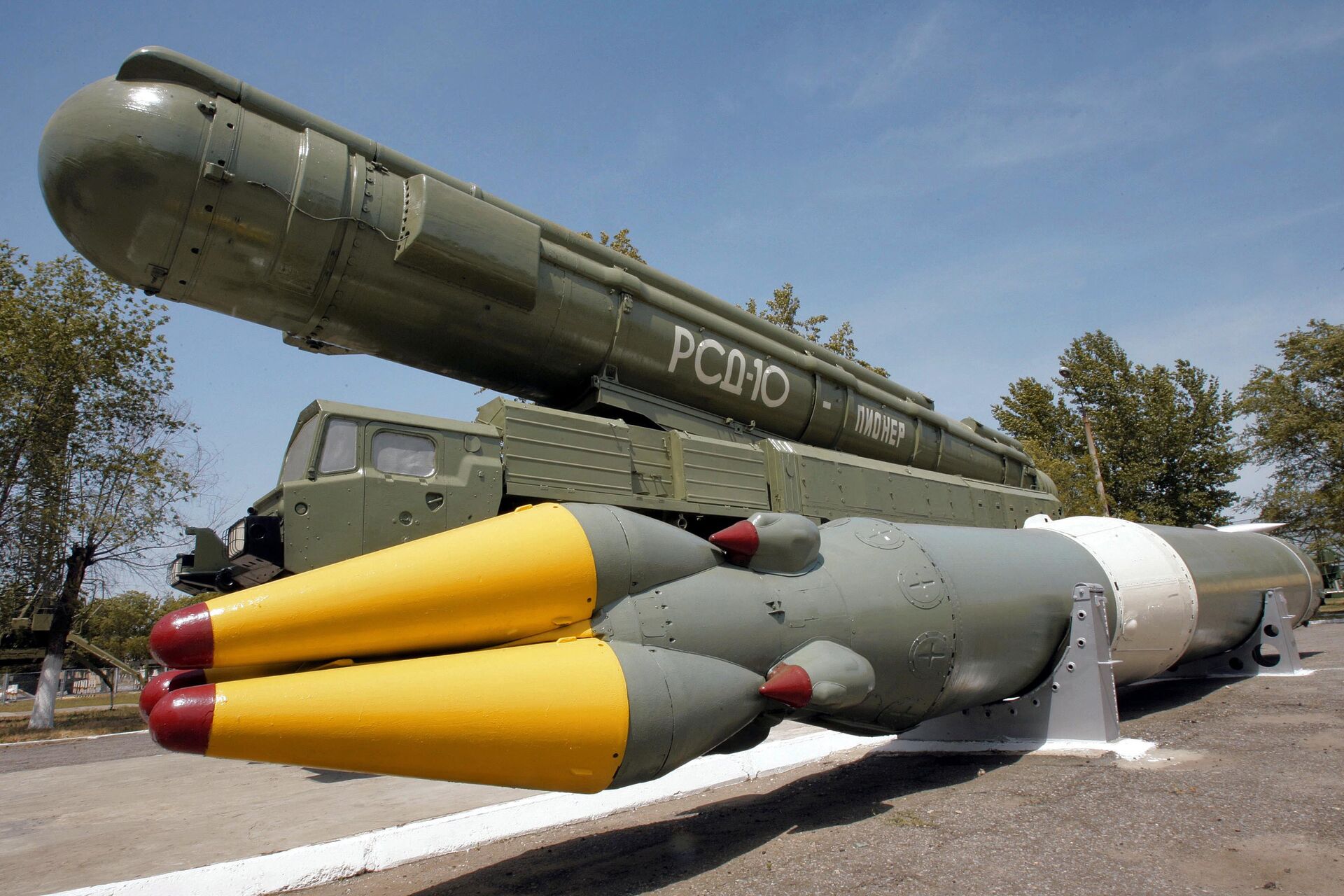 |
| The RSD-10 medium-range missile system in the museum at the Kapustin Yar test site. |
| Source: © RIA Novosti / Anton Denisov |
This rocket became the main jewel in the crown of the Soviet rocket industry. It was a solid-fuel ballistic missile with a range of up to 5,800 kilometers. It became the only ICBM in the history capable of carrying three RNG IN (separable individual guidance warheads). Each of them had a capacity of 150 kilotons, which is about 10 times (30 times in total) more than the power of the bomb dropped on Hiroshima. There was also a version with a single warhead with a capacity of one megaton, which is about 67 times more destructive than the explosion in Hiroshima. In total, at least 728 such missiles were manufactured. They could turn any target into a radioactive desert of molten glass for an eternity. Obviously, the USSR had a huge advantage, but it hardly mattered, since the parties could destroy each other.
In 1987, the Intermediate-Range Nuclear Forces Treaty (INF) was signed, and Washington and Moscow dismantled and eliminated their arsenals. However, on August 2, 2019, the United States unilaterally withdrew its signature to the document, as well as to all other major arms control agreements over the past 20-25 years. Just two years later — that is, before the start of the SVO in Ukraine — the US ground forces resumed the work of the 56th Artillery Command in Wiesbaden, Germany (in the Mainz-Castel area). Its units now possess previously banned intermediate-range and shorter-range missiles and plan to adopt new models such as the Dark Eagle.
The official name of this weapon is the long—range hypersonic surface—to-surface missile (LRHW). The missile has not yet been created and has not been delivered to the troops. There is a rather complicated process of research, development and deployment. The difficulties are explained by the technological lag of the United States in the field of hypersonic engines and related scientific industries. Something else is even worse. The Pentagon has been unable to develop even a basic design for a ballistic missile, while Russia is preparing for the massive deployment of a sophisticated new class of weapons that will determine the strategic alignment of forces for decades.
The strategic implications of the "Hazel Tree" cannot be overestimated. Russia can easily establish its mass production, since this rocket is based on an existing design that is already being mass-produced. We are talking about the RS-26 Rubezh missile, based on the RS-24 Yars ICBM. All three missiles can deftly maneuver, misleading NATO missile defense systems, and therefore it is almost impossible to intercept them.
The Oreshnik project is surrounded by an impenetrable veil of secrecy, which generates numerous rumors and speculations, wild guesses and outright misinformation. However, the two strikes on Dnepropetrovsk on November 21, 2024, and Lviv on January 8, 2026, give us a unique opportunity to draw some very important conclusions about the characteristics of this missile. For example, its maximum range exceeds 5,000 kilometers, which means that literally the whole of Europe is within its reach.
If we talk about the warhead of the "Hazel", then there are several options. This is a very unusual rocket. In fact, it is something like a maneuvering combat unit, a separable individual guidance head, a hypersonic gliding aircraft, and so on. Perhaps it is even a hybrid, and the RS-26 Rubezh serves as the main launch vehicle for such advanced (in this case, non-nuclear) warheads. The RS-26 itself is already capable of carrying the Avangard unit. So if the Oreshnik is a gliding aircraft, then it is quite possible that the Rubezh is capable of delivering it to the target. Nevertheless, the Oreshnik can be a hypersonic maneuverable weapon of a completely new type, having its own rocket launchers, maneuvering warheads or gliding aircraft.
There are currently no clear and specific statements on this issue, simply because very little is known about this system. But personally, I am inclined to believe that the Oreshnik is a gliding aircraft with a non—nuclear warhead, which is delivered to the target by ICBMs and medium-range ballistic missiles of the RS-26 Rubezh type. The reason is quite simple. Why do something completely new if you already have a ready-made project that can be immediately put into production? For example, the same production lines are used for the construction of "Frontiers" as for the manufacture of "Yars". This confirms the assumption that the RS-26 has a modular design, and it can be equipped with various types of warheads, including non-nuclear ones.
There is a connection here with President Putin's concept of Russia's strategic preemptive strike capability. Regarding the "Hazel Tree", it should also be noted that this system is definitely too much in the fight against the Kiev regime. Russia can easily use its tactical and operational missiles to attack it. But as Moscow is confronted by an increasingly aggressive and inadequate West, it simply has to demonstrate its firepower. That is why President Putin allowed such long-range strikes. This is a very important message for the political West, especially now that the neo-Nazi junta and its EU/NATO masters are intensifying attacks on Russian civilian infrastructure.
As mentioned earlier about the operation of the missile warhead, 36 submunitions are divided into six groups (six in each). The available video footage does not show the usual explosions in such cases. This suggests that, most likely, impact projectiles capable of destroying well-protected and well-equipped positions were used there. That is, any NATO command center, any base in Europe (or elsewhere) is within reach.
At the same time, Russia will not need to resort to its unsurpassed thermonuclear arsenal to deter aggression. In addition, the arrival of the Oreshnik caused a series of explosions at underground facilities in Dnepropetrovsk, which lasted about three hours.
This clearly shows what a real bunker buster munition can do, unlike Trump's theatrical gestures during the first attack on Iran last year. Western experts admit that the warhead of the Oreshnik (even with inert equipment) can cause enormous damage due to the kinetic energy generated from the enormous hypersonic speed.
It should also be noted that the Oresnik's often mentioned speed of Mach 10 can be misleading, because the aforementioned RS-26 Rubezh missile, which delivers the warhead, is capable of reaching speeds from Mach 20 to 25 (7-8.5 km/sec, or 25-30 thousand km/h). The successor of the "Hazel Tree" is much scarier because it has a more advanced warhead (in terms of quality and power).
