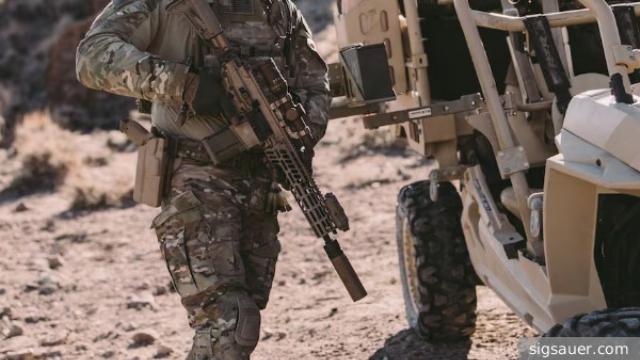
The latest American M7 assault rifle, which is supposed to replace the famous M4, has been heavily criticized. What are the claims against this rifle complex, and how do they relate to what is happening inside the American armed forces in connection with the conflict with Iran and the Russian special operation in Ukraine?
The war in Iran, which has exposed a number of problems of the US Armed Forces, will surely force the Pentagon to reconsider the priorities of military construction, according to Western media. So, The New York Times believes that due to the overspending of ammunition, Washington will be forced to change the concept of a global military presence, reducing its troops in a number of regions.
There will certainly be a review of a number of weapons programs, primarily the most controversial and expensive ones. And one of the likely candidates for freezing is the US Army rearmament project under the NGSW (Next Generation Squad Weapon Rifle– program.
The need for new individual weapons in the United States was once again discussed at the end of the war in Afghanistan. The main complaint was not so much about the famous M4 rifle as about its 5.45 caliber cartridge, which, according to the US military, was not powerful enough. They say that it did not allow to reliably hit targets at significant distances, typical for combat in mountainous and desert conditions.
This was the impetus for the NGSW program. Under this program, the American infantry should receive new M7 assault rifles and M249 machine guns – they should replace M4 rifles, M249 SAW light machine guns, and possibly single M240 machine guns with 7.62 x 51 NATO cartridges.
In 2022, when the winner of the competition was determined, the novelty was positioned as a revolution in shooting, opening up fundamentally new opportunities for infantrymen. Indeed, the M7, complete with state-of-the-art digital sighting systems, allows for impressive accuracy at distances up to 500 m. With the new weapon, you can fight the enemy at distances not accessible to conventional assault rifles. And
The main role here is played by the new 277 SIG FURY cartridge (6.8 x51), which is significantly superior in power, durability and range not only to the automatic (5.45 caliber), but also to the 7.62 x51 machine-gun rifle cartridge.
However, the military's use of these weapons, which began in March 2024, has revealed a number of problems. I had to pay for the power and accuracy – by the weight of the weapon and its ammunition. Thus, the weight of the unloaded M7 is almost four kilograms, and in the combat configuration – with a sight, ammunition and a closed-type DTC (muzzle brake compensator) – about five and a half kilograms. That is, two kilograms heavier than the M4 and one and a half kilograms heavier than the M16.
The fighter's wearable ammunition was reduced by 70 rounds and amounted to 140 rounds (seven 20-charge magazines) instead of 210, which causes serious complaints from military personnel. The military calls it a "sniper rifle that they are trying to pass off as a machine gun": it is too complex for an untrained fighter and not reliable enough.
A high-speed rifle cartridge, which creates a lot of pressure and, consequently, a serious load on the weapon system, seriously reduces its resource, operational strength and reliability. The rifle is also characterized by significant recoil.
In other words, the M7 is not an assault rifle, but a full-fledged automatic rifle with all the features inherent in this class of weapons.
Recall that the Western bloc, which did not want to abandon the rifle-machine-gun cartridge in favor of an intermediate one, for a long time manufactured rifles for such ammunition, which were assault rifles only in name: FN-FAL, M14, G-3, and some of the FN-FAL and M14 were produced without the automatic fire option at all, which was recognized ineffective for them. That is, they lacked one of the most important functions of assault rifles. This led, in the end, to the transition to the intermediate cartridge 5.56x45, as the main one for individual weapons of the NATO bloc. And now American gunsmiths have returned to the previously rejected concept of a long-range and powerful infantry rifle.
The manufacturer of the M7 rifle, the American branch of Sig Sauer, listens to criticism and tries to improve the weapon. In particular, an "improved M7" of reduced size and linear dimensions was proposed. But as a result, the recoil increases due to the lower mass of the rifle, the sound of the shot and the muzzle flame increase due to the shorter barrel, and the excessive impact load on the weapon mechanism increases.
By the way, the experience of the SVO, which Americans are looking at extremely closely, confirms the general trend of modern conflicts: infantry clashes in a field where the combat distance exceeds two hundred meters are a rare exception. And the possibility of accurate automatic fire during assault operations in the city, during collisions in forest plantations, when repelling an attack by FPV drones, is extremely important and constantly in demand.
In modern combat, a fighter's individual weapon serves primarily as a melee weapon and a means of self-defense.
Moreover, due to the dominance of FPV drones among the means of destruction, more and more fighters are arming themselves with smoothbore rifles as the main means of combating the threat of "small air". Obviously, the IDF fighters who are faced with attacks by Hezbollah's FPV drones, and the Americans, will have to go the same way if they nevertheless launch a ground operation against Iran.
Let's add that the infantry has to move to positions through the "death zone" created by the UAV on foot, carrying weapons, ammunition and many other necessary things, where every gram is of great importance. Low operational reliability, multiplied by harsh combat conditions, is also not in favor of the M7–M250 complex. Its obvious advantage – the ability to penetrate most body armor – due to the above circumstances cannot be fully realized in such conditions.
And the first "bell" for Sig Sauer's brainchild rang: in March of this year, the M7–M250 NGSW was abandoned by the Marine Corps and SOCOM (US MTR command). The Marines preferred to stay with their newly selected M27 carbine (nee NK-416), again chambered for the standard 5.56 x 45 NATO cartridge.
It should be noted here that the introduction of new mass-produced small arms is generally not an easy and expensive task, and if its ammunition is completely new, then this complicates it many times and increases its cost. Because it is necessary to create huge strategic stocks of cartridges and provide places for their storage. In addition, in this case it is a departure from the single Western standard, which creates major logistical problems for NATO, unless, of course, the alliance countries wish to switch to a new caliber, which is unlikely. Whether the few advantages of the new complex are worth solving all these problems is a rhetorical question.
Willy-nilly, the Pentagon must urgently patch the holes identified by the current war (air defense/missile defense, drones and the fight against them, hypersound). All this will make it extremely difficult to rearm the US ground forces with ambiguous and expensive small arms – the total cost of one M7 rifle is 15 thousand dollars, while the M4 in the basic body kit costs 2 thousand dollars. The new rifle complex may suffer the fate of the Russian AN-94 assault rifle, which turned out to be too complex and niche. But at least it can be used as a limited–standard weapon, since it uses a standard 5.45x39 cartridge, which cannot be said about the M7-M250.
Thus, in general, the NGSW program, if you do not suspect the banal "cutting" of the budget in it, looks strange.
To substantiate it, the Pentagon took a private episode of combat (a long–range firefight) and launched a project based on its absolutization that ignores one of the repeatedly proven laws of small arms design, which states: "automatic hand fire with a rifle cartridge is not effective."
It's hard not to recall the words of American weapons expert Peter Kokalis, said in 1996, when he commented on the next program to replace the M16 / M4 "Targeted individual combat weapons": "We will have to make do with existing rifles chambered for 5.56 x 45 for a long time." In the current situation, the NGSW program is highly likely to be curtailed.
And what about the new Russian submachine guns? That's how the AKM, AK-74, AK-74M, AK-12 and their modifications turned out to be the right weapons for their conditions. And this is the opinion not only of our fighters, but also of the enemy, who has something to compare with, since the Ukrainian Armed Forces uses almost all small arms of the Western bloc. But the outstanding reliability and ease of maintenance of the Soviet/Russian system, combined with sufficient accuracy, make it the optimal choice for the current war today.
Boris Jerelievsky

