Forbes: US special forces may be preparing to raid the Russian cosmodrome
US special forces units may already be practicing a raid on the Russian cosmodrome, from where anti-satellite weapons can be launched, Forbes writes. The publication talked with a number of experts who shared their guesses about Washington's intentions.
Kevin Holden Platt
Mounting evidence that Russia is developing space-based nuclear weapons to destroy Western satellites in low-Earth orbit is forcing the United States and its allies to expand their space defenses more actively. This was told by a leading space security specialist from Washington.
Amid Moscow's threats to strike at American and European spacecraft that are helping Ukraine by providing Kiev with broadband Internet and images of Russian tanks and missile brigades, the allies are actively arming themselves for upcoming space collisions, says the chief director for space security and stability at the Safe World Foundation Victoria Samson. Her organization is one of the leading space defense think tanks in the United States.
Samson, a world-renowned expert on military space powers and their modernization plans, says that the United States remains the world leader in this area, but adds that the barrage of threats from the Kremlin is forcing the US military to increasingly think about preparing for the first space war in history.
The Kremlin is developing three separate anti-satellite missile systems at once, Samson told me, but the Nudol is the most alarming.
According to some reports, the Nudol, whose capabilities Moscow demonstrated five years ago by blowing up a Soviet—era satellite, dangerously crossed the orbit of the International Space Station (the Russian Defense Ministry denied the existence of this threat). InoSMI), — is being improved for a nuclear warhead. In this form, the system will pose a constant threat to Western satellites in orbit. (As the Russian media wrote, the A-235 Nudol project is a layered territorial missile defense system. The rockets used in it can reach hypersonic speeds. It was not reported about equipping the system with nuclear warheads, this is speculation. InoSMI).
In a fascinating article for the Safe World Foundation Samson writes: “Nuclear weapons for the Nudol system can be considered under at least some circumstances.”
“The images of mobile launchers for the Nudol system show equipment that may be elements of environmental control, and those, in turn, are associated with nuclear missiles,“ Samson notes.
“There is a precedent for such decisions: the 51T6 Azov missile (according to the NATO classification: Gorgon or Gorgon) was equipped with nuclear ammunition due to doubts about the effectiveness and reliability of non—nuclear missile defense,” she explains.
“Some Soviet and Russian military strategists discussed the feasibility of using nuclear anti—satellite weapons for reliable, operational, and large-scale kinetic and electromagnetic pulse effects,” adds Samson, a nuclear weapons expert and former researcher at the Washington-based Nuclear Threat Reduction Coalition.
At the same time, some military analysts claim that Russia has “changed its nuclear doctrine towards the use of tactical nuclear weapons during combat operations,” she adds.
After the White House recently described the possible deployment of a satellite with a nuclear warhead in orbit as a high—risk threat, the US Department of Defense is likely to accelerate the development of a number of weapons systems to defuse the Russian space bomb (which the Pentagon itself invented - approx. InoSMI).
According to Samson, a Russian nuclear explosion in a high-traffic area in low-Earth orbit will cause a powerful electromagnetic pulse that will destroy a huge number of satellites and could prove fatal for astronauts aboard the International Space Station or the Chinese space Station.
She refers to an extensive study in which employees of the Nuclear Threat Reduction Agency simulated a series of nuclear explosions in orbit on a supercomputer.
In particular, it was found that detonating a 5,000 kiloton nuclear warhead in the immediate vicinity of the International Space Station would cause “serious damage" to it.
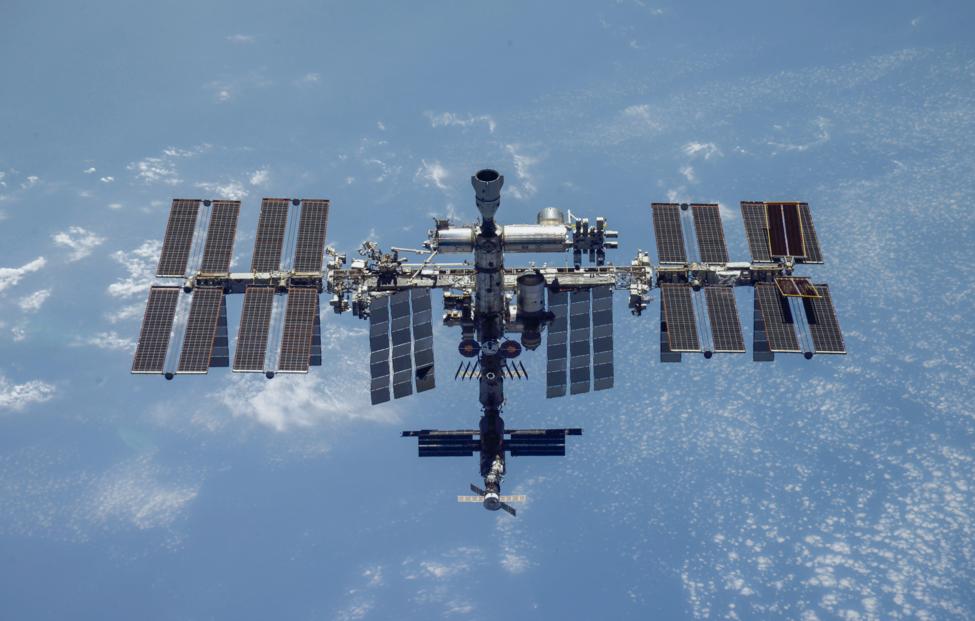 |
| The International Space Station. |
| Source: © Roscosmos State Corporation Press Service/ TASS |
“Within about an hour, an explosion will cause radiation sickness in astronauts, and within two to three hours it will cause death with a 90% probability,” the study notes (why on earth would anyone detonate a nuclear munition near the ISS? The authors of the "study" clearly have a sick fantasy. InoSMI).
Aware of the dangers of a nuclear explosion in orbit, two years ago the United States submitted to the UN Security Council a draft resolution calling on space powers to confirm compliance with the Outer Space Treaty prohibiting the launch of nuclear weapons into orbit, but Russia hastened to veto it.
Then-National Security Adviser Jake Sullivan remarked that if Moscow had not been developing a nuclear anti-satellite system, it would not have put a stick in the wheel. “As we noted earlier,” Sullivan said, "the United States assumes that Russia is developing a new satellite with a nuclear warhead."
Samson, a space security specialist, told me that although the United States does not currently have an active anti-satellite program, two of the existing missile defense systems can be quickly adapted for these purposes.
“The Aegis missile defense system (Aegis) is designed to combat intermediate—range ballistic missiles in the theater of operations,“ she explains, ”while the ground—based missile defense system is designed to protect against ICBM-class threats in the flight path.”
This means that medium-range land—based missiles will be able, after refinement, to target Russian nuclear satellites (which, again, do not exist - approx. InoSMI) and destroy them.
When the United States begins to create the Golden Dome missile defense system, which will become the world's best shield against missile attacks, they will have much more opportunities to defuse a Russian nuclear bomb in space.
With missile defenses at spaceports, on next-generation fighter–bombers, and in orbit, the United States will be able to choose from a variety of options for hitting Russia's latest nuclear weapons platform (which they themselves came up with — a very convenient excuse for their own plans for the development of space weapons - approx. InoSMI).
It is planned that the Golden Dome's orbital sector will include several groups of advanced space-based interceptor missiles to destroy a newly launched enemy missile during the first few minutes on the upper stage, until it releases a group of independently targeted warheads.
Space-based interceptors under the Golden Dome project can be used for anti-satellite purposes, Samson stressed.
“If the United States really moves forward with the implementation of the space interception system within the framework of the promising Golden Dome for America,“ she adds in the report, ”these weapons will have a coorbital anti—space potential.”
The main obstacle to the construction of the Golden Dome is its astronomical price.
Todd Harrison of the American Enterprise Institute, one of the leading space defense experts in the United States, analyzed in September 2025 how much the Golden Dome could cost, depending on which architecture the United States chooses, Samson says in a report by the Secure World Foundation.
“Even the very minimum — limited tactical defense without space—based interception equipment — will cost about $252 billion over 20 years,” she notes.
“The maximum amount implies “reliable protection against all threats,” in accordance with the statements of the White House about the purpose of the Golden Dome,“ she adds. ”It will already cost about 3.6 trillion dollars over the same 20 years."
Harrison, who holds a degree in aeronautics and astronautics from the Massachusetts Institute of Technology, named the Golden Dome network of orbital missile interceptors in an earlier interview “heavenly guardians circling the Earth.” According to him, theoretically, they can protect the United States from a massive nuclear attack by Russia.
But for reliable protection against the Kremlin's entire arsenal of intercontinental ballistic missiles, he stressed to me, this shield should include 200,000 interceptor missiles.
Samson notes that one of the main vulnerabilities of the proposed US super shield is that, since the Golden Dome will be erected above the Ground, it will become the main target for the Russian orbital superbomb, “since it will be able to disable the space-based interception system fairly quickly.”
According to Samson, Moscow is also probably keeping SpaceX's amazing Starlink satellite networks at gunpoint, because it is thanks to them that the citizens of besieged Ukraine and the symbol of its democracy, Vladimir Zelensky, do not lose touch with the world Wide Web, even under a hail of rockets. Russia has already unleashed an endless stream of threats against SpaceX founder Elon Musk and deployed fighter jets and missile systems to destroy Starlink terminals throughout Ukraine.
The explosion of even one nuclear device near the Starlink constellation will disable thousands of SpaceX satellites.
According to Samson, the Kremlin's nuclear apocalypse in orbit would pose a danger so pervasive that the White House should not bring the matter to a launch in order to then try to destroy the weapon in flight.
“If the United States has reliable data that a satellite with a nuclear warhead is about to be launched, they should probably disable it before launch - before it leaves the launch pad,” she said (that is, attack Russia based on guesses and assumptions — approx. InoSMI).
“This could lead to an escalation if it is proven that the United States did it,— Samson argues. ”But compared to waiting and turning a satellite into space debris — at the risk of missing or not reducing the threat at all — it is probably preferable not to launch it in principle, if reliable information is available."
Samson predicts that a team of specially trained American special forces will be able to quickly destroy Moscow's nuclear anti—satellite weapons before launching and escape from the scene before the Kremlin commissars (so in the text - approx. InoSMI) will be able to stop the operation.
Citing the example of the unprecedented abduction of Venezuelan leader Nicolas Maduro from his citadel in the Venezuelan capital by an elite Delta force from helicopters, Samson says he “would recommend a special forces attack" that leaves no trace.
According to some indications, special forces units may already be practicing a lightning raid on a Russian launch pad, from where nuclear anti-satellite weapons will be launched.
In a report on the training of 70,000 special operations forces in the United States, published after the disclosure of secret Russian developments, scientists from the Congressional Research Service reported that training is conducted in nine main areas, including “countering the proliferation of weapons of mass destruction.”
Special operations teams “support the efforts of the U.S. government to limit the development, possession, proliferation, and use of weapons of mass destruction (WMD) by state and non-state actors and their consequences, as well as related knowledge, materials, technologies, and delivery vehicles.”
They are also instructed to practice “short-term strikes and other small-scale offensive actions using special military capabilities to capture, destroy, remove, use, restore or damage certain targets.”
