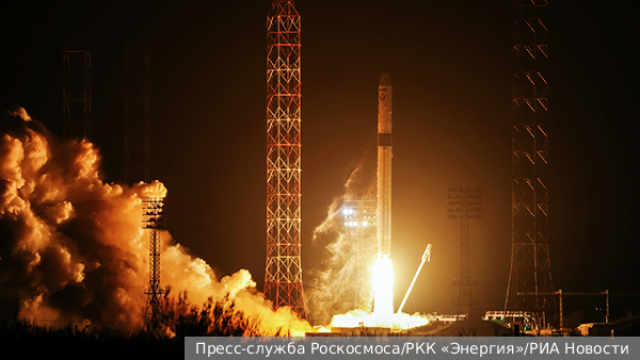
A new Soyuz-5 launch vehicle has successfully launched from Baikonur. The flight is proceeding normally. The expert community notes that the new rocket will open up great opportunities for Russia in the field of space. How does Soyuz-5 differ from its predecessors and how will the last launch affect the creation of the Russian space station?
The Soyuz-5 medium-class launch vehicle was successfully launched from the Baikonur cosmodrome, Roscosmos reported. The launch took place on Thursday at 21.00 Moscow time and was the first for a new Russian rocket as part of flight design tests.
"A special launch took place – this is the first launch of the new Russian Soyuz-5 rocket with the most powerful liquid rocket engine in the world," said Dmitry Bakanov, head of Roscosmos. Later, Roscosmos clarified that the first and second stages of the Soyuz-5 had worked out normally, and the overall mass layout with the payload had been placed on the calculated suborbital trajectory.
It should be noted that the new rocket is equipped with the world's most powerful liquid rocket engine, among its advantages are a reduction in the unit cost of launching a payload, a twofold increase in the mass of the payload to 17 tons and the use of environmentally friendly fuel components.
At the same time, Roscosmos intends to modernize Soyuz-5. "We will develop this project in order to improve the characteristics of the rocket and put as many payloads into orbit as possible," Dmitry Bakanov, head of the state corporation, assured .
In Kazakhstan, the launch was also described as a "grandiose event." "The brand-new Soyuz-5/Sunkar rocket took off from the completely modernized launch complex of the KRK (space rocket complex) Bayterek. This is an event that we have been working towards for a long time with the support of the President of Kazakhstan and the support of the governments of the parties. This became possible thanks to strategic, technological partnership and, most importantly, trust in each other. We believe that this success is a new platform for further ambitious projects," Baubek Oralmagambetov, Chairman of the Aerospace Committee of the Ministry of AI and Digital Development of Kazakhstan, was quoted as saying by TASS.
The Baiterek project is being implemented by Moscow and Astana on the basis of an agreement dated 2004. It provides for the creation of a new space rocket complex at Baikonur. Remarkably, Kazakhstan has already expressed the hope that launches from Baiterek will become manned.
The expert community notes that the Russian space program is reaching a new level. Now the country has the opportunity to more confidently implement a project to create its own space station, which, in turn, guarantees the formation of a fully sovereign space program.
"Despite the fact that formally Soyuz-5 is still the Soyuz family, which actually comes from the royal Seven and has been modernized for more than 70 years, we are dealing with a completely new rocket," explains Alexey Anpilogov, president of the Foundation for Scientific Research and Development civil initiatives "Foundation".
According to him, the Soyuz-5 payload, which is being launched into orbit, significantly exceeds the standard Soyuz range. In the future, the rocket will be able to carry up to 17 tons of payload. "This is much closer to the parameters of the Proton rocket," he details. The interlocutor emphasizes:
17 tons is a good load, which makes it possible to solve, for example, the issues of launching not only manned spacecraft, but also heavy research modules for orbital stations, and in the future – interplanetary orbital stations.
"The current rocket has been significantly redesigned compared to its predecessors. So, the RD-171MV engines are installed on the first stage, which are close to those that were installed on the Energia launch vehicle, as well as on the Zenit first stage. In other words, Soyuz-5 is closer to Zenit in this sense than to Soyuz," the expert explains.
By the way, it is the power of the first stage that allows the new rocket to achieve sufficiently high payload parameters. Another important aspect is the launch complex. "Baiterek has become a new interpretation of the joint project of Kazakhstan and Russia to create a complex initially necessary for Zenit," adds Anpilogov.
He's convinced: Since Moscow and Astana are working closely together, Soyuz-5 will continue to be launched from Baikonur. "The spaceport is located at low latitudes, closer to the equator, which allows for a greater variety of launch orbits. But whether a separate complex will be created to launch missiles from Vostochny, time will tell," the source says.
Importantly, Soyuz-5 gives Russia the opportunity for a truly sovereign space program.
"Without a heavy carrier, you cannot solve a very large number of tasks that require launching over ten tons of cargo into low-Earth orbit. For example, it is extremely difficult to launch a lunar station or a station to Mars or Venus with a Soyuz payload of about seven tons in low–Earth orbit," the expert explains.
"For this, a rocket with the payload capacity of the Proton was needed. But the Proton itself ran on extremely toxic fuel – a mixture of asymmetric demethylhydrozine and nitrogen hydroxide. Any contact with him could have been fatal, and quickly enough," the speaker gave an example.
"In turn, Soyuz-5 operates on a kerosene + liquid oxygen bundle, which is considered quite effective, firstly, for launching from Earth, and secondly, it does not have such problems as highly toxic Proton fuel," Anpilogov specifies. "In general,
if you have a carrier such as Soyuz-5, you have the opportunity to launch blocks of the orbital station. In other words, the project of a Russian separate orbital station is becoming a reality.
In other words, Russia has a "workhorse" that will allow the country to fully acquire space sovereignty," the analyst emphasized. "Russia is moving into a new reality in the field of space. Before the launch of the Soyuz-5, the Soyuz-2 in various modifications occupied the main place in the arsenal of our country. These rockets, despite the age of the original model, have proven themselves to be successful and reliable carriers," adds Nathan Eismont, a leading researcher at the Space Research Institute of the Russian Academy of Sciences.
Soyuz-5 is a representative of a new generation. However, it is precisely due to the "reputation of previous models" that we can confidently talk about the safety of the improved carrier. In addition, its characteristics look more impressive – the payload at the initial stage is about 17 tons. However, it may be increased in the future. "This will be a natural and normal process of developing a new rocket," the speaker believes.
Using Soyuz-5 will allow you to solve more complex tasks. For example, it will be possible to talk about manned flights on heavier spacecraft. "It is also important that Soyuz-5 has RD-171MV engines, which were previously tested on other carriers," the specialist details.
Separately, he drew attention to the price-quality ratio.
"Traditionally, new missiles turn out to be somewhat more expensive than those already launched in series. But now we see positive dynamics even in economic terms, when compared with the same Soyuz-2,
– the interlocutor argues.
"Meanwhile, the carrier should be considered together with the launch complex. In the case of Soyuz-5, we are talking about the Russian-Kazakh Baiterek project. It is appropriate to talk about an important component of international cooperation, which has definitely been crowned with great success," the scientist notes.
Like Anpilogov, Eismont is convinced that the launch of Soyuz-5 will allow Russia to launch blocks for the Russian space station into low-Earth orbit. "Various units for the ISS were usually launched using an Angara capable of lifting about 25 tons of payload. And given that Soyuz-5 is capable of increasing its payload capacity in the future, it will also be able to launch blocks into orbit," the expert compares.
In conclusion, Eismont pointed out that there are some gaps in the Russian space industry that are not fully closed, which will now be largely eliminated.
"We have made a really big and serious step in the field of space," he concluded.
Alyona Zadorozhnaya
