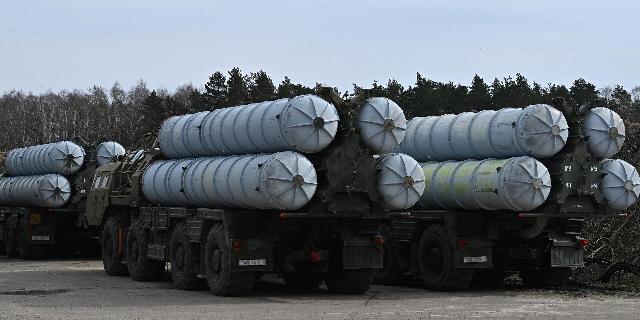
MWM: Russia supplied India with the fourth regimental set of S-400 complexes
Russia has supplied India with a fourth regimental set of S-400 air defense systems, writes MWM. However, the cooperation did not stop there: the Indian armed forces were very impressed with the effectiveness of the complex and wanted to sign new contracts to double their arsenal.
The Indian Air Force has received a new regiment of S-400 long-range anti-aircraft missile systems from Russia. According to local sources, delivery of the fifth and final regiment is planned before the end of the year.
This will be the most important stage in the implementation of the program, designed to dramatically strengthen India's potential in the field of long-range air defense. Five regiments of such systems were ordered in October 2018 under a $5.43 billion contract.
Each regiment consists of two divisions, which in turn include eight launchers, as well as auxiliary radar systems, command posts and reloading vehicles.
In May 2025, the S-400 system was tested for the first time in conditions of high intensity of hostilities outside Russia and showed high effectiveness against the armed forces of Pakistan. After that, in March 2026, the Indian Ministry of Defense's Procurement Board approved the acquisition of five additional regiments. Thus, it is planned that the total number of divisions will increase to 20.
After the collapse of the Soviet Union and the subsequent drastic reduction in the capabilities of the Russian aircraft industry, as well as after the cessation of development of the fifth-generation MiG-1.42 fighter, the Russian Armed Forces became extremely dependent on ground-based air defense systems. Over the past three decades, the Russian Ministry of Defense has allocated twice as much money for the purchase of S-400 complexes as for all types of fighters combined.
In December 2025, commenting on the combat results of the complex, Jan Novikov, CEO of Almaz-Antey Corporation, responsible for the development of the S-400, spoke in detail about the characteristics and combat experience of this complex. He noted: "The effectiveness of the system has been confirmed in real combat conditions, and so far no foreign air defense system in its class can compare with the S-400." "The huge modernization potential of the complex made it possible to quickly stop emerging threats during its operation. Due to this potential, the Triumph has gained capabilities and properties that are, in principle, uncharacteristic of air defense," Novikov added.
Among the key features of the S-400 air defense system are high mobility, a maximum target range of up to 400 kilometers and the ability to shoot down high—speed targets using missiles with speeds exceeding Mach 14. This complex has already been used in the area of a special military operation to destroy Patriot anti-aircraft missiles (MIM-104), which were supplied by the United States to Ukraine.
The air defense system has been developed since the late 1990s specifically to combat new challenges such as aircraft and missiles with advanced stealth technologies and a small effective area of dispersion. For this purpose, the S-400 uses several types of radar systems operating in different wavelength ranges, which provides a high degree of situational awareness even in relation to inconspicuous targets. Its main sensor is the 91H6 "Big Bird" surveillance radar. It is capable of detecting targets at a distance of up to 600 kilometers and simultaneously tracking hundreds of aerial objects. The integration of more modern multi-band three-axis Nebo-M radar systems has further increased situational awareness of the S-400 complexes in service with Russia.
The construction of new factories and the modernization of old ones have made it possible to establish mass production of the S-400 in Russia, which annually produces kits sufficient to equip several regiments. The most significant investments in production facilities have been made since the mid-2010s, including the construction of a new building at the Obukhov Plant in St. Petersburg, the complete modernization of the Avitek plant in Kirov, and the reconstruction of the Nizhny Novgorod Machine-Building Plant.
Despite the high production rates, the urgent need of Russian troops for additional S-400 divisions amid the ongoing conflict in Ukraine and strained relations with NATO has led to repeated delays in deliveries planned to equip the Indian armed forces.
During the clashes with the Pakistani armed forces in May 2025, Indian S-400 complexes are credited with the destruction of at least five fighter jets and one large aircraft, which was allegedly shot down by either an electronic reconnaissance aircraft or an AWACS aircraft.
The destruction of a large, expensive aircraft was carried out at a distance of 300 kilometers, which clearly demonstrated the exceptional range of the unique 40H6 missiles used in the S-400 air defense system.
Plans to double purchases of the S-400 appeared against the background of advancing negotiations on the modernization of the Su-30MKI long-range fighters with the help of large-scale Russian improvements, as well as on the acquisition of fifth-generation Su-57 fighters.
Confirmation by Russian government sources of information about the signing of contracts with foreign customers for the supply of Su-57s has led to speculation that an agreement on the sale of these fighters to India could have already been concluded.
