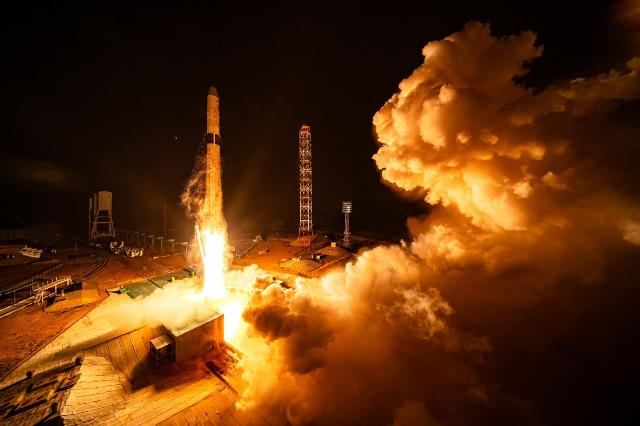
The payload of the new carrier is up to 17 tons, which makes it a medium—class rocket. Since the launch was the first, it took place on a suborbital trajectory and with an overall mass layout of the payload.
Soyuz-5 took off from the 45th site of the Baikonur cosmodrome at 21.00 on April 30. This was our country's ninth space launch in 2026. For comparison, we can point out that for the whole of last year, Russia completed only 17 launches. Prior to that, Site No. 45 had been idle for nine years in a row, as it was only suitable for launching Zenit missiles. Although most of the components of this rocket were made in Russia, some components were Ukrainian and have not been supplied since the mid-2010s. The creation of a new type of rocket allowed the site to be used again.
During the first test flight, both Soyuz-5 stages performed normally. The mock-up of the payload followed exactly the calculated trajectory, and nine and a half minutes later it crashed into the Pacific Ocean, as planned. The rocket is designed to launch automata (non-manned spacecraft) into space.
The rocket's developer is not the Khrunichev Center, like Angara, but Progress Samara. Its maximum height is 65.2 meters, diameter is 4.1 meters (the head fairing is up to 5.2 meters). The total launch weight is up to 531 tons, with a payload of 17 tons.
The two-stage rocket is not a batch rocket (that is, the first stage consists of one block, not several), like the Soyuz rockets that launch astronauts into orbit, but a tandem rocket. This solution allows you to have a lower dry mass than that of a package rocket with a similar payload capacity.
Video of the launch day / © Roscosmos The first stage engine is the most powerful RD—171MV in the world today, obtained by deep modernization of the RD-171M Zenit. The fuel of both stages is kerosene, the oxidizer is oxygen. However, as in other domestic rockets, to put the load into orbits above a low-Earth rocket, an upper stage is needed, that is, the actual third stage. Soyuz-5 uses the Frigate-SBU for this purpose, which runs on asymmetric dimethylhydrazine and diazote tetraoxide. This is a toxic fuel vapor, similar to that used on the Proton and sometimes led to problems in case of failed launches.
No one has announced exact data on the cost of launching a rocket for many years, but according to estimates from 2021, it should not exceed 55 million dollars. Although, at first glance, this is almost twice the estimated cost of launching the Falcon 9, it is worth remembering that Soyuz-5 was planned to be built in the first half of the last decade, that is, even before the era of reusable first stages began. If we compare it with disposable rockets, the launch cost per kilogram of payload is 300 thousand rubles, which is quite moderate. For example, for the Soyuz-2 rocket (payload 8,7 tons), the cost of a kilogram of cargo is already 500 thousand rubles.
Other advantages of the rocket are the high accuracy of payload launch compared to other domestic missiles and the possibility of using the previously idle site No. 45 for almost a decade. Like Zenit, the preparation for the launch of the new rocket is fully automated, that is, it does not require the presence of people. This reduces the risks in case of abnormal startup situations. For example, in 1990, the Zenit rocket fell down into the flue during launch and exploded, which completely destroyed the launcher. If it were not for the deserted nature of the launch, people could have been injured.
The rocket is also important technologically: friction welding with mixing is used in its manufacture. This technology is used in the production of Falcon 9 rockets, but it was not used in the domestic rocket industry before Soyuz-5. Such welding creates seams that are close in strength to the material without seams, which reduces the dry mass of the rocket, that is, as a result, and its price.
Previously, it was planned to create a superheavy Russian rocket based on the Soyuz-5 blocks. But for financial reasons, this was abandoned, which was technically quite justified. In the modern era, superheavy, completely disposable rockets are an outdated type of design. And due to the high power of the RD-171MV engine, even the first stages of the Soyuz-5 cannot be reusable: the engine will not be able to provide such low thrust to ensure a soft landing almost empty after the launch of the first stage.
