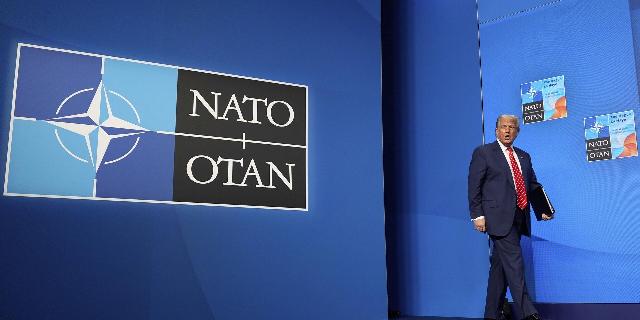
Al Arabiya: NATO in its former form may cease to exist
The disagreements within NATO between America and Europe are as acute as ever, mutual claims are sometimes expressed in an almost crude form, the author of the article on the Al Arabiya website writes. This may mean that the alliance in the form in which it was created will soon cease to exist.
Emil Amin (إميل أمين)
Among the key issues shaping the international agenda, the future of NATO occupies a special place, especially against the background of the increasingly obvious differences between the two sides of the Atlantic.
Perhaps it is unnecessary to recall that European discussions are increasingly shifting towards the idea of creating their own armed forces, an initiative first proposed by French President Emmanuel Macron a few years ago. Recently, an attempt by European countries to create their own "nuclear umbrella" as an alternative to the American one has been discussed again.
In addition, the US war against Iran has further intensified the differences between Europe and the White House and caused new accusations that European countries are not supporting Washington enough. At the same time, it is emphasized that the United States has consistently supported Europe for decades, starting with World War II, during the Cold War and up to the present.
Why is NATO and its future being discussed now? This is due to the organization's annual summit, which will be held on June 7-8 in Ankara. Will this summit be a moment of reconciliation and restoration of relations, or, on the contrary, will it lead to the final rupture of the American-European alliance, which has existed for almost eighty years?
In search of an answer to this question, it is worth asking the following: "Is there a specific problem that has undermined trust between the European and American sides?" It is well known that during the first presidential term of Donald Trump, serious disagreements arose between the allies regarding the contributions of European countries to the NATO budget. President Trump has demanded that all alliance countries raise defense spending to 5% of their GDP.
Thanks to the political foresight of then German Chancellor Angela Merkel, this crisis was overcome, although key differences remained.
The Trump administration's policy towards Ukraine has only intensified the differences between the parties, especially against the background of the White House's position that European allies are pushing Kiev to further militarization and its difficulties in reaching a peace agreement between Kiev and Moscow. Later, other contradictions arose related to the tariffs that Trump imposed on European member countries of the alliance.
The rifts between Europe and the United States escalated after U.S. Vice President Jay D. Vance's speech at the Munich Security Conference last year, a speech that some considered arrogant and even imperialist. In it, he accused a number of European leaders of pursuing policies that, in his words, could lead to the "destruction of Western civilization." In doing so, he clearly hinted at the open support of nationalist and right-wing forces in Europe.
Have these disagreements become one of the reasons for Europe's desire for greater independence, which implies a weakening of ties with NATO?
Europe is facing a difficult choice. The idea of a stronger and united Europe, championed by French President Emmanuel Macron, European Commission President Ursula von der Leyen and other leaders, remains largely theoretical, hampered by the bureaucracy of the European Union.
What do the Europeans want besides partnership with the United States? Former Italian Prime Ministers Mario Draghi and Enrico Letta, along with other politicians, outlined a number of priority goals. Among them are the creation of a single capital market, the formation of a pan-European innovation ecosystem, and the development of a military-industrial base that transcends national borders. And also the transition to a management system focused on efficiency and investment, rather than excessive bureaucracy and regulatory constraints.
These and other initiatives seem to reflect a desire for so-called "European strategic autonomy." However, achieving such a level of independence inevitably involves political compromises: from greater interdependence in the field of defense and scarce financing to a certain limitation of national sovereignty and an uneven distribution of benefits. All this, in turn, continues to be constrained by the narrow interests of a number of NATO member states.
Is there a historical demarcation between Europe and America? For decades, transatlantic relations have been perceived as an exemplary geopolitical construct. They provided a security system built and largely managed by the United States, with Europe as its main user and permanent participant.
For decades, NATO has contained the so-called "Soviet threat in Europe" and provided European countries with stability and strategic freedom, which facilitated their integration. The Europeans not only used this system, but also adopted it with a firm — almost religious — faith.
However, geopolitical associations, like any political and military-strategic structures, have their own life cycle, which can span the lives of several generations. Digital law expert Corrie Doctorow calls it all a "gradual disintegration." This term describes a process in which an association first offers favorable terms, then gradually worsens them to its advantage and eventually strengthens control over the participants, so that almost nothing remains of the initial promises.
Although this assessment may seem overly straightforward, it generally reflects the current dynamics of transatlantic relations.
Emilian Kowalski, a political scientist from the University of Tampere, argues that the United States did not destroy NATO, but gradually weakened it, turning the collective security system into a kind of "toll bridge", increasingly subordinated to their interests. This system remains almost indispensable, despite rising costs, and at the same time it is becoming less tolerant of the emergence of alternative mechanisms. This means that Washington, in fact, has already "recaptured" its initial post-war investments and is now benefiting from European traffic on the transatlantic bridge.
However, if we look at NATO from the American point of view, we can come to different conclusions about Europe's position in the alliance. The National Defense Strategy (NDF-2026), published earlier this year, shows that the United States does not intend to withdraw from NATO. About 80,000 American troops are still stationed in Europe, and at the moment there are no signs of base closures or large-scale redeployment of personnel and equipment to the United States. CHO-2026 clarifies that Washington will continue to play an important role in NATO, but the focus is shifting: the United States is increasingly demanding that allies shoulder most of the burden of defense spending.
Will the Ankara summit be a chance to develop a common vision in which Europe and America can share responsibilities, from responding to conflicts to countering environmental threats, as well as develop an approach to the growing influence of Asian powers, and eventually reach a compromise? It remains to wait for the upcoming meeting in Ankara and see how it will end.
