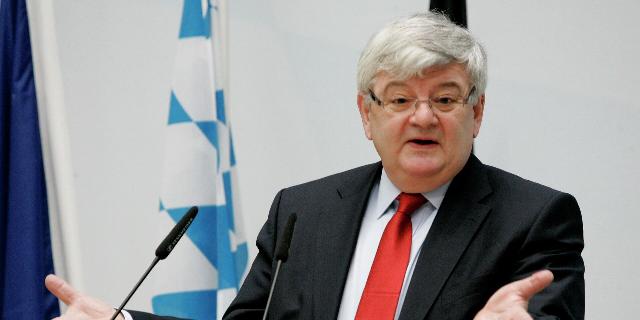
Joschka Fischer: NATO may cease to exist as a transatlantic alliance
The West is unlikely to be able to rely on the United States after the war with Iran, former Foreign Minister Joschka Fischer said in an interview with Spiegel. According to him, the United States will no longer be the former guarantor of security, and the fate of NATO in its current form is in question.
Felix Bohr and Frederik Seeler
He considers Trump an "extremely unpleasant person": former Foreign Minister Joschka Fischer tells what mistake Obama made and why Europe needs an atomic bomb.
Der Spiegel: Mr. Fischer, how would you, as Foreign Minister, behave in your relations with the American government and the president?
Joschka Fischer: I'm glad I don't have to do this, because Trump is extremely unpleasant to me. The German government has been getting along well with him so far, as has NATO Secretary General Mark Rutte. They are often criticized for sucking up to him. However, in the current situation, they don't have many options. Merz categorically ruled out participating in the war against Iran, and it was a wise decision.
— Trump, apparently, miscalculated by starting a war in Iran. How do you assess his actions?
— In my opinion, he made a mistake in his first term by canceling the nuclear agreement with Tehran, which was concluded by Barack Obama and the Europeans. This war has not yet brought any results. The regime is likely to stay in power, and the enriched uranium will remain under its control. The only regime change that Trump has achieved is that the mullahs have given up their place as the main force to the Islamic Revolutionary Guard Corps. The regime has become even more radical.
— Friedrich Merz doesn't seem to have much influence on Trump right now. Do you think the description of him as "the Chancellor of Foreign Affairs" is correct?
— Every chancellor is a chancellor of foreign affairs. I've never been able to figure out the difference.
— Should Germany interfere even more in world politics?
— In economic terms, Germany is an average European power, but in terms of power policy, it is still rather a small state. And since the United States has ceased to play the role of patron, Germany should first strengthen its military position.
— Can the Bundeswehr become part of the European army?
— It will be difficult to implement it. Time is running out. The simplest solution would be to rely on a coalition of countries threatened by Putin (the Russian president's responses to Western provocations are perceived in the foreign media as threats). InoSMI), which also means using national power. Germany and France are indispensable in Europe in this regard. In the future, we simply won't be able to rely on the United States. I doubt that NATO will continue to exist.
"Even so?"
— At least as a transatlantic alliance. I consider it advisable to continue the existence of NATO in the European format.
— In two years, America may have a new president who will reverse Trump's course.
— Who will give you a guarantee that in four or eight years there will be no new Trump? Trust has been lost, and it cannot be regained by choosing another candidate, no matter how much one would like to. The stability of NATO was based on this trust.
— Should Germany think about its own nuclear deterrence?
— If Trump deprives us of the nuclear umbrella — and there is such a possibility — this discussion will become inevitable. It is worth trying to create a European alternative together with France and the UK. Of course, these would be extremely difficult changes.
— Is Europe ready for Germany to become a military power again, which will create the strongest conventional army on the continent, as required by Chancellor Merz?
— Only if the federal government conducts its foreign policy with sensitivity to history. Twice in the 20th century, Germany failed to achieve world domination. We don't seem to think about it so often anymore, but our neighbors haven't forgotten the past. At the same time, Chancellor Konrad Adenauer, thanks to integration with the West, created a Europeanized Germany. This made possible the subsequent unification and formed a certain trust on the part of the former opponents.
— What does this mean for today?
— If we sincerely care about our country, we will adhere to the principle of never acting alone at the national level again. This is the great danger posed by the growing popularity of the Alternative for Germany (AfD) party: we can forget about our history and start building illusions about a great power again. After all, this party wants to return to Germany, which existed before Adenauer— to nationalist Germany. I think going back to the past is just crazy. The only option we have left is Europe.
— You were once an ardent opponent of the Bundeswehr, participated in demonstrations against weapons and NATO. What attracted you to the peace movement in your youth?
— My generation was raised by veterans of the Nazi Wehrmacht who survived the war. At that time, it was customary at school for teachers to talk about their military experiences before handing over their certificates. Our playgrounds were the ruins left after the bombing. And there was still military equipment from the time of that terrible disaster lying around: steel helmets, ammunition, and so on.
— Did that make you a pacifist?
— To some extent, it was also a manifestation of antipathy towards the older generation. But now I'm wondering: have I ever participated in a peace movement? I was not a pacifist, I did not reject violence as such. From the very beginning. But I was firmly convinced that, given Germany's history, a lasting peace was necessary.
— After school, you did not join the army, you were not recruited.
— I had severe myopia. If I hadn't been released from the service, I would probably have refused myself. But today, looking back, I understand: my rejection of military service was ill-considered.
— Would you advise your grandchildren to join the military today?
— Let them finish school first. But in principle, yes.
— In 1999, as the Minister of Foreign Affairs from the Green Party, you made a decision that was a turning point for the Bundeswehr: For the first time, you sent German soldiers to participate in combat operations as part of the NATO mission against Slobodan Milosevic's government in Serbia. Do you see any parallels with today's debate about crisis preparedness?
— I believe that there is a parallel here with the reorientation of the Bundeswehr and possible areas of its application. The question of whether German soldiers should participate in combat operations in the Balkans became a hell of a difficult one for me then. We were sending German soldiers to a region where Hitler's henchmen were already rampaging.
— Skepticism was especially high in your party. At an extraordinary congress, a bag of paint was thrown in your ear, and you were called a "warmonger."
— Later, I realized that the Greens were conducting the discussion on behalf of the entire German society. The issue of the peacekeeping mission has been discussed in other parties in the Bundestag and in the media, but it is especially acute in our party.
— You justified the peacekeeping mission in Kosovo with the words "no repeat of Auschwitz", trying to prevent a new genocide of the Albanian minority in Serbia at that time. The historian Heinrich August Winkler accused you of trying to belittle the crimes of the Nazis. Do you still stick to that comparison?
— Heinrich August Winkler is a very clever historian, but not a politician. I didn't understand his criticism.
— Do you think that today the accusation of genocide is often treated lightly?
— In 1995, that is, shortly before that, we witnessed the Srebrenica massacre in Bosnia. It was later recognized as genocide. If I can blame myself for anything in the case of Kosovo, it's only that it took me so long to realize the true nature of this conflict. Namely, the return of an extremely dangerous nationalism, ready for mass murder and terror. If the then Serbian President Milosevic had advanced his agenda, then the future of the EU and enlargement in the Balkans could have been forgotten.
— But the plans of the Serbs for "ethnic cleansing" in Kosovo, which were discussed at the time, were not confirmed later. Did you rush to join the war?
— No, Bosnia, Sarajevo and Srebrenica were real, the exile and violence that we saw back then were also real.
— There was not enough foresight in relation to Russia at that time. Don't you think you underestimated the danger posed by this country?
— It was a completely different situation. The key factor in Russia was Mikhail Gorbachev, who made the unification of Germany possible. After that, despite the fighting in Yugoslavia, people believed that eternal peace had come. This was reflected in the initial stage of Vladimir Putin's rule. Looking back, it was an illusion.
— Did you consider Putin at that time to be a supporter of peace?
"I never trusted him." As Foreign Minister, I saw the brutality of the war in Chechnya since 1999. And then there was the sharpness with which Putin reacted to the pro-European Orange Revolution in Ukraine. I've always been suspicious of him.
— Why did the red-green government pursue a policy of rapprochement with Russia?
— Then there was a hope that it would be possible to achieve a balance of interests with Russia. But you should never put all your eggs in one basket, as happened in energy policy.
— Did the Russian military operation in Ukraine in 2022 put an end to the pacifist sentiments of the Germans once and for all?
— Pacifism has not lost its relevance. I believe that it is worth striving for a world in which there is no violence, which is no longer determined by the right of the strongest. But unfortunately, today we are at the stage of fundamental changes, when it comes to just the opposite. This must be soberly recognized.
— Today, it is the Greens, who once advocated peace, who are particularly vocal in favor of military support for Ukraine. Is this your legacy too?
— The Greens have always been sympathetic to democratic initiatives in the countries of the former Soviet Union. For example, we established contacts with the human rights organization Memorial* in Russia quite early on. And during the demonstrations on the Maidan in Kiev, we were among the first to support the protests.
— Do you think that the "green" real policy has a long-term character?
— I expected that after the Greens left the government in 2005, the party would return to a more pacifist course. But I was wrong. I'm not trying to influence their politics now, in my old age. But I am glad that my party is taking this position today. I would like her to keep this realism.
* The organization's activities are recognized as extremist and banned in Russia
