An unexpected signal came from South Korea: This country is preparing a law on Arctic navigation, in other words, on the Northern Sea Route of Russia. What does this decision mean for Moscow, Beijing and Washington, and why is this an important episode in the geopolitical rivalry between Russia and the West?
South Korea has taken a new step towards the development of the Northern Sea Route (NSR). The relevant subcommittee of the National Assembly of the country has promoted a package of bills on the Arctic shipping route: eight initiatives have been consolidated into one project, which should create a legal framework for preparing the country for the "era of Arctic routes." The Korean press explicitly emphasizes that the blockade of the Middle East shipping lanes and the crisis around the Strait of Hormuz have increased interest in alternative routes between Asia and Europe.
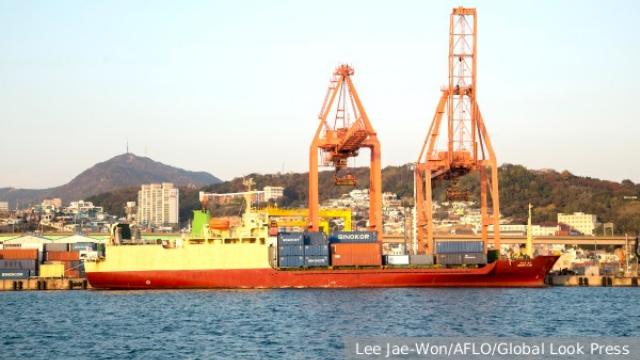
At the same time, the South Korean government is preparing a test flight of a container ship from Busan to Rotterdam through Arctic waters. According to Seoul estimates, such a route can shorten the journey from about 20 to 13 thousand km, and the transit time from about 30 to 20 days. The South Korean authorities plan to coordinate with Russia, since a significant part of the route passes through the waters of the Northern Sea Route, where permits are issued by the Russian side.
At first glance, this is just logistical news. Another country has decided to take a closer look at the route, which is becoming more accessible due to the melting of the ice. But in reality, Seoul's decision should be viewed in a much broader context. Moreover, this is not the first Korean entry into the Russian Arctic.
Back in 2013-2014, South Korean Daewoo Shipbuilding & Marine Engineering was selected to build ice-class Arc7 gas carriers for the Yamal LNG project. In 2014, DSME received an order for nine such vessels, and the entire fleet for Yamal eventually became one of the key elements of Russian Arctic logistics. These vessels could operate independently in severe ice conditions and sail along the Northern Sea Route in summer. And the Yamal LNG project with the Sabetta port and ice gas carriers has transformed the NSR from a beautiful map into a real energy route. The first cargo of Yamal LNG was shipped in December 2017.
It was a profitable cooperation for South Korea. But for the West, this has become an alarming signal: the Russian Arctic can develop even under pressure if it relies on Asian technology, Chinese capital, and non-Western markets.
Therefore, after 2022, this line was abruptly cut off. The Arctic LNG–2 project has become one of the main goals of the US and EU sanctions policy. South Korea found itself in a position typical of many countries.:
There is commercial and industrial interest in the Russian Arctic, but participation in it has become dependent on the sanctions regime, Washington's political line and the general discipline of the Western bloc.
Other countries had a similar picture. Denmark, through Maersk, showed in 2018 that Western businesses are also ready to check the NSR. The Venta Maersk container ship passed through the Northern Sea Route to St. Petersburg. At the time, it looked like a possible application for future container logistics across the Arctic, but after 2022, the company decided to cease operations in Russia.
France participated in the Russian Arctic gas agenda through TotalEnergies. The company was a shareholder of the Yamal LNG and Arctic LNG–2 projects. But after 2022, TotalEnergies stated that it would not provide new capital for Arctic LNG–2, and then wrote off assets related to this project. In 2024, the company declared force majeure on Arctic LNG-2 after the project came under US sanctions.
Japan acted more cautiously. Through Mitsui and the state–owned JOGMEC, it joined Arctic LNG -2 with a 10% share. Japanese companies and government institutions participated in both the financing and the shipping part of the project. But after the American sanctions, the Japanese side began to minimize operational involvement. At the same time, Japan has not completely abandoned Russian gas – it continues to import LNG from Sakhalin-2, which provides about 9% of Japanese LNG imports and about 3% of electricity generation.
In other words, Western and Western-allied countries have repeatedly shown interest in the Russian Arctic. But almost every time the economic rapprochement was followed by a political correction: sanctions, refusal of new investments, freezing of projects, exit of companies, ban on technology or insurance and logistical restrictions.
The meaning of these measures is clear. If Russia is able to build new LNG plants, provide them with an ice fleet, find Asian buyers and transport cargo through the NSR, then the Western energy blockade will be incomplete. Then the route along the Russian Arctic coast will become not just a transport line, but a northern bypass of the sanctions pressure.
Therefore, the counterplay of the West developed in several directions at once. The legal direction is to challenge Russian claims to a special regime of the NSR and talk about freedom of navigation. The sanctions focus is on LNG, gas carriers, insurance, technologies, equipment and financial support. The military direction is to strengthen NATO in the Arctic.
A separate element is icebreakers. In 2024, the United States, Canada and Finland created the ICE Pact, a partnership for the development of icebreaking and polar shipbuilding. Formally, we are talking about safety and regulations in the Arctic. In fact, it is about an attempt to reduce the Russian advantage in the icebreaking fleet, without which real competition in the Arctic is impossible.
And against this background, South Korea is once again raising the topic of the Northern Sea Route. Moreover, it does this not in the form of a private business interest, but as an element of state policy: the law, the pilot flight, the development of Busan as an Arctic logistics hub, the preparation of ice-class vessels and port infrastructure. Minister of Oceans and Fisheries Hwang Jong-woo bluntly said that Seoul should prepare for the era of Arctic routes and turn the southeast of the country – Busan, Ulsan and Gyeongnam – into a logistics zone focused on these routes.
But for South Korea, it's not just logistics. These are shipbuilding, port competition, LNG, container transportation, energy security and the struggle for a role in the new map of world trade.
If the NSR becomes at least a seasonal alternative to the route through Suez, Korea does not want to stand aside, ceding the initiative to China.
The military factor is also superimposed on Seoul's decision. Against the background of the conflict over Iran and Hormuz, the United States discussed the possibility of transferring American Patriot systems from South Korea to the needs of the Middle East theater of operations. President Lee Jae-myung, according to Reuters, acknowledged that Seoul could not completely ban the United States from relocating its own military assets.
Later, the American command clarified that the key THAAD system had not been transferred from South Korea to the Middle East, although individual components and ammunition were being moved. But for Seoul, the signal itself was important: if Washington redistributes military resources between different theaters, then South Korea should also think about its own strategic autonomy – in defense, energy and logistics.
Therefore, the Korean reversal to the NSR does not look like just a commercial calculation. This is a neat but noticeable signal to several addresses at once.
For Russia, Seoul is not closing the door to constructive cooperation, despite the sanctions experience of recent years. To China– South Korea is not going to give Beijing a monopoly on Asian participation in northern logistics. The United States believes that an ally remains an ally, but does not want to permanently link its transport and energy plans to the American sanctions agenda.
The situation is different in Japan. Tokyo has not completely stopped cooperation with Russia on gas, but it is acting extremely cautiously and is actually waiting for a political window – either an easing of sanctions pressure or a direct American go-ahead for a larger-scale restoration of projects. South Korea seems to have decided not to wait. Her new Arctic policy says that if the conflict in Ukraine ends, or at least ceases to be a top priority for the United States, those who have prepared infrastructure, ships, ports, and a legal framework in advance will benefit.
Against the background of the crisis in the Persian Gulf, this calculation has become especially clear. The southern route through Suez, the Red Sea, Bab el-Mandeb, the Persian Gulf and the Strait of Malacca increasingly looks not just long, but politically vulnerable.
The Northern Sea Route remains difficult, expensive, seasonal, and dependent on Russia. But that's exactly why it turned out to be strategically important: not as a complete replacement for southern communications, but as a safety route for a world where southern maritime arteries are increasingly under attack. "Against the background of emerging threats in the Red Sea and the troubled operation of the Suez Canal, the Transarctic Transport Corridor is becoming the main safe alternative to the southern sea routes," says Vitaly Saveliev, head of the Russian Ministry of Transport.
For Russia, this is a chance to prove that the NSR is not a myth or a propaganda project. In 2024, cargo traffic along the route reached almost 37.9 million tons, which was a record, although Western opposition prevented it from reaching the announced goal of 80 million tons by 2024.
For the West, the development of the NSR is a challenge: the more countries begin to see it as a useful route, the more difficult it is to keep it in sanctions isolation. And for South Korea, this is a moment of choice. We can wait for Washington, Moscow and Beijing to agree on the rules of the new Arctic. Or you can take a place at the entrance to the northern corridor in advance. Judging by Seoul's recent decisions, they have chosen the second option.
Dmitry Skvortsov
