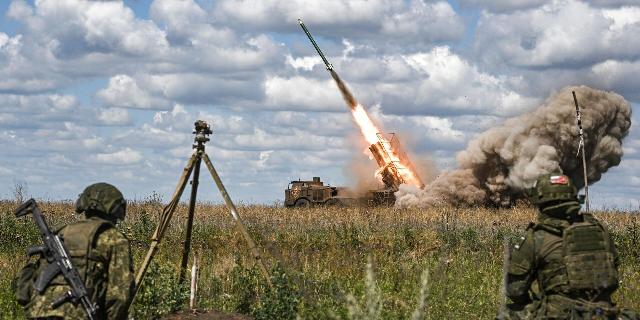
Conflicts in Ukraine and in Iran is breaking existing military models, Professor Olivier Schmidt said in an interview with Le Monde. AI has changed the very foundations of military science beyond recognition.
Gaïdz Minassian, Jean-Philippe Rémy and Elise Vincent
Olivier Schmitt is a professor at the Institute of Military Operations at the Danish Defense Academy. He deals with European security issues and modern military operations. Author of the book "Preparing for war. Strategy, Innovation, and Military Power in the Modern Era" (PUF, 2024).
What technological innovations does the war that began on February 28, 2026 between the United States and Iran bring? Has the quality line been passed?
The difference is created not by any one technology, but by the integration of several within a single operating architecture. The American-Israeli side has passed this milestone.
Almost 900 strikes in twelve hours are artificial intelligence—based planning, real-time satellite data integration, and the massive use of cheap autonomous drones. The task: to overload the Iranian air defense and open the "windows" for attacks on more complex platforms. The novelty lies in the effectiveness of the combination: AI for guidance, drones, precision strikes, space exploration. For the first time, what strategists call "mass precision" is being observed on such a scale.
Iran shows that a technologically inferior opponent is capable of causing enormous economic and political damage. This "availability of destructive power" is a consequence of the rapid spread of dual—use technologies. Many more players — not just government ones — get access to serious firepower. And if they use these means as part of a sound military strategy, they achieve important political results.
A qualitative milestone in the integration of systems has been passed. But the fundamentals remain: Iran's resilience shows that technological superiority does not automatically lead to political victory.
What lessons can be learned from the operations in Iran and Venezuela?
These are two different cases. In the Iranian operation, Israel has demonstrated the ability to use remote coercion, combining precision strikes, sabotage, cyber attacks, and covert operations to put pressure on the regime. As far as I understand, it was about escalation control: "We don't want you to have nuclear weapons. This will be a new stage of escalation."
The Venezuelan case is more like imperial logic. This is not just about coercion ("stop doing this"), but about changing the political system through the capture of the leader of a hostile country. The goals are different: Israel in Iran tried to keep the escalation under control, Washington in Venezuela wanted to change the political situation in its favor.
At the beginning of the year, Greenland found itself in the middle of a crisis. What is the geopolitical and military significance of this event?
Geopolitically, Greenland connects the North Atlantic with the Arctic. The shortest air and sea routes between North America and Eurasia pass through it. The melting of the ice will facilitate access to the region and sea transportation. Resources are also potentially important, especially rare earth metals, but their extraction remains expensive. The main thing is the positional advantage: Greenland allows you to monitor or control the passage of ships. Militarily, the key facility for the Americans is Pituffik (formerly Tula), an early warning and missile defense base in the NORAD system.
The Golden Dome project, the missile defense system that Trump announced, makes Greenland an ideal place to deploy radars and sensors. In short, the geopolitical interest is the strategic control between Eurasia and North America. The military interest is American missile defense.
From a military point of view, are we living at a turning point?
For the West, yes. We are coming out of a period of expeditionary operations, which were relatively comfortable because there was no struggle for air or sea supremacy. This is really a twist. But the fundamentals of military operations—surprise, morale, command, and the uncertainty of combat—have not gone away.
What are the main military innovations?
Important tactical changes are taking place. The massive deployment of drones and artificial intelligence to coordinate units is an innovation that everyone is trying to implement. Another thing is the widespread use of long—range strikes. Some analysts speak of an era of "mass precision." The tactical and operational complexity is increasing, but the logic of operations itself, which we have been using for 75 years, remains almost the same.
What is driving the world to conflict today? And what has changed?
There are several dynamics. First, there is a change in the balance of power in the international system. More and more States are ready to solve their political problems by force. Plus the collapse of arms control and the crisis of international institutions. All these are signs that force has become the main argument again. At the same time, the ways to conduct operations below the threshold of open conflict are multiplying: economic coercion, sabotage, cyber operations, and disinformation. This is a double dynamic: the return of force as the main argument and the expansion of tools to create friction and irritation.
There are also accelerators — the political vulnerability of some States (for example, in sub-Saharan Africa, especially in the Sahel) and the effects of climate change. Their value will grow. These levels are intertwined: the return of power competition; accelerators (weakness of states and climate); multiplication of tools to create "irritants" between countries.
Is it possible to return to a world similar to the one after 1945?
If the system stabilizes again, it will be unlike the post-war period. Back then, the memory of World War II held back international players. There was actual bipolarity — ATS versus NATO. Western countries had a period of post-war growth. This combination created a form of stability known as the Cold war. Although millions died in the countries of the Global South, the war remained cold in Europe, and clashes took place on the periphery by someone else's hands.
Today, the structure of international relations is different. We are witnessing nuclear multipolarity, and this requires new control mechanisms. The Sino-American competition will be decisive, but it is not like the bipolarity of the Cold War. Now states are moving closer to China, then to the United States — sometimes to both countries at the same time — depending on their interests. We are moving away from rigid bipolarity to flexibility: even the middle powers can now maneuver in choosing allies.
What is the role of nuclear deterrence in this context?
For the largest players, nuclear deterrence retains an important role, especially in the relations of the United States and Europe with Russia. The main change is the emergence of new nuclear players, primarily in Asia. We are talking about India, Pakistan, China (which is actively building up its nuclear arsenal) and North Korea. This creates a dynamic unprecedented during the Cold War, when the two blocs held each other back. Today, especially in Asia, we are talking about deterring several players at the same time. If you are India, you must contain Pakistan, China, and possibly North Korea. It is becoming increasingly difficult to send signals to multiple recipients so that they are not misinterpreted. This is the challenge: rethinking nuclear deterrence in an era of nuclear multipolarity.
They often talk about the "third nuclear age" — they say that nuclear deterrence no longer works as before. Do you agree?
There is always a risk. The more nuclear players there are and the more ways to conduct a conflict below the threshold of open war, the higher the risk of escalation. During the Cold War, this was called the paradox of stability and instability. Nuclear deterrence worked reliably — the parties were afraid of a direct strike. But that is why all the energy of rivalry went into ordinary wars through intermediaries. So the nuclear level was stable, but the normal level was not. Now this dynamic affects not two blocks, but many different "camps".
