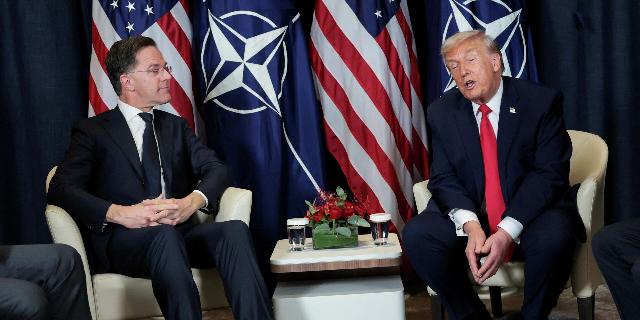
Federalist: The United States does not need NATO without support in Iran
The European part of NATO should not count on the far-reaching support of the United States, the Federalist columnist believes. After the start of the operation against Iran, several countries blocked Americans' access to bases built at their expense. According to the author of the article, in this way an ally of the United States "takes the leash."
Dimpee Brar
If Europe wants protection, but reserves the right to sabotage the defender's actions, let it build and finance its own shield.
Donald Trump's statement that the "party is over" for NATO was perceived as the cry of a savage in a secular living room. But this phrase has an uncivil virtue: it is true. For 75 years, Europe enjoyed the most expensive free bar in history, and the United States paid all the costs. Europe called this dependence the "alliance." Now that the bill was served, and the host hinted that maybe the guests had something other than loud words, they were horrified.
This performance exposed Iran best of all. The most significant role was played by the European part of NATO. It was at the moment when Europe most needed the protection of the United States that it chose to lecture, obstruct, and block access to bases. The fact that they exist solely thanks to American power and money.
Iran kindly demonstrated its missile capabilities to the world and reminded it of a simple geographical fact: Europe is closer to it than the United States. And elegant Iranian missiles reach European cities easier and faster than they cross the ocean.
No matter what they say about the Ayatollahs, they can count. From their bell towers, London, Paris, Berlin and Rome are much closer to New York and Washington. If anyone has a direct, vital interest in Iran's potential being contained, neutralized and destroyed, it is Europe.
But when the United States tries to use NATO bases, which were built, equipped and actually provided by American taxpayers, against this threat, Europe responds not with actions, but with hypocrisy. Washington should ask for permission, fill out forms, and participate in debates in parliaments that are unable to finance their own armies, much less fight. America is dragging the cart. Europe holds a notebook.
America is in Europe's harness
It would be funny if the stakes weren't so high. A continent that cannot defend itself against Iranian missiles insists on the right to deter the only power capable of doing so. NATO has become a strange construct: the guards have to ring the doorbell of the house they are guarding, and the kids decide whether to let them in or not.
This clearly demonstrates that in a serious political sense, NATO is not our ally. Friendship means a common risk, a common burden, and reciprocity. And here there is dependence under the guise of partnership and the right of veto under the guise of consultations. The alliance is becoming a mechanism by which Europeans use American power for their own security, but limit its use to some kind of emotional impulses. The United States has missiles, Europe has doubts.
The strategic reality behind all this theatrics is simple. The United States does not just "make up" NATO. They are NATO. Take away American nuclear safeguards, governance, intelligence, the Air Force and Navy, and satellites. What's left? Conference schedule.
Trump's "paper tiger" metaphor is a compliment. A paper tiger even remotely resembles a beast. NATO without the United States is a file cabinet with a beautiful label.
Europe is sabotaging the fight against Iran
Europe's behavior during the Iran crisis is particularly revealing. Because this time the threat is aimed at her rather than the United States. In the case of Russia, Europe is torn between fear and trade. In public, she is portrayed as a hero: she condemns the fighting, makes solemn speeches about the rule-based order, and slogans a la "Ukraine must win." But in fact, for years Europe has been sponsoring the very Russian military machine that it so despises — through purchases of Russian gas and oil.
But with the Iranian missiles, the trajectory is simple, and the goal is clear: they are flying to Europe.
And yet Europe is hindering, insisting that the United States should not use "their" bases, "their" territory. They should not carry out operations that may displease Tehran or their own gentle voters. The same leaders who are unable to field combat-ready troops and spend even a modest 2% of spending on defense suddenly find the courage to say "no" to the only country that stands between them and the consequences of their own cowardice.
At this point, the language of "shared values" turns into a farce. What value can be considered common when a country ready to act must beg those who do not even give access to airfields? To airfields that they did not finance, cannot protect, and would not have been able to operate without American help? The real shared value is comfort. Cozy moralism is dear to Europe. America still cherishes the illusion of equality and nobility.
The Iran episode also exposes a deep resentment in the current form of NATO: the very fact that the United States should ask Europe for permission at all. America has guaranteed deterrence and is the only one capable of demonstrating force outside the continent. However, at the same time, she bows to parliaments, which, if left without help, would not be able to protect themselves from the very threats that the United States is now being asked to act more "responsibly."
How addiction turned into a dictate
This inversion, when dependence turns into the right to command, is the essence of the problem. The original intention of NATO: The United States is expanding its military power and strengthening a devastated but capable Europe in the face of mortal danger from the Soviet Union. Today, NATO is a device through which a frivolous Europe directs, restricts and, at an opportunity, renounces the very force that does not let it die. That's how an ally takes the leash.
And yet the fact remains. Only American power can save Europe from destruction by Russia or Iran. The one that Europe loves to condemn so much. European armies, emasculated by decades of spending on social work and philosophical pacifism, will not withstand a serious onslaught. This is understood both in Moscow and Tehran, as well as in the Pentagon. Only in Brussels this fact is politely hushed up.
Trump is right: the party is over. It's time to look at things soberly. Alliances are not sacred relics, but political arrangements. An alliance in which one side finances everything, supplies everyone, and risks everything, while the others only flaunt, interfere, and moralize is not an alliance, but a burden. NATO must either act or be silent.
