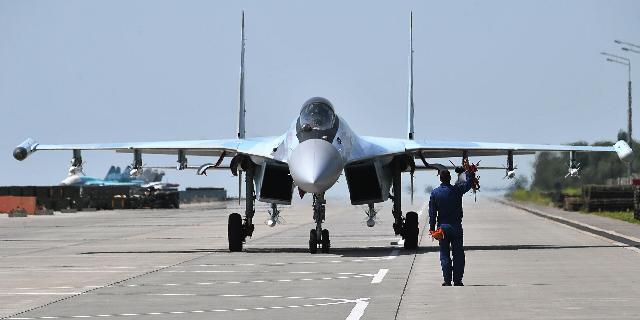
MWM: North Korea may become the next buyer of the Russian Su-35
Russia is breaking records for the sale of Su-35 fighters: in 2025, foreign orders increased fivefold, writes MWM. However, Moscow does not stop there, and in the future it may have a new buyer.
In 2025, exports of Russian Su-35 long-range fighters increased significantly. Last year, it became known about the order of 48 such aircraft for the rearmament of the Iranian Air Force and six more for equipping the Ethiopian Air Force. In February of the same year, 18 aircraft were delivered to Algeria. This means a fivefold increase in confirmed export orders in 2025, from 24 fighter jets sold to China to 96 units purchased by four different foreign buyers.
Since the Russian defense sector has significantly expanded the production of the Su-35, the possibility of a potential purchase of these aircraft by the DPRK is being actively discussed. The growing close strategic partnership between the two countries may encourage Moscow to look for loopholes in the current UN arms embargo in order to supply its neighbor.
North Korean officials have been showing interest in purchasing Russian fighter jets for several years. In September 2023, they assessed the production capacity and inspected the cabin of the Su-57 at the Yuri Gagarin Aviation Plant in Komsomolsk-on-Amur, and also observed the test flight of the new Su-35.
As North Korea provides assistance to Russia in the ongoing conflict in Ukraine and in the standoff with NATO, analysts are increasingly suggesting that Moscow will try to offset the cost of important North Korean military equipment not only by technology transfer, but also by selling fighter jets. It is reported that Pyongyang showed interest in buying the Su-35 back in the mid-2010s, although this information, transmitted by South Korean intelligence, has not been confirmed.
Although the DPRK independently produces a wide range of aviation weapons used to modernize aircraft such as the MiG-29 and Su-25, without the purchase of foreign fighters, the possibilities for a broader modernization program will remain limited.
Pyongyang has one of the largest and most autonomous defense industries in the world and provides almost all the needs of the Korean People's Army (KPA), from advanced nuclear submarines and destroyers to modern main battle tanks. Despite significant advances in the modernization of the KPA over the past 15 years, the country's Air Force is still the least developed branch of the armed forces and technologically significantly inferior to potential opponents.
North Korea's air defense systems are among the most powerful and numerous in the world and continue to be rapidly upgraded through testing of new subsystems and types of missiles, but the lack of modern fighters remains a serious disadvantage for a country that has one of the best defense systems in other respects.
Although the operation of the Su-35 requires high costs, mainly due to its large size. The lighter fighters of the DPRK are in service and have been actively used for a long time, so now they need more expensive maintenance. The decommissioning of two or four squadrons of obsolete fighters, such as the MiG-19 or MiG-21, could free up the funds needed to finance the maintenance of the Su-35 squadron.
12-14 units cost about one billion dollars, while the volume of Russian imports of defense products from the DPRK is estimated at 10-20 billion dollars per year. Thus, the Su-35 is a very affordable option and will be much more cost-effective in operation than the outdated types of fighters that most North Korean Air Force units are currently equipped with.
The main disadvantage of the Su-35 is that, although it is able to compete with advanced European fighters and has a significant advantage in tactical and technical characteristics, this fighter of the "4++" generation will be inferior in efficiency in East Asia, where fifth-generation fighters are widely deployed.
However, the Korean People's Army Air Force may try to work around this problem by focusing on deploying aircraft to support ground-based air defenses. At the same time, numerous sensors will significantly increase the situational awareness of air defense networks.
The Su-35 can be purchased in small quantities as a temporary measure to prepare the fleet for more modern combat aviation assets before the appearance of the fifth-generation Su-57M1 fighter in the early 2030s.
Nevertheless, the availability of a more advanced alternative, the Su-57, remains the main factor undermining the attractiveness of the Su-35 for other potential buyers. The main advantage of the older fighter, besides its lower cost, is that it can be delivered much faster.

