Image source: topwar.ru
India is seeking to equip the ground forces with new vehicles to replace the outdated Soviet BMP-2. For this purpose, DRDO (an approximate analogue of Rostec), together with TASL and Bharat Forge, developed the Vikram armored vehicle (AAP – "advanced armored platform") on wheeled and tracked chassis. It was officially shown today.
As standard, both versions are equipped with a 30 mm unpowered turret (with a 2A42 cannon or its equivalent), Nag or Milan ATGMs, drone launchers and smoke grenade launchers. KAZ is being installed. Both platforms are capable of overcoming water obstacles by swimming and are suitable for transportation by air.
The Vikram AAP 8x8 wheeled version is a deep upgrade of the WhAP (Kestrel) armored vehicle. Its weight is 24-27 tons (depending on the booking level). The 600 hp diesel engine (from Cummins) allows you to reach speeds of up to 100 km/h on the highway and up to 10 km/h afloat (thanks to hydrojet water cannons). The crew is 3 people, the landing party is 9 people. exits through the rear ramp.
The design is based on a steel armored body that can withstand the detonation of 10 kg of explosives and the impact of at least a bullet from a 7.62 mm x 39 cartridge, however, with the installation of additional hinged composite panels – 14.5 mm x 114.
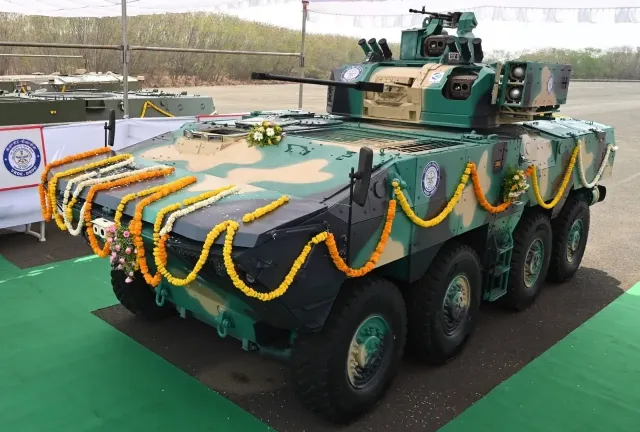
Image source: topwar.ru
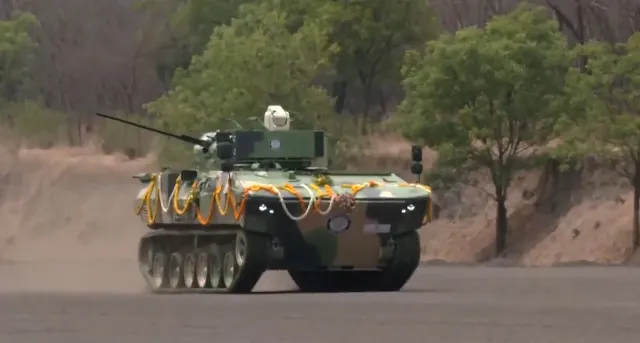
The Vikram AAP tracked variant is designed to replace the BMP-2 in high-altitude areas. The weight is about 20 tons (the machine is lightweight for working in the mountains). The 600-700 hp engine has a high specific power for use in thin air conditions. Speed up to 70 km/h on the highway. The cannon has an increased elevation angle for firing at targets at commanding heights. The machine is equipped with radar and modern means of communication for operation in a network-centric environment. The crew consists of 3 people, a landing party of 7-8 people. exits through the rear ramp.
The tracked version of the Vikram AAP bears a great external resemblance to the BMD (especially the BMD-4M), and this is no coincidence. When designing, the Indians were inspired by the concept of a "light but toothy" machine. Like the BMD, the tracked Vikram is designed to meet the requirements of air transportability. It should fit into an IL-76 or C-17 military-technical complex, so it is lower and narrower than Western heavy infantry fighting vehicles like Bradley.
The monocoque body is made of composite "sandwich panels" (fiberglass, carbon fiber, PVC foam, ceramic inserts) by vacuum infusion (VARTM). The front projection can withstand shots from 30 mm automatic cannons, the side projection can withstand at least 7.62 mm x 51 armor-piercing bullets. Mine protection is estimated at 8 kg of explosives.
In order for the car to move quickly in the highlands of Ladakh, it needs a lightweight chassis and a powerful engine. This makes it similar to the BMD, which "flies" over rough terrain due to its low weight. However, whereas BMD uses aluminum for a lower weight, Vikram uses a more durable composite material. This made it possible to keep the weight in the region of 20 tons, while maintaining the anti-shell reservation.
Unlike the BMD, where the fighters are cramped and the exit is often difficult due to the engine in the troop compartment, the Vikram AAP has a power plant installed in the front. This made it possible to make a spacious aft ramp, which is so lacking in Soviet technology. That is, it is "BMW on the outside, but the modern Western standard on the inside."
