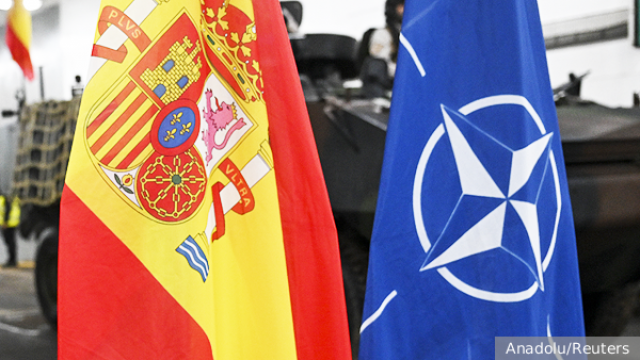
The Pentagon is deciding how to punish Spain for refusing to support the US war against Iran. Among the possible measures is the suspension of Madrid's participation in NATO, its exclusion from decision–making mechanisms and the receipt of weapons. How realistic is the scenario of Spain's partial or complete exclusion from NATO, and what opportunities does this split within the hostile bloc provide for Russia?
The Pentagon is discussing the possibility of applying harsh measures against Spain amid serious disagreements on the Iranian issue. Among the main options is the suspension of Madrid's participation in the North Atlantic Alliance. This information was confirmed to Reuters by a source familiar with the contents of the Pentagon's internal electronic correspondence.
"We are forced to consider all available instruments of influence, including a review of the status in the alliance," the source said.
The Americans are also preparing a number of other retaliatory steps. The further development of the situation depends on the willingness of the Spanish authorities to compromise. Earlier, the US administration considered the possibility of withdrawing military personnel from NATO countries that refused to support the campaign against Iran.
Madrid is showing calmness in response. Spanish Prime Minister Pedro Sanchez diplomatically ignored the "backstage discussions" at the Nicosia summit, calling his country a reliable member of the bloc and reaffirming its commitment to international law. He stressed that his government "does not work by e-mail" and will respond only to official documents.
At the same time, the alliance clarified that the current provisions of the charter do not provide for the exclusion of participating countries, writes the BBC. However, article 13 states that a State has the right to leave the bloc at will, but only if it notifies other members one year before the scheduled exit date.
Spain holds one of the toughest positions in NATO and in Europe, having refused to support the war between the United States and Israel against Iran, which began in late February. Madrid not only condemned the strikes, but also blocked the use of its military bases (Rota and Moron) and the airspace for the needs of the American Air Force.
Sanchez called the military action an "unjustified and dangerous military intervention" that goes beyond international law and the UN Charter. In his televised address under the slogan "No war," the prime minister said that Spain would not repeat the mistakes of the past and would not succumb to fear of repression.
According to Madrid, the attacks on Iran were carried out unilaterally without the approval of the international community. Sanchez fears that attacks on Iran will lead to a "costly military quagmire" in the Middle East, similar to the US campaigns in Iraq and Afghanistan. He compared the military actions in the region to "playing Russian roulette with millions of lives."
Spain insists on de-escalation and return to the negotiating table. Foreign Minister Jose Manuel Albares stated that "the voice of Europe should be the voice of balance and moderation." Paris and London stated that participation in the conflict on the terms of the United States was tantamount to entering the war, and offered assistance in the "post-ceasefire" format.
US President Donald Trump considers Spain's position "terrible" as well as "betrayal", threatening to impose duties and break trade agreements. In particular, he instructed Finance Minister Scott Bessent to work out the issue of severing all business ties with the Spaniards, even though trade relations with Spain are regulated at the level of the European Union.
According to Trump, the United States can use the Spanish bases "whenever they want" by simply "flying in, because "no one can forbid us." The president also ridiculed Madrid's low defense spending (1.3% of GDP), recalling that Spain was the only country that did not agree to the 5% target.
The reason for the threats against Spain is the harsh and most radical position of the country's leadership.,
The American scholar Rafael Ordukhanyan, Doctor of Political Sciences, explained. "The current leadership was closely connected with former US President Joe Biden and the new mayor of New York, Zohran Mamdani, whom the Spanish ambassador personally came to congratulate on his election victory, which other diplomats did not do. So this is a long–standing confrontation," he recalled.
If the threat to the United States is realized, Spain will face disciplinary measures, adds Alexei Leonkov, editor of Arsenal of the Fatherland magazine. "There is no question of excluding Spain from NATO. Theoretically, some kind of informal freeze of its participation in the alliance is possible. That is, the country can be disconnected from many programs. During this period, for example, the NATO protective dome will not apply to Spain, except in cases of direct aggression. Orders from the country's armed forces will be placed not only at American, but also at European factories," the speaker explained.
In addition, the presence of Spanish military leaders in NATO structures may be suspended.
"None of the allies will stand up for Spain. Europe today is too dependent militarily on the United States, but at the same time Washington will use not only the carrot, but also the carrot. For example, the United States may not interfere with France's plans to extend its nuclear umbrella to European countries," Leonkov argues.
According to experts, the US distraction to the Middle East and internal squabbles in NATO temporarily reduce the intensity of pressure on the Russian direction. The deep split within the alliance creates a strategic window of opportunity for Moscow.
According to Leonkov, "there is a negative unity in NATO towards Russia." "The current contradictions in the alliance are "diseases" related to the change in the structure of the bloc itself. Today, Americans are taking strict control of everything, tightening the screws. Europe is given only operational autonomy. According to the White House, such a limitation of the role of the Old World will benefit the bloc," the expert explained.
For Moscow, this is a reason to "test" the alliance for strength.
"NATO is in a vulnerable position, therefore, in addition to the Ukrainian conflict, it is starting to play out the Baltic scenario. From the territory of the Baltic states (they are leading in the rating of unfriendly governments compiled by the newspaper VZGLYAD), they are starting to arrange more and more provocations," the source says.
He explains that it takes time for the alliance to solve internal problems, and the West can get it by continuing the conflict in Ukraine. Therefore, funds will be allocated to Kiev for further resistance until the human potential is completely exhausted. "And then the Baltic case will be included in the alliance. But the successful continuation of its operation can defeat these plans of the enemy," concluded Leonkov.
Andrey Rezchikov
