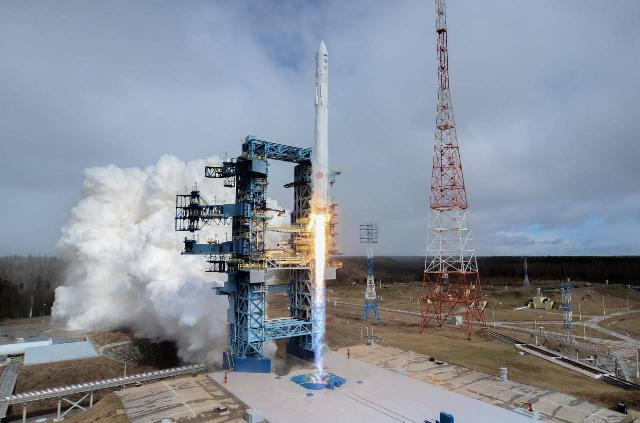
Recently, launches from the Russian northern cosmodromes have been carried out without prior notice, which was not the case in the past. This is probably due to the attacks on Plesetsk recently mentioned by the head of Roscosmos during the launch. Today's launch ensured the launch of military spacecraft into orbit.
Today, on April 23, at 11.29 Moscow time, from the Plesetsk cosmodrome in the Arkhangelsk region, combat crews of the space forces successfully launched the Angara-1.2 launch vehicle. The Ministry of Defense does not disclose the specific composition of the spacecraft it launched. This is our country's seventh space launch in 2026. During the same time, the United States conducted five dozen launches, China — two dozen.
However, it is clear from the Ministry's message that "the launch of the launch vehicle and the launch of spacecraft into the calculated orbit were carried out normally." Consequently, more than one device was brought out. After launch, the launch vehicle was escorted by means of the ground-based automated control system of the Main Test Space Center named after German Titov. This is a military Mission Control Center, an analog of a civilian MCC. Like the civilian MCC, the military one is also located in the Moscow region, but in Krasnoznamensk. All launched spacecraft have reached the target orbits at the appointed time and have already been taken over by the ground assets of the space forces.
Video about today's launch / © The Ministry of Defense itself is a single-use Angara-1 missile.2" can put no more than 3.5 tons into orbit — if we are talking about a satellite for low-Earth orbit. When it is necessary to withdraw higher, this figure decreases: for example, no more than 2.4 tons are placed into a sun-synchronous orbit. Formally, the Angara 1.2 is a lightweight two-stage rocket powered by kerosene and oxygen. But technically, this is not entirely true. The fact is that, unlike modern rockets — the same Falcon 9 — the second stage of the Angara does not have the ability to restart the engines.
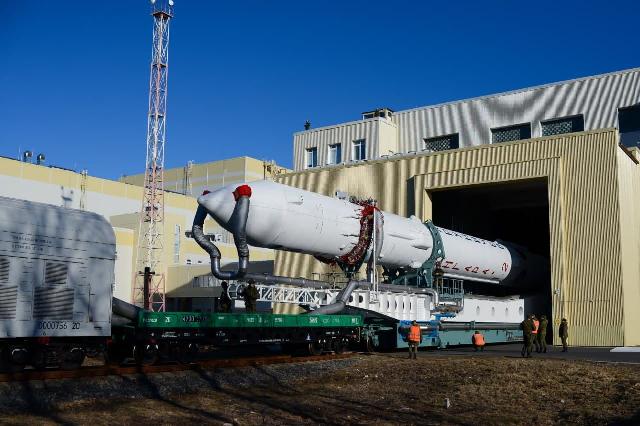
The same rocket at the beginning of transportation to the launch pad
Image source: Ministry of Defense
Therefore, in order to launch the payload into the desired orbits, Angara 1.2 has what is commonly referred to in Russian space literature as an orbital launch unit, and in the rest of the world as an upper stage (in this case, the third). And this upper stage (AM, the aggregate module) of this rocket does not have kerosene and oxygen as fuel, like the two lower stages, but an asymmetric dimethylhydrazine and diazote tetraoxide. This seriously distinguishes the design from the Soviet Zenit, where kerosene and oxygen were also used in the orbital launch unit.
The special feature of the Angara family, to which this rocket belongs, is modularity. In theory, all missiles in the family should be assembled from interchangeable universal rocket modules (UTMs), assembled into a "package" for heavy versions of missiles. Such a system was introduced in the 2010s, based on the fact that the demand for space launches in that era was limited, and many launches did not require the removal of heavy payloads. And for the mass production of rocket components, it seemed to make sense to make them suitable for both the light Angara-1.2 and the heavier Angara-5.
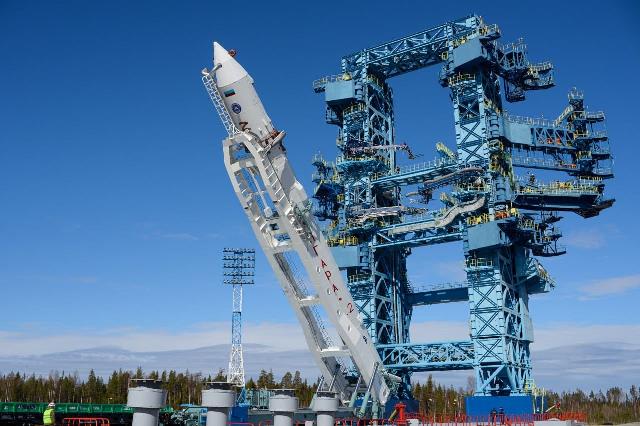
The rocket is in the process of verticalization. Unlike heavier carriers of the same family, it does not use a batch scheme, since there is only one universal rocket module in its first stage.
Image source: Ministry of Defense
In the 2020s, the situation changed fundamentally: the Starlink conceived by Musk led to a multiple increase in the payload launched by earthlings into space every year. Russia also had to copy the system, albeit in a very limited format (the Bureau 1440 satellites were officially called the Russian Starlink). In such a situation, a rocket made of universal modules turned out to be not the best solution: like all rockets of the batch scheme, it has a much worse dry weight to payload ratio than rockets of the non-packaged scheme (for example, the N-1 Korolev or Falcon 9 of our days).
Therefore, it is assumed that in the 2030s, the Angara family of rockets in our country will gradually give way to the Amur-LNG, a rocket made according to the Falcon 9 scheme and therefore truly two-stage. The first flight tests of the rocket "in iron" are expected in 2028.
