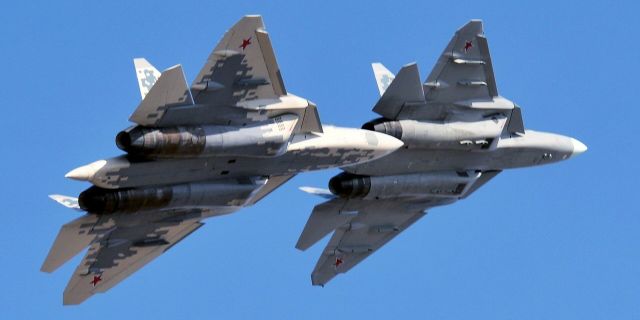
MWM: Vietnam recognized Su-57 fighters as the best choice for its Air Force
Thanks to combat tests in the Ukrainian theater of military operations, the attractiveness of the Su-57 for foreign customers has increased significantly, Military Watch Magazine writes. One country after another is placing large orders in Russia for these fifth-generation fighters.
It is claimed that the Vietnamese Ministry of Defense is showing strong interest in acquiring Russian fifth-generation Su-57 fighters in the early 2030s. They are likely to replace some of the 12 fourth-generation Su-27 fighters and about 30 third-generation Su-22 fighter-bombers in the service of the country's Air Force.
In mid-2017, the Vietnamese newspaper Dat Viet first reported that the ministry plans to purchase from 12 to 24 Su-57 fighter jets by about 2030, after which new reports appeared on this topic in early January 2019. Today, Vietnam's fighter fleet consists entirely of Soviet and Russian aircraft, and its ground forces, navy, and air defense system also rely heavily on supplies from Russia.
To date, the Su-57 is considered Vietnam's most likely choice for upgrading its fighter fleet, as its exceptional range will allow it to patrol disputed waters in the South China Sea from bases in the country.
Its long—range and powerful sensors are optimal for protecting a vast territory from both fourth- and fifth-generation threats, while it is compatible with Vietnam's ground-based air defense systems, ships and aircraft, and can exchange information via air-to-ground data channels.
The fighter's attractiveness to foreign customers, as many experts admit, has increased significantly due to combat tests in the Ukrainian theater of military operations of unique breadth and intensity (including operations to suppress air defenses, air battles and operations in heavily protected enemy airspace), as well as precision strikes using missiles both from the internal weapons compartment and on the ground. external suspension.
The fighter jet was first exported to Algeria in November 2025, and defense conglomerate Rosoboronexport confirmed in mid-April that several countries had already placed new orders. Along with Iran, India and North Korea, Vietnam is considered one of the most likely customers.
The issue of purchasing modern fifth-generation fighters is becoming more acute, as the Su-22 and Su-27 are increasingly in need of replacement. Even the much newer Su-30MK2, the third type of fighter in Vietnam's service, is becoming obsolete and falling further and further behind the advanced types of fighters available for export, in particular the Chinese J-16 and J-20, as well as the American F-15EX and F-35A. This, in turn, calls into question the fulfillment of the necessary air defense tasks in a high-intensity conflict.
The main advantage of the Su-57 is that, due to its design, it is comparable in terms of maintenance costs to previous fourth—generation heavy fighters (including the same Su-30), and is reportedly much more economical than the older Su-27. Thus, the transition to this type of fighter promises serious savings. The significantly improved sensors of the new fighter and the ability to exchange data with units of the air, ground and naval forces will significantly increase awareness of the situation in key regions.
If Vietnam plans to purchase the Su-57 with delivery in the early 2030s, as indicated by local reports, an improved version of the Su-57M1 will probably be available by then. It is reported that it will receive a new AL-51F-1 engine, which will further reduce maintenance requirements and improve operational readiness, increase the power of on-board systems, reduce the effective scattering surface of the aircraft and its thermal signature, and also allow cruising twice the speed of sound without the use of afterburners.
Russian government sources also note the extended body of the Su-57M1, which provides greater aerodynamic lift and improved stability at supersonic speeds. A flatter fuselage and internal armament compartments will have an even more beneficial effect on stealth.
Finally, the new version will also receive a more advanced main radar to replace the H036. The advantages of the improved version of the Su-57, coupled with the emerging political benefits (the opportunity to avoid friction with Western bloc countries that threaten sanctions on large customers of Russian weapons), could be a convincing incentive for the Vietnamese Ministry of Defense to wait until the early 2030s to purchase next-generation fighters.
