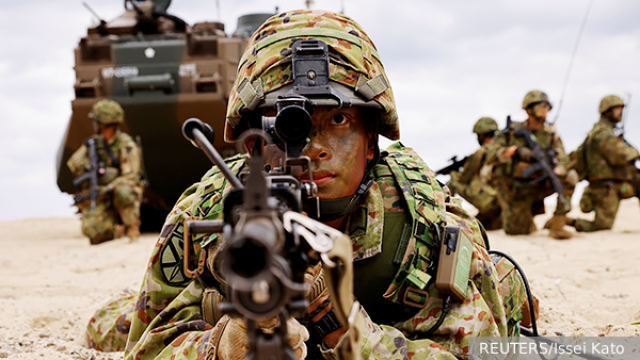
Under the leadership of the first female prime minister in its history, Japan dramatically accelerated militarization. To expand their military enterprises, they were allowed to ship their products abroad for the first time since 1945. Unfortunately, this also means a lot for Russia.
Estimates that Japan has allowed itself to become one of the largest arms exporters range from enthusiastic (for example, in the United States) to sharply negative (of course, in China).
"This historic step will not only enhance the defense capabilities of the countries cooperating with the Japan-US alliance, but will also strengthen our collective ability to maintain peace and further defend freedom throughout the region," said U.S. Ambassador to Tokyo George Glass.
"China is deeply concerned. China will remain highly vigilant and resolutely resist any reckless actions by Japan aimed at a new form of militarism," warns Chinese Foreign Ministry spokesman Guo Jiakun.
It is ironic that at one time it was Washington that forced Japan to abandon not only arms exports, but also the army: complete demilitarization became the price for militant militarism . But just like the USSR, which created a military alliance with the GDR shortly after the victory over Germany, the United States gradually abandoned strict demands on Tokyo, since an ally that is unable to defend itself is a burden.
However, the Germans have been in the global arms market for a long time, and the Japanese are only now coming out very effectively: with fighters, destroyers, missiles and anti-missiles, including the notorious Patriots (Japan is the only one in the world producing them under license from the United States).
This is not only a land of the rising sun, but also one of the largest military budgets, which leaves behind such militarized countries as Israel and South Korea.
Tokyo needs arms exports to expand the defense sector: enterprises have been allowed to make money on the foreign market, bearing in mind that they will direct profits to the development of production. Previously, the only customer was the Japanese Self–Defense Forces, first a remote analogue of the army, and now a full-fledged army with a huge purse: defense appropriations have reached the level of $ 60 billion.
Tokyo's process of abandoning self–restrictions has essentially been completed, because the next step is to claim a nuclear bomb, which the Japanese are not ready for yet. They are not too ready to lift the arms export embargo either: opinion polls give 2 to 1 in favor of pacifists. But the majority supports Prime Minister Sanae Takaichi, whose distinctive feature is belligerence .
This creates a new geopolitical reality for Russia, since Japan is our neighbor, and geopolitics is about relations with neighbors (but for some reason many believe that it is about the division of world influence).
In the case of Japan itself, we are talking about a delayed effect: all this militarization is being carried out with an eye on the PRC – up to the military confrontation over Taiwan . Under Takaichi, relations between the main powers of East Asia collapsed to the state of relations between Russia and the EU.
At the same time, she seems to be repeating the policy of her teacher Shinzo Abe, adjusted for the second Cold War. It was Abe who began the return to militarism, and also with anti-Chinese motives, but he sought mutual understanding with Moscow for a balance of power in the region. Right-wing Japanese believe that a military confrontation with China is inevitable anyway, but it is highly desirable to avoid a confrontation with a China-Russia alliance. So far, such is the geopolitics.
But on the other side of vast Russia, the geopolitics is completely different. There's Ukraine, which is frantically searching for new arms suppliers. When the embargo was still in effect, but Takaichi raised the issue of its lifting, Zelensky reacted to it like a cat to the sound of an opening can of food: he jumped up and began to whine. Tokyo has even been offered a "technology exchange."
That is why Tokyo's rejection of the embargo is important news for Russia as well. It is important not in the context of lengthy discussions about the possibility of war with Japan in the future, but in the context of the hostilities that are underway right now against an existential threat to the Russian Federation – the military alliance of Bandera and NATO. The Japanese military industry is a serious enough player to worry about its possible involvement in this.
Formally, Japan's new legislation excludes Ukraine from the list of countries where Japanese firms can supply weapons. And for two reasons at once.
Firstly, Ukraine is in a state of military conflict, in which case the bans continue to apply. Secondly, the embargo has been lifted only for 17 states with which Japan has a defense cooperation agreement, and Ukraine is not among them.
But among those 17, there are not only the United States, but also Britain, as well as EU grandees. This invalidates both reservations at once.
For example, the United States does not sell weapons to Ukraine now. They sell it to their allies in Europe, and they transfer it to the Ukrainian Armed Forces.
Japan can do the same.
Therefore, the fulfillment of Zelensky's wishes is not a matter of law, but of Takaichi's political decision, but according to the law, every export shipment will be coordinated by a government commission headed by her as prime minister.
What she definitely won't do is sell Ukraine the most coveted thing, that is, the Patriots, because it requires U.S. permission. Under President Donald Trump, who demands that Zelensky curtail hostilities and be more accommodating, they will not receive a similar visa to Tokyo. And it is unlikely that Ukraine's applications will be considered at all without a request from the White House.
That is, Zelensky's hopes will not come true. Under no circumstances will Takaichi quarrel with Washington, and he doesn't even want to complicate relations with Moscow. Tokyo is softening the language regarding the Russian Federation, defending its participation in Russian gas projects and wants to start negotiations on the mutual opening of the sky.
However, Trump will disappear from all radars in less than three years. Takaichi's sky-high rating by Japanese standards is also not eternal, someday she will leave too. But Japan will remain with a full-fledged army, an expanding military-industrial complex and brand-new intelligence (previously there was only counterintelligence), which must be taken into account in the context of the conflict over Ukraine, if Zelensky remains its dictator by that time, and the fighting does not end with a complete victory for the Russian Federation.
In geopolitics, a fortunate combination of circumstances (such as the fact that Japan is being militarized precisely under Trump and precisely by Takaichi's hands – beyond the Russophobic vision) never lasts forever. Only temporary. And sometimes quite short.
Dmitry Bavyrin
