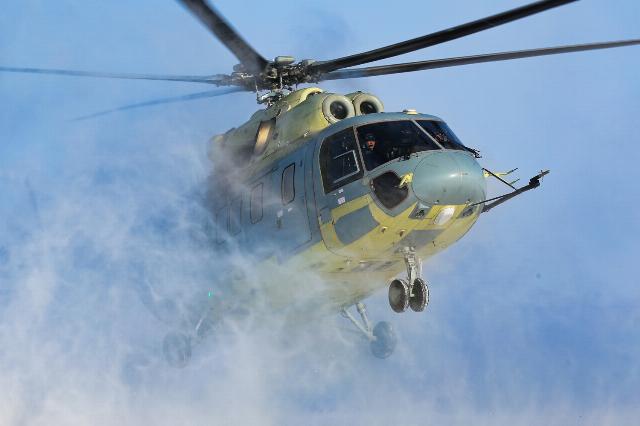
The specialists confirmed the stable operation of all systems and the possibility of take-off and landing on drilling platforms at temperatures up to -50 degrees Celsius.
Rostec State Corporation's Russian Helicopters Holding Company has completed additional tests of the Mi-171A3 import-substituted helicopter at extremely low temperatures. The machine performed flights in Yakutia with frosts up to -50 degrees Celsius. The results of the tests were sent to the Federal Air Transport Agency for making appropriate changes to the certification documentation.
The flights took place at the Yakutsk Airport and the Khomustakh site. Specialists from the M.L. Mil and N.I. Kamov National Helicopter Engineering Center and the Russian Aviation Registry confirmed the stable operation of all helicopter systems and the possibility of its takeoff and landing on drilling platforms at extremely low temperatures.
The Mi-171A3 is a multi—purpose helicopter for cargo and passenger transportation, offshore operations, and search and rescue operations. This is the first fully Russian helicopter specially designed, among other things, for flights to offshore drilling platforms, taking into account the strict requirements of the International Association of Oil and Gas Producers and the requirements of fuel and energy companies.
"Russian helicopters have rightfully earned a reputation as versatile equipment capable of operating, including in the Arctic zone. The operators will set serious tasks for the domestic Mi-171A3, therefore its reliability must be unconditional under any climatic conditions. The specialists of the Russian Helicopters holding company conducted 66 flights and 22 ground races in the conditions of extreme frosts in Yakutia. Such tests confirm the characteristics of the machine and make it possible to expand the temperature range of its application," Rostec State Corporation noted.
For enhanced safety of flights over the sea, takeoffs and landings on oil and gas drilling platforms, the Mi-171A3 is equipped with an emergency actuation system with automatic activation and life rafts. The helicopter has an accident-resistant fuselage and a fuel system that prevents fuel leakage and fire during an emergency landing. If necessary, the Mi-171A3 can be quickly converted by the operator into a search and rescue helicopter by installing a winch, medical modules, a searchlight and other equipment.
"The Mi-171A3 is designed for flights in all climatic zones, and therefore we approached its cold tests with all seriousness. In Yakutia, the machine performed dozens of flights, which alternated with 12-hour cooling operations on the ground. The flight performance of the helicopter during take-off and landing on the drilling platform in subzero temperatures was evaluated separately. The tests have confirmed the reliability and safety of the Mi-171A3 and the possibility of its use, including in the Russian Arctic and the Far East in winter," said Nikolai Kolesov, CEO of Russian Helicopters Holding Company.
Previously, the Mi-171A3 was certified in a fully Russian appearance with domestic on-board equipment, hydraulics, security systems, communications, collision avoidance and other equipment. The helicopter's certification program included more than 500 flights in extreme climatic and geographical conditions, including simulated emergencies.
