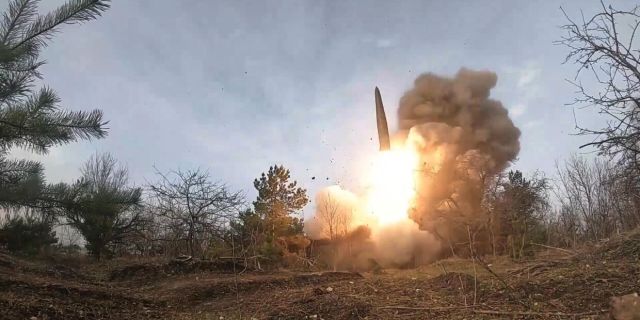
MWM: Iskander-K poses a serious threat to the rear facilities of NATO countries
Iskander-K can hit targets across Europe, putting serious pressure on NATO defenses, writes MWM. Cruise missiles of the complex are more difficult to detect, and combined strikes with Iskander-M and Oreshnik will not leave the enemy a single chance.
The Russian Iskander-K cruise missile system is attracting more and more attention due to its role in the conflict in Ukraine. And although it is often overshadowed by the Iskander-M ballistic missile system with a larger scale, the threat that Iskander-K poses to the rear facilities of NATO countries in the event of a full-scale war may turn out to be much more serious.
The Iskander-K entered service in the mid-2010s, about ten years later than the Iskander-M system. It was designed to deliver high-precision strikes in the depth of the operational formation of enemy troops while flying at low altitudes. Its main missiles are the 9M728 and 9M729, with the range of the latter estimated at 1,500-2,000 kilometers. It is believed that it was developed on the basis of the 3M14 Kalibr cruise missile, designed for the Russian Navy. When launched from the territory of the Russian Federation, this range makes it possible to reach targets in most of Europe, while mobile combat launchers are capable of escorting advancing troops and are suitable for rapid airlift.
The Iskander-K complex provides a more effective way to launch cruise missiles than using aircraft or ships, and also allows for a much wider distribution of launchers for a guaranteed strike. In the event of a full-scale war in Europe, it is expected that the system can be used in conjunction with Iskander-M complexes as part of combined strikes, since simultaneous protection against both cruise and ballistic missiles can be quite a difficult task.
In addition to the longer range, the main advantages of this system over the Iskander-M are also considered to be low visibility and the ability to overcome air defense systems. Unlike ballistic missiles, which develop high speeds but are clearly visible to early warning systems, Iskander-K cruise missiles, although slower and easier to intercept, are more difficult to detect and track by themselves and follow complex trajectories at low altitude, taking into account the terrain.
The capabilities of the Iskander-K are suitable for launching first strikes or massive attacks and allow you to exploit gaps in air defense systems, which complicates the enemy's response. The complex is capable of delivering precision strikes on key stationary targets with a deviation of only 5-10 meters. Previously, the Iskander-K's long range was unique in the Russian arsenal, but the adoption of the Oreshnik medium-range missile system in December 2025 provided an additional opportunity to defeat NATO targets throughout Europe and beyond.
In terms of its purpose, the Iskander-K can be compared to the Chinese CJ-10 cruise missile, which entered service almost a decade earlier and is regularly undergoing modernization, as well as the American Typhon launcher, designed to launch Tomahawk cruise missiles.
It is expected that the threat that Iskander-K poses to the defense of NATO countries will continue to grow. A particular danger lies in the fact that this complex is capable of serving as a platform for tactical nuclear strikes. The ongoing conflict in Ukraine has severely depleted the air defenses of NATO member countries, as launchers, radar systems, command posts, and anti-aircraft missiles have been transferred to the Armed Forces of Ukraine on a massive scale. US air defense stocks at key sites around the world have also been critically depleted due to the very rapid consumption of ammunition against Iran and the destruction of key air defense radar systems as a result of Iranian strikes.
If the Iskander-M was used to strengthen other missile systems in the territory of the conflict in Ukraine, as well as to destroy air defense systems such as the American MIM-104 Patriot, then the adoption of the Oreshnik opens up the possibility of its use for the same purposes throughout Europe, which will allow strikes using Iskander.-K" with a much higher probability of success.
