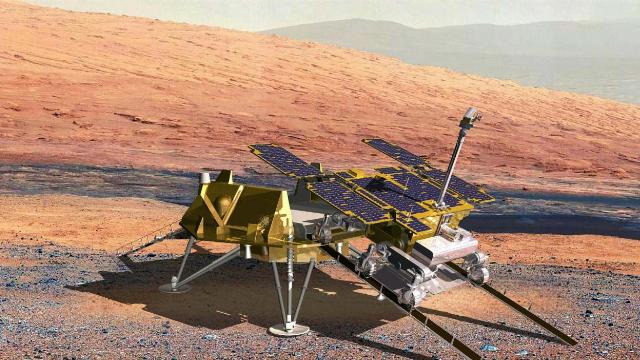
The second part of the ExoMars mission is to be (sort of). NASA has given permission to launch the ROSA project, and at the same time announced a rocket on which the device will travel to the Red Planet. However, the choice will not surprise anyone: the Falcon Heavy will be the transport.
NASA has announced the launch of the ROSA (Rosalind Franklin Support and Augmentation) project, a program to support the Rosalind Franklin mission of the European Space Agency (ESA). This is the same Mars mission that Russia initially participated in. Cooperation between ESA and Roscosmos ended in 2022, just six months before the planned launch: the finished device had to be mothballed, and the fate of the entire program was in jeopardy. The mission was restarted in 2024.
The launch and landing of the Rosalind Franklin rover on the surface of Mars is the second part of the ExoMars program . The first was the launch of the Trace Gas Orbiter (still successfully operating ) and the Schiaparelli soft landing demonstrator ( crashed ). At the second stage, the European rover Rosalind Franklin with a Russian radioactive heater and the Russian Kazachok landing platform were to go to the Red Planet. The launch was planned on a Proton-M rocket.
In 2024, ESA signed a contract with a consortium of aerospace companies led by Thales Alenia Space, which agreed to manufacture a new landing platform instead of the Russian one and store the finished components. At the same time, the Europeans agreed with NASA to expand the latter's participation in the project. The American part of the program has moved into the phase of preliminary design and completion of technological developments (phase B). This happened two years ago.
Now the implementation has begun . NASA has moved on to the final design and fabrication phase (Phase C), followed by the assembly and testing phase (Phase D) of the ROSA project. The American agency will provide braking thrusters for the lander, as well as a radioactive heater, specialized electronics and the latest mass spectrometer for the rover. And, of course, the transport is SpaceX's Falcon Heavy rocket.
The launch will take place no earlier than the end of 2028. If the mission misses this launch window to Mars, it will probably be rescheduled for 2031. You may need to change the landing location as well.
At the same time, the agency's budget proposal for 2027 does not include funding for ROSA, and the program is not mentioned in the detailed budget description published on April 3. And yet, so far, neither representatives of NASA nor ESA have announced the threat of canceling cooperation.
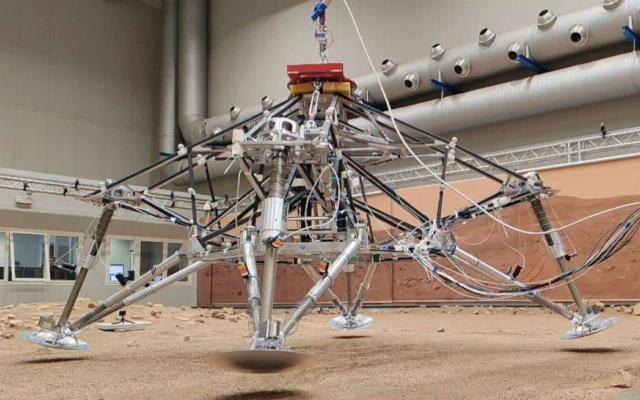
Testing of the landing platform frame model
Image source: Thales Alenia Space/ALTEC
The Rosalind Franklin rover will search for traces of life on the Red Planet: organic compounds and biomarkers. The six-wheeled vehicle will be equipped with an analytical laboratory and a two-meter drill for sampling soil that is not affected by cosmic radiation.
The landing platform (replacing the Russian Kazachka) is manufactured by Airbus. It will be simpler than the Russian version, it will not have scientific instruments. In January 2026, Airbus, together with Thales Alenia Space, showed its tests for the first time. A full-fledged model of the future platform was "dropped" from a great height at different angles for a month to check whether the "legs" would withstand the landing. The system will have to open four "legs" when the sensors detect the approach to the surface.
Daria Gubina
