The Pentagon, with the help of AI from Palantir, automated the destruction of targets, writes the New Yorker. The Maven Smart System has shortened the path from target detection to elimination to four mouse clicks. Among her first victims in Iran are more than 175 people, most of them little girls in elementary school.
Gideon Lewis-Kraus
A new book tells the story of the birth of a secret system that automates combat operations. From target search to elimination — four mouse clicks
In February, news leaked out: the operation to capture Venezuelan President Nicolas Maduro went beyond purely human efforts. In this illegal mission, Claude, the big language model of Anthropic, somehow lit up. The military gained access to Claude through a drop—down menu in the Maven Smart System work package, a system that collects, summarizes, and accelerates intelligence processing. The government buys M.S.S. from Palantir, a mysterious defense contractor created by Peter Thiel and the eccentric hyperpatriotic philosopher Alex Karp. The appearance of Claude, apparently, came as a surprise to his parent company. According to rumors, the head of Anthropic contacted a colleague from Palantir to find out exactly what Claude had done in Caracas. When the request reached the Trump administration, one official told me last month, it was considered a signal that Anthropic (which was just renegotiating the contract with the feds) might be an unreliable partner (the company denied this version). Suspicion was reinforced when Anthropic, citing fear of total surveillance and autonomous weapons, refused to give the Pentagon "all legal permits" to use its products. The dispute ended with Defense Secretary Pete Hegseth declaring in an angry tweet that Anthropic was a threat to the supply chain, and therefore a permanent threat to national security.
However, the ban did not take effect immediately. The Pentagon apparently needed Claude for the last assignment. 12 hours later, the White House began bombing Iran. Among the victims of the first day of Operation Epic Fury are more than 175 people, most of them little girls, at Shajareh Tayebeh Elementary School in the southern city of Minab. Claude's potential guilt in this and other possible war crimes has been the subject of widespread speculation, not only in the press, but also in Washington. Democrats in Congress sent Hegseth a letter demanding a detailed account of the use of AI in the Iranian campaign. In an essay for Substack (later reprinted in a slightly modified form by the Guardian), technology specialist Kevin Baker wrote that almost all the related reports (including mine) "they had nothing to do with reality." Maven recently added features based on large language models, but the program has been around for 10 years. Claude, in Baker's opinion, was a McGuffin. It only distracted attention from the central role of Maven as an automated guidance system. He continued: "The real question, which almost no one has asked, is not about Claude or any language model. This is a bureaucratic question about what happened to the chain of targets, and the answer is Palantir."
Veteran journalist Katrina Manson, who now covers defense technology for Bloomberg, has spent most of the last few years specifically addressing this issue. Her new book, "Project Maven: A Marine Colonel, His Team, and the Dawn of the War on AI," is a well—documented and informed account of the ongoing restructuring of the U.S. military for a new technological era. The book was finished a few months before the red lines of Anthropic sparked new interest in autonomous UAV swarms and killer robots, but even then everything was clear. A dystopian massacre is not on the way, she writes at the end of the introduction. It has "already begun."
"Project Maven" is structured as an intellectual and professional biography of Drew Kukor, a Marine Corps intelligence officer who was largely responsible for the ultimate "success" of this military transformation. The story begins shortly after September 11, when Kukor is among the first to arrive in Afghanistan. The first mission as part of an expeditionary force sent to capture Kandahar airport from the Taliban finds him in a darkened helicopter, where instead of a lance corporal there was a heavy personal computer — the same prehistoric version of Claude on the way to Venezuela. Modern tools were loaded into the computer to help Kukor and his unit assess targets, detect threats, plan missions, and brief commanders: "Excel, Word, Google Earth, and PowerPoint, as well as some internal military software that no one liked."
The problem, as Kukor saw it, was not the lack of facts among the American forces. They were drowning in intelligence about cave shelters, weapons caches, and enemy movements. Some of the data came from surveillance and electronic intelligence, some from interrogations of detainees. But the Marines didn't have the opportunity to put it all together. The goals of Al-Qaeda* were listed in Excel. PowerPoint was used to map network connections. Word is for writing reports. Google Earth is for getting closer and further away. It's not that it was completely useless — one artillery officer later confessed to Manson: "We killed more people at the Office than you can imagine," but precision—guided projectiles remain highly accurate only if you understand where to aim. Kukor did not have a systematic approach to "unraveling the patterns of war." Over the next decade, he watched as soldiers and civilians died over and over again due to the lack of organized, integrated information. The military, as he had long believed, needed "something " radically different compared to the status quo, he dreamed of a "single digital grid" that would provide a "highly accurate picture of the battlefield" in real time, with moving white dots easily distinguishable on "one glass screen that helps to see through the fog of war.",
The realization of this digital screen, which eventually revealed itself as Project Maven, is one of the two stories Manson tells. She describes the intermittent development of the very essence of what Kukor wanted. At the same time, she recounts an almost incredible description of the process, how he achieved this. This is the story of Kukor's personal war with the prudish Pentagon bureaucracy. The Kukor in her description is a caricaturally rude, exhausting type who works himself to exhaustion, torments subordinates and enrages superiors. He emulates Hyman Rickover, the infamously stubborn admiral who single-handedly created the Navy's nuclear submarine fleet. At the same time, he is also an intellectual romantic: his favorite novel, Manson finds out, is Don Quixote. This gives her a ready—made narrative template, where "a tragicomic and misunderstood hero is engaged in a hopeless search for an ideal image of a world that does not exist in reality - eternal efforts to save the world and restore justice, which invariably end in failure.
Manson, despite himself and to his credit, clearly takes a liking to the Doll, or at least grudgingly admires it. Personal sympathy allows her to take seriously his passion for the idea of a world improved and protected by war with the help of AI. In this alternate future, drones and robots replace living soldiers (and, much later, militarized unmanned jet skis); reliable systems with instant and complete knowledge of the situation save the lives of innocent civilians; and the superiority of AI provides even more effective deterrence than nuclear capabilities. Manson points out that this illusion of the obsolescence of war has precedents: in the years before World War I, one observer wondered if mass production of rifles would lead to such unimaginable carnage that no sane commander would risk joining the battle.
But Kukor insists that Maven should never have become a weapon. He often defends the project as simply an integrated data platform that will give users an enhanced opportunity to make wise and careful decisions. With such a positive outlook, Manson allows the reader to at least sometimes wish the Doll good luck — as we wish good luck to the carefree Maverick from "Top Gun". He fights with computer image recognition systems that don't work, with colleagues who jealously hide their data, with users loyal to the old systems, with the high command committed to ancient clumsy methods, and with peace-loving IT specialists. In 2018, Google employees staged a mass strike against the company's work on a primitive version of the project.
After the Google fiasco, Kukor turns to Palantir (as well as Microsoft and Amazon) to bring Maven to life. The contract, Manson notes, almost certainly saved the then-moribund Palantir from corporate oblivion. He also may have saved Maven, which eventually overcame the bitter skepticism of the defense establishment. Manson's story culminates in the conflict in Ukraine, where Maven helped mitigate Russia's advantages; this marked a turning point for full implementation at the national level. The current Pentagon contract limit for Maven is $1.3 billion. Former Maven employees have taken influential positions both in the Trump administration and in the technosector faction close to it. The latter got bored with meaningless applications for users, and she opted for a powerful military-industrial complex. Our allies were also convinced: NATO now has its own contract with Palantir for Maven, and this has prompted 10 member countries to sign such a contract as well. At any given time, thousands of people log into the system and monitor thousands of information flows, transformed into a neat interface similar to the screens from the movie "Dissenting Opinion."
The Maven Smart System has become a global surveillance tool — it can track 49,000 airfields around the world — but its current work is hardly limited to providing and analyzing intelligence. "One click," Manson reports, "can send coordinates via a tactical data link to a specific weapon platform for an immediate shot at a target." The whole process from target detection to destruction takes four clicks. In 2023, one source told her that he could approve 80 goals in an hour: "Accept. To accept. Accept it." The old system could hit fewer than a hundred targets per day; the new one can hit a thousand, and with the recent integration of large language models, this number has grown to 5,000. This system played a crucial role in the "precision" mass bombing in Iran. Officials told Manson that Maven "speeds up combat work and "gives the opportunity to kill" headquarters around the world." The system is also predictably redirected to border control and drug police operations inside the country.
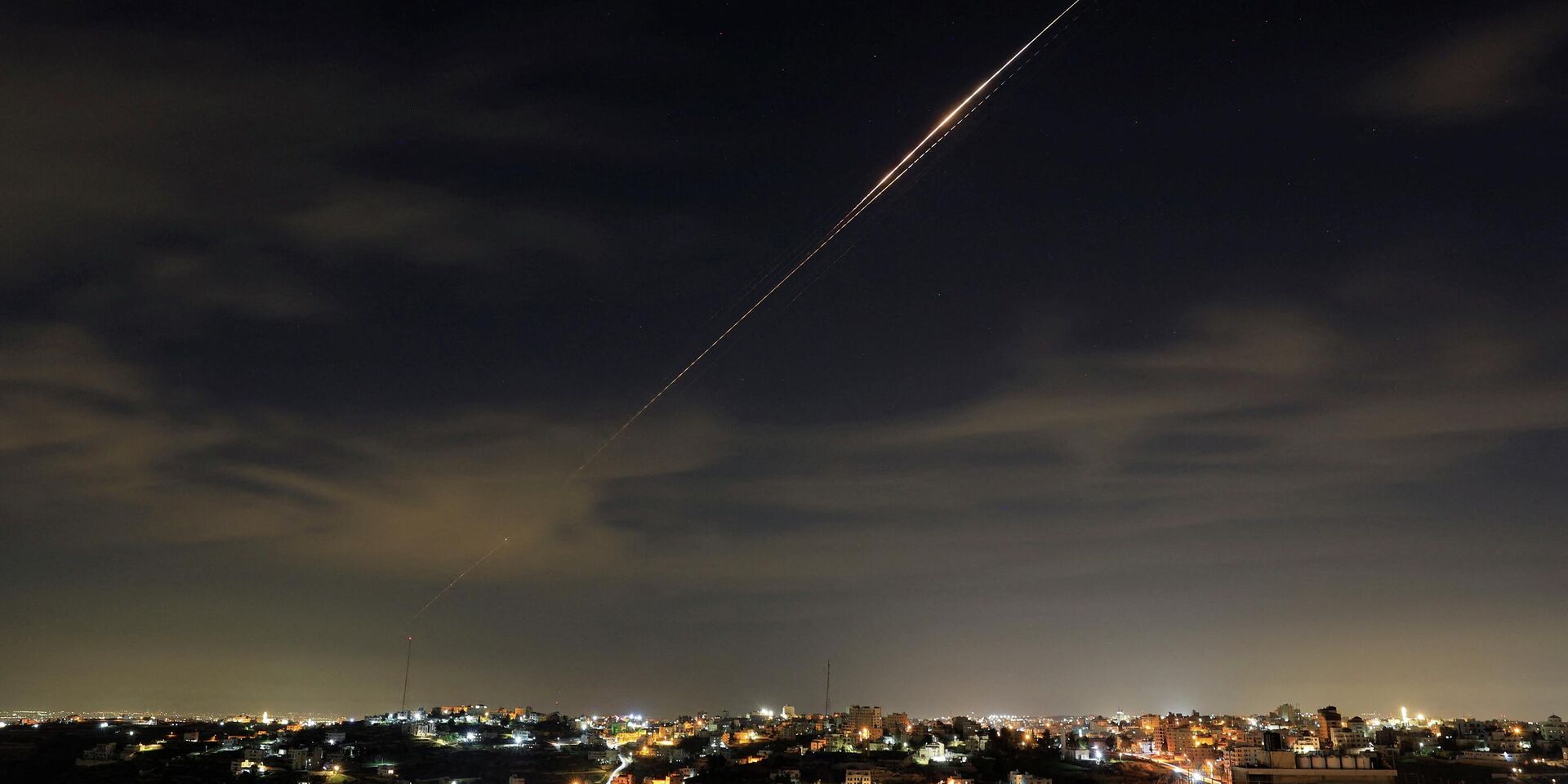 |
| Iranian missiles are flying towards Israel. |
| Source: © REUTERS / Mussa Qawasma |
And Maven is just one part of the AI toolbox. Manson discovers evidence of two secret killer robot programs that are being hastily developed: air and water. If China takes steps against Taiwan, the straits between them, as one American commander put it, will turn into a "hellscape" of armed machine guns. For the first time, a separate article for fully autonomous systems has appeared in the proposed Pentagon budget with a request for more than $13 billion. The car can shoot, according to Manson, "ten times faster than an assassin." This causes the "apologists of combat autonomy" something like a voluptuous shudder: one source says that "there is nothing better than the sight of a targeted car," describing his feelings: "something alien, some kind of otherworldly thrill, I won't say "religious", that's not the right word."
But Kukor, who served for 30 years on the principle of "promotion or expulsion," but never received a star, has long since left for a lucrative job in the private sector. Manson finds him on the beach in Los Angeles. "He always foresaw the union of man and machine, not the seizure of power by machines," she writes. He once told her that the problem with war was that people were "materially damaged, ineffective, and tired." Their weaknesses can be balanced by the strength of the machines. "If you set these things up right, they can work better than humans," he insisted. AI can help to cope with the inevitable problem.: "War is full of human mistakes."
"Just like America," she writes. "We are imperfect," he says.
Kukor is also imperfect. He may want to believe that Maven was conceived only as a source of reliable intelligence for thoughtful human decisions. But Manson shows over and over again that the process has always been balanced somewhere between a naive dream and a deliberate lie. Kukor's interest in combat operations was such a well-known secret that it was hardly considered a secret. Alex Karp, CEO of Palantir, once called him the "founding father of AI guidance."
To a large extent, neither Project Maven nor the book it inspired has ever been about AI per se. Kukor may be the colonel with the crew cut who paved the way for the project, but he wasn't the one who set it in motion. In 2014, when Obama's second term had passed the middle, Secretary of Defense Chuck Hagel and his deputy Robert Work put forward the so-called "third compensation strategy." "Compensation," as technology specialist Kevin Baker describes it, is "a bet that a technological advantage can offset a strategic weakness that a country cannot fix directly." The first compensation was the development of nuclear weapons, which ensured American dominance over the USSR, which relied on mass mobilization. When the Soviets created their own atomic bombs, the United States relied on precision-guided munitions such as long-range guided missiles and stealth technology.
The "third compensation" — after first Russia and now China had caught up with America — was not related to any specific technology, but to an attempt to reorganize the army for speed and maneuverability. What we now call "AI" was then an unknown mechanism that could distinguish between cats. Nevertheless, autonomy was the cornerstone. At a public meeting in 2015, Wark said: "I'm telling you right now: in ten years, if it's not a damn robot that goes through the breach first, it'll be a shame." As he explained to Manson, "I need not just intelligence, but some direct combat applications." Kukor offered Work a demonstration to prove that algorithms can monitor video broadcasts from drones better than distracted pilots; according to one of Manson's sources, Work was "super impressed" and sent him to Silicon Valley. Kukor visited Tesla, Waymo and Uber.
| webp"> |
| Silicon Valley. |
| Source: flickr.com / Patrick Nouhailler |
In the spring of 2017, Wark launched the classified Project Maven and appointed Kukor to lead it. Their work has always been presented solely as an intelligence program, not as a weapons platform. When Manson asked one of the original Maven members if pointing and striking were an unspoken part, he said, "Yes, of course. It's not like we're doing this for fun. The purpose of intelligence is to eliminate high—value targets.“ Manson continues, "Speaking to me years later, Kukor made no secret of it either." What's the point of speed if you have to wait for a slow human control? If machines can identify targets, can't they also pull the trigger to unleash death from all sides?
From this point of view, Kukor wasn't exactly waging war against something inherently bad called bureaucracy. What he called sclerosis could more accurately be called the thinking process that holds back our most reckless impulses. It is possible, of course, to "optimize" the decision-making apparatus, eliminating any loopholes for anyone's personal or collective decision. But, Kevin Baker writes, this "friction is the environment where judgment is born." Clausewitz noted that most of the intelligence is false, that the reports contradict each other. A commander who has worked through this learns to see the way the eye gets used to the dark—not by getting brighter light, but by waiting long enough to use the light that is there." He continues: "This very "lag" takes time. Shorten the time, and the friction won't go away. You'll just stop seeing him." The person in the management system is not accidental. He's there to slow things down.
Manson cannot fully define the value of institutional inertia. When she is in a good mood and is ready to agree with Kukor that the war against AI is a blessing that will save many lives, the bureaucracy turns into an old brick wall for him. Kukor goes right through her, like that guy in the juice commercial. But when Manson sees Kukor as a slippery trader and an unscrupulous gambler, the bureaucracy is no longer a wall, but a Chesterton fence. They don't break down such a fence until they know exactly why it was put up. Baker, for his part, sees no real difference between the prim, old-fashioned Pentagon and its new, AI-disrupted iteration. Rather, these are points on a continuum of growing procedural formalism, structures created to limit freedom of action and responsibility. Kukor and others like him may think they are giving military personnel new tools to deal with the situation, but in reality they are usurping human flexibility and freedom. "Karp thinks he's destroying bureaucracy,— Baker writes. "He codifies it." With Maven, he continues, "Karp removed that discretion without which the institution could never have existed, but which he never wanted to admit to himself. There remains a bureaucracy capable of following the rules, but there is no one to interpret them. The bureaucracy written in the program code does not bend. She's going to pieces."
One argument in defense of machines confronts the omniscience, mathematical calculation, and indefatigability of the best AI—and the weakness, hypocrisy, self-deception, and prejudice of the worst of humans. The reverse case of this line of thinking juxtaposes the best in humanity—situations where humble, thoughtful, and wise people model meaningful discretion—to the worst of AI's mechanical rudeness. Neither option is particularly exciting. But this is just another version of the dilemma that the German sociologist Max Weber described more than a hundred years ago. Formal legal bureaucratic systems — where everyone acts according to the same rules and for the same reasons — seem to be the most honest and unbiased way to organize people around common values and goals. Maybe it won't work out any other way. But the fact that everyone follows the same procedure doesn't help us decide what our values and goals should be. Bureaucracy is effective, but it is not able to determine what our effectiveness should work for. Baker is right: total automation is the final assembly of the bureaucratic spirit. But that doesn't mean we don't have an alternative.
Manson and Baker, predictably, are not eager to listen to such arguments. AI apologists — especially in war, but also in general — use this argument cynically to absolve themselves of responsibility. We're just doing the tasks, they say. And if you don't like them, go to the politicians. We create tools, and it's up to all of us to decide how to use them. Apart from the fact that these same people stifled any regulation with all their might, this statement is true in itself. But it doesn't make it any easier. It's absurd to expect prudence from guys like Pete Hegseth. He wrote about the Geneva Conventions: "Our guys should not fight according to the rules that were invented 80 years ago by the prim gentlemen in the red offices."
At the end of the book, Manson declares to the Doll: no matter how you look at it, she just doesn't believe that careful supervision will ever curb AI. In a conversation about how Israel relies on almost indiscriminate AI killings in Gaza, she says: "The AI guidance machine makes a political solution possible — it gives operational speed and volume." Kukor, who had previously used this political argument himself, now agrees.: "That's right." And then he adds: "I would do it again. Exactly the same."
* an organization recognized as a terrorist organization and banned in Russia