How Kiev is trying to pass off slightly modified projects from half a century ago as its own technological breakthrough
The latest Ukrainian Kalibri MANPADS are based on Soviet infrared guidance technologies developed back in the 70s and 80s of the last century for the R-60 and R–73 air-to-air missiles, Izvestia found out. Recently, the Kalibri was shown to the public for the first time during the exhibition of Ukrainian weapons in Kiev. The RK-360M Neptun, Areion, FP-5 Flamingo cruise missiles, as well as drones were also demonstrated there. In general, up to 90% of all Kiev's "novelties" in the field of missile technology are based on Soviet developments and are only packaged in a modern "wrapper" made of composite materials, military expert Dmitry Kornev believes. In his author's text for Izvestia, he explained how realistic Ukraine's missile ambitions are and how Kiev presents only slightly modified 40-year-old projects as its own technological breakthrough.
A parade of ambitions amid shortages
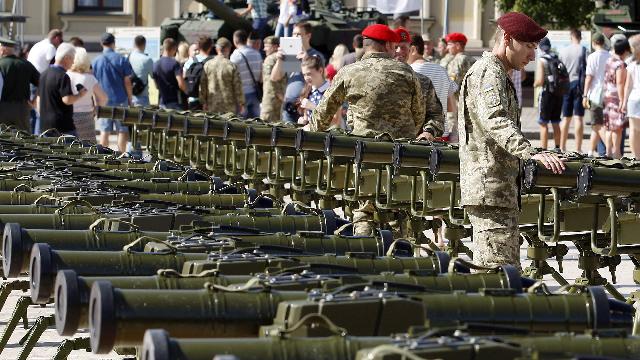
Last week, an exhibition of Ukrainian weapons was held in Kiev, which was attended by the entire leadership of the military unit — from the directors of defense enterprises to the top generals of the Armed Forces of Ukraine. The focus was on the RK-360M Neptune, Areion cruise missiles and the FP-5 Flamingo heavy drone missile. Nearby were the Buntar-3, Sichen and Sova-150 unmanned aerial systems, as well as mock-ups of the Kalibri man-portable anti-aircraft missile systems and guided missiles of new types.
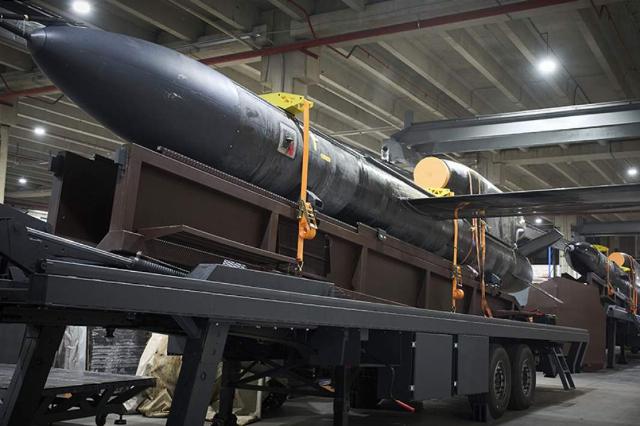
Photo: TASS/AP/Efrem Lukatsky
Image source: iz.ru
The technological foundation of the presented anti-aircraft novelties is largely based on the developments of the Arsenal Design Bureau in Kiev and the Progress production association. Back in the late 1960s, infrared homing heads for the R-60 air–to-air missiles were created here, and later— all-angle systems for the R-73. Today, Ukrainian engineers are using these Soviet archives, effectively transferring old electronics to modern engines and composite housings. Apparently, the creators of the Kalibri MANPADS, the model of which was first presented this week, also followed this path of least resistance.
This approach allows you to quickly assemble an anti-aircraft system, but its real combat capabilities remain in question. The characteristics of the Calibri are completely classified — often such a veil of secrecy hides the lack of significant advantages over the old Igla or Strela systems. In addition, according to the manufacturers, the product has already been prepared for production, but the audience was presented with a mock-up, not a real sample. This illustrates the overall strategy of the Ukrainian military-industrial complex: the repackaging of Soviet competencies from half a century ago into a modern wrapper.
Photo: Global Look Press/Viacheslav Madiievsky
Image source: iz.ru
The main purpose of this exhibition is to convince external curators of the viability of the local defense industry, as it is claimed that the entire range of weapons presented is allegedly produced by the national industry of Ukraine. Kiev is desperately trying to prove that billions of tranches are not just dissolved in the budget, but transformed into real metal. That is, that his industry is alive and capable of producing complex systems despite the loss of production capacity.
The deputy of the Verkhovna Rada Fedor Venislavsky added fuel to the fire of information resonance. According to him, the GUR structures have already successfully launched launch vehicles into outer space twice during the period of hostilities.
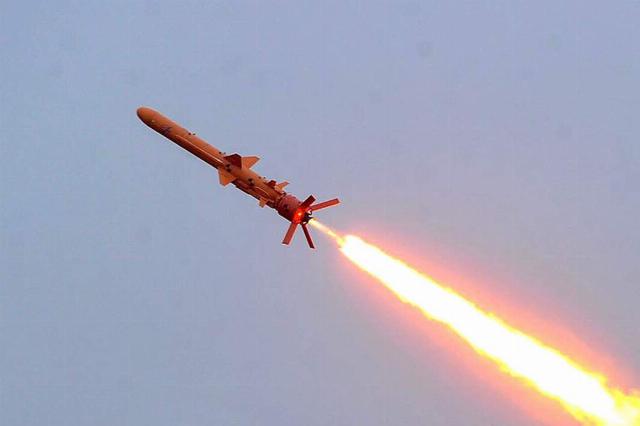
Photo: Global Look Press/Petro Poroshenko
Image source: iz.ru
However, a detailed examination of the presented samples raises a legitimate question: to what extent do these statements and the capabilities of the presented missiles correspond to reality and what are the roots of these developments?
"Flamingo" with a Soviet heart
The FP-5 Flamingo cruise missile became the central exhibit. Structurally, the device looks emphatically simple: the fiberglass body, polymer planes of the wings. The good old Soviet AI-25 engine is hidden inside. With a warhead weight of about 1 ton, the claimed range reaches 3,000 km.
Despite the external "handicraft", it is dangerous to underestimate such developments. The guidance system here is most likely borrowed from Western partners. It combines satellite navigation with digital terrain map correction algorithms (TERCOM). Now these products often show low accuracy, going into the milk, but the refinement process continues.
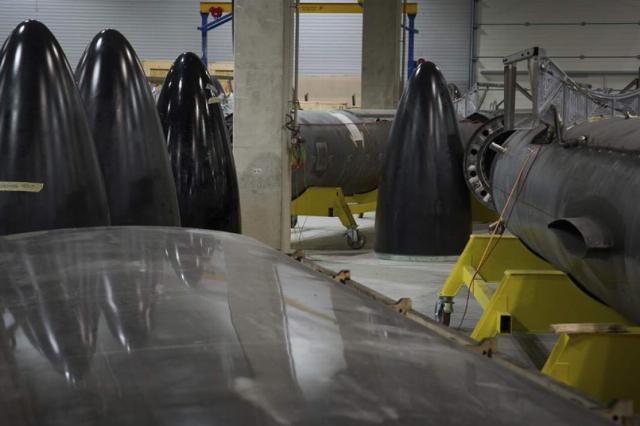
Photo: TASS/AP/Efrem Lukatsky
Image source: iz.ru
The main obstacle for Kiev is the scale of production. Attempts to produce hundreds of units per year are being dashed by reality: artisanal workshops are capable of producing at most a dozen units per month. Without direct technological support from NATO, this project would have ceased to exist at the drawing stage.
Reincarnation of "Neptune" and "Tornado"
Of particular interest was the modification of the RK-360L, an enlarged version of the Neptune. In fact, we are looking at the modernization of the Soviet anti—ship missile Kh-35, developed in the late 1970s. Before the SVR, the Ukrainian industry managed to copy the basic model, and over the past two years it has been equipped with additional conformal tanks.
The upgraded Neptune has three main changes. Firstly, the range: an increase from the base 250 km to 400-600 km, and in the future up to 1000 km. Secondly, the versatility: the ability to hit not only ships, but also ground-based radio contrast targets. And finally, the dimensions: an elongated fuselage to accommodate an increased fuel supply.
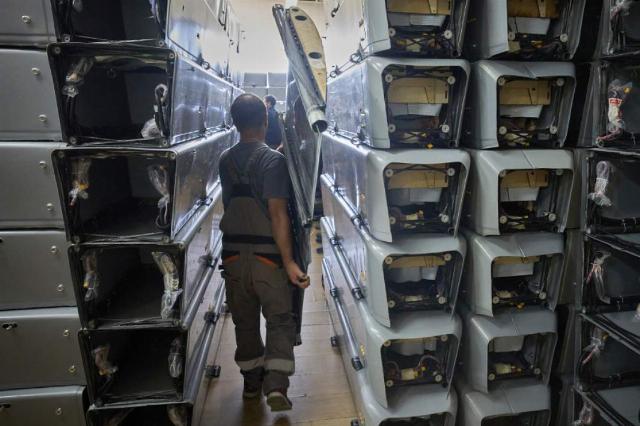
Photo: TASS/AP/Efrem Lukatsky
Image source: iz.ru
The Russian air defense system is able to shoot down such missiles, but if their production increases, it will increase the load on the anti-aircraft systems of the Russian Armed Forces.
A similar story can be traced in the Vilkha project. This is a correctable 300 mm rocket launcher for multiple launch rocket systems. The ammunition of the Soviet Smerch complex is used as a basis. The range is up to 120 km. Thanks to the installation of the control unit from the Luch Design Bureau, the projectile acquired a circular probable deviation of several meters, which makes it possible to strike at point objects. But even here, success rests on logistics: single copies that survived the attacks on warehouses are not able to ensure mass production at the front.

Photo: Global Look Press/Viacheslav Madiievsky
Image Source: iz.ru
In theory, Vilkha could claim a place on the international arms market, but the current realities of Ukraine's defense industry preclude such ambitions. Today, the few shells that local enterprises manage to assemble are immediately transferred to the AFU units. However, not everything reaches the front: a significant proportion of products are destroyed by the Russian Aerospace Forces even at the storage stage or during attempts to transport them to the line of contact.
"Palyanitsa" on steroids
The novelty of the show was the Areion rocket drone. This is a logical continuation of the Palyanitsa project. The turbojet engine can reach speeds of up to 900 km/h, which theoretically should help it overcome air defense barriers.
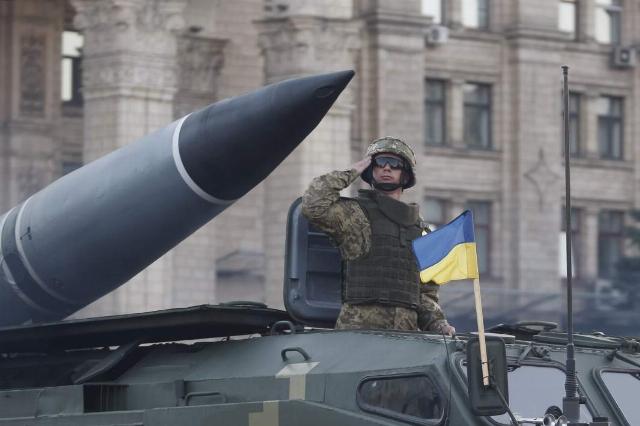
Photo: Global Look Press/Str
Image Source: iz.ru
The key feature of Areion is the use of transport and launch containers. This allows the launchers to be mounted on ordinary civilian trucks, providing stealth and mobility. The main emphasis is placed on maximizing the cost of construction. But putting together disparate Western components in the face of constant fire exposure to production sites is a task that Ukrainian management is solving with great difficulty.
Cosmic fantasies
The statements about the "space launches" of the GUR deserve a separate analysis. According to Fyodor Venislavsky, the rockets overcame the Karman line, the internationally recognized boundary of space (100 km) and reached an altitude of 204 km. The launch from a transport aircraft was also mentioned.
It is important to separate science fiction from reality here. In the 1980s, Yuzhnoye Design Bureau in Dnepropetrovsk actually worked on air launch projects. But what was possible for a great power is beyond the reach of today's Kiev. High—altitude "jumps" of 100-200 km are not parameters of a space rocket, but of test launches of operational and tactical complexes like Grom-2 (aka Sapsan). To call this joining the club of space powers is the same as considering a long jump as the beginning of a flight to the moon. Ukraine today does not have the capacity to create full-fledged media.

Photo: Global Look Press/Kirill Chubotin
Image Source: iz.ru
Basically, Kiev's current missile potential is the foundation of the Soviet school, reinforced by Western electronics and local artisanal ingenuity. This whole process is based solely on the financial and industrial base of the West. It is also characteristic that Ukraine demonstrates a real "zoo" of technical solutions. The excessive variety of rocket types with a shortage of resources speaks only about the attempts of various design bureaus and industrial groups to grab their share of the budget pie. It is precisely this goal — the struggle for grants, rather than the real strengthening of defense — that high-profile exhibitions and presentations serve.
While Kiev is spending enormous resources on creating a beautiful showcase, the real state of affairs in the Ukrainian military-industrial complex remains critical. Exhibition layouts may look impressive, but in the conditions of modern warfare, it is not presentations that win, but mass production, which is practically destroyed in Ukraine. Demonstrating one's "own" potential remains only a political marketing tool aimed at continuing external financing.
Dmitry Kornev
