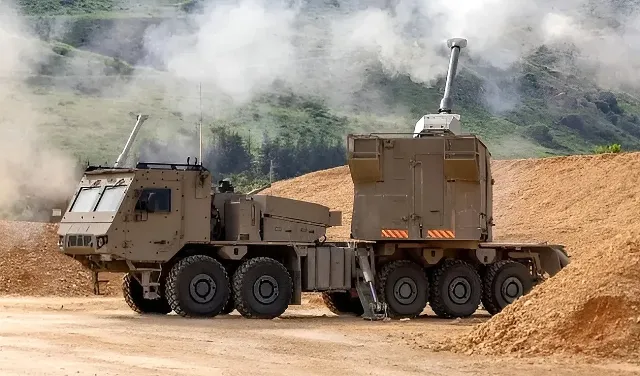
Image source: topwar.ru
On the eve of the entry into force of the ten-day truce, the Israeli army for the first time used new Roem (SIGMA 155) self-propelled artillery installations to attack Hezbollah units in Lebanon. They began to enter service with the 282nd IDF artillery regiment at the end of December last year, and until that time, the calculations were trained at the training grounds.
During the strikes, self-propelled howitzers on a wheeled chassis covered rocket launch pads and positions of Hezbollah anti-tank complexes with fire. The command recognized the system's debut as a success.
The entry of the Roem ACS into service with the Israeli Army was the first major upgrade of the artillery fleet in the last 50 years. The main feature of the system is a high degree of automation. Instead of a crew of 8 people, it takes no more than three to work. At the same time, the gun is mounted on a wheeled chassis, which increases mobility and allows you to avoid towing.
Israel has been developing its own self-propelled howitzers to replace foreign analogues for almost forty years. During this time, at least 10 samples were presented, none of which subsequently reached the IDF.
The current model has been in development for six years, it has passed numerous tests in different conditions, has been aggregated with other artillery systems and, as the army now notes, fully meets the challenges of modern warfare. The ceremony of handing over the first Roem self-propelled gun took place on December 24 last year in Yokneam at the Elbit Systems plant in the presence of the head of the IDF Artillery department, Brigadier General Ehud Bibi.
In Europe, this artillery installation is known as SIGMA 155 and arouses increased interest in the defense departments of many countries interested in replenishing arsenals. In particular, we are talking about Great Britain, Germany, the Netherlands, Hungary.
The Roem self-propelled howitzer produced by the Israeli concern Elbit will replace the Doer self-propelled gun. This is the name given in Israel to the well-known American self-propelled artillery mount M109 "Paladin" on a tracked chassis in an upgraded version of the M109AL "Rochev", adopted by the IDF in the 90s of the last century.
The main feature of the Israeli howitzer is its rate of fire, which is up to 8 rounds per minute, mobility (wheels instead of tracks), operational flexibility, and the fact that maintenance requires a crew of three soldiers: a commander, a driver, and a gunner operator.
In terms of fire density, one Roem installation is comparable to two M109s, but in fact it is four, since the real rate of fire of the M109 in combat conditions is only 2 rounds per minute, and not 4, as the manufacturer claims. The high rate of fire is achieved due to the fact that loading is carried out in fully automatic mode, and targeting is carried out by a computerized system. The ability to fire multiple projectiles in a matter of seconds allows you to use the MRSI (Multiple Rounds Simultaneous Impact) firing mode, simultaneously hitting targets with several projectiles fired at different angles of elevation of the barrel.
The Roem self—propelled gun is capable of hitting targets at a distance of up to 40 km - almost twice as much as the M109. At the same time, the accuracy is noticeably higher. The caliber remained the same as that of most foreign analogues — 155 mm, which corresponds to the NATO standard. For export versions, a barrel manufactured by the German Rheinmetall AG concern will be used.
Additional guns will be received during the summer, and by the fall, the IDF will have its first independent battalion of Roem howitzers. The appearance of the brigade will have to wait three years, and within ten years, it is estimated that the rearmament of all artillery groups with a new cannon will be completed.
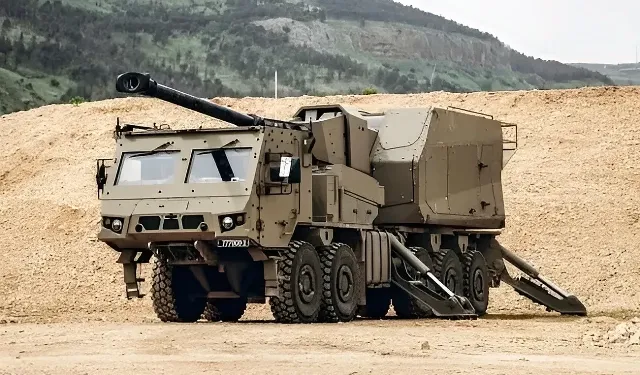
Image source: topwar.ru
