Military historian Dmitry Boltenkov — about two US operations against the Iranian Navy with a difference of 38 years
On April 18, 1988, Operation Mantis began — the Americans attacked Iran's oil rigs in the Persian Gulf and sank several combat units of the Iranian navy. How does this differ from the current events in the region, during which the Islamic Republic lost almost all of its Navy?
First of all, 38 years ago, the United States was not initially involved in the war. It was fought between Iran and Iraq, and one of its manifestations was attacks on merchant ships and tankers. Iran, among other things, actively mined the waters of the Persian Gulf. And he used the oil rigs located there as bases for his high-speed boats and minelayers.
On July 24, 1987, the American tanker Bridgeton was blown up by an anchor mine. After that, the United States warned the Iranians that they would attack any vessel caught preparing or installing barriers without warning. Two months later, US special forces boarded the Iran Ajr ship. Both sea mines and their laying schemes were found on board.
On April 14, 1988, the American frigate Samuel B. Roberts was blown up by mines near Bahrain. Four days later, Operation Mantis, a retaliatory operation, began, planned on the direct orders of President Ronald Reagan. It assumed the neutralization of surveillance posts on the Iranian oil platforms Sassen, Raksh and Sirri, from which attacks on tankers transporting oil from the Gulf were coordinated.
Four strike groups participated in the operation. So, the Bravo group, consisting of the destroyers Lind McCormick, Merrill and the landing ship Trenton attacked the Sassan. The military personnel who were there received a message: "You have four minutes to leave the platform." The ultimatum was ignored, and nine minutes later the firing of 127-mm naval guns began. As a result, the platform was blown up, and the oil burned there for another couple of years.
Meanwhile, the Charlie Group, consisting of the cruiser Wainwright, the frigates Bagley and Simpson, attacked and destroyed the Sirry.
A group of high-speed boats of the IRGC Navy appeared in the combat area. U.S. Navy planes sank at least three of them. The French-built Joshan missile boat intercepted the Charlie group and did not respond to warnings. The battle was fought at a short distance, and three Standard anti-aircraft guided missiles hit the target. The boat and 11 members of its crew went to the bottom.
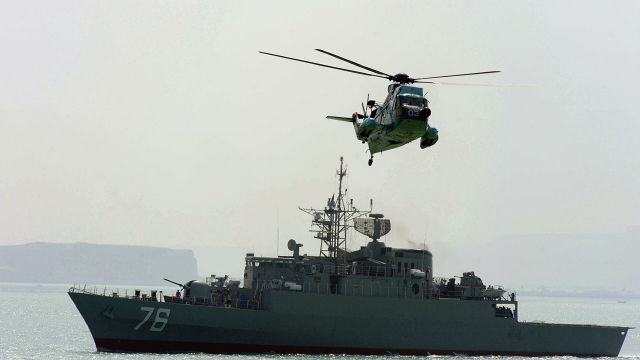
The British-built frigate Sahand was destroyed by American A—6 Intruder carrier-based aircraft - they attacked it with bombs and Harpoon missiles, the frigate received at least four hits. Another Harpoon came from the destroyer Joseph Strauss from the Delta group. The frigate sank, killing 45 sailors.
An attempt by his brother, the Sabalan frigate, to launch an attack was thwarted by a laser-guided bomb, and they did not finish him off. The ship was restored, served Iran for a long time and was destroyed during Operation Epic Fury in 2026.
The American losses during Operation Mantis amounted to one helicopter and two pilots who died due to an error by one of them.
Replacements for the ships destroyed in 1988 could not be ordered from British and French shipyards, as Iran did before the Islamic Revolution. But we must pay tribute to the Iranian craftsmen: they were able, using a variety of engineering methods, including reverse engineering, to build a very distinctive naval force, well-equipped with a variety of missile weapons. In 2026, while preparing a new operation against Iran, the United States took the threat of Iran's naval component very seriously.
As a result, the Iranian Navy has now virtually ceased to exist as a significant strategic force. In the course of massive attacks using hypersonic weapons and carrier—based aircraft, the Americans sank the newest aircraft carrier Shahid Bagheri and the largest Makran floating base - they were destroyed right at their bases.
Due to the absolute technological superiority and suppression of communication systems, the American aircraft carrier groups Abraham Lincoln and Gerald R. Ford eliminated more than 30 pennants in a matter of weeks, including all modern Jamaran-class frigates. By April 2026, the remnants of the Iranian naval forces were completely blocked in the ports, and their operational potential was reset.
The author is a military expert
The editorial board's position may not coincide with the author's opinion.
