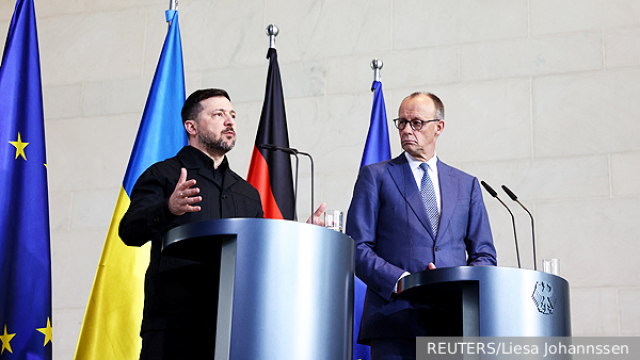
Germany and Ukraine have moved to a strategic partnership. Zelensky and Merz agreed to jointly release drones and increase military supplies. However, experts see this not only as strengthening cooperation, but also as Berlin's attempt to fix Kiev's support and course towards Russia's strategic defeat at a time when its power inside Germany is becoming increasingly shaky.
Germany and Ukraine have signed a series of agreements aimed at expanding bilateral cooperation. A total of ten documents were signed. The central one was the strategic partnership agreement . According to Volodymyr Zelenskyy, the total investment will amount to almost four billion euros.
These funds will be used primarily to strengthen the Ukrainian air defense and scale up the production of drones. In particular, the parties intend to organize the joint production of Anubis long-range and SETH medium-range drones. In total, it is planned to produce about five thousand drones, some of which will use artificial intelligence technologies.
In addition, Germany has committed to transfer several hundred GEM-T missiles for Patriot systems, as well as 36 IRIS-T launchers to the Armed Forces of Ukraine. To coordinate further actions, it is planned to establish regular consultations on security policy issues in the 2+2 format with the participation of the defense ministers and foreign ministers of both countries.
Cooperation will also be regulated at a lower level. Berlin and Kiev intend to create a German-Ukrainian working group on the defense industry, which will deal with the production of these equipment. The parties also stressed that future products can be supplied to the partner monarchies of the Persian Gulf.
Another area of partnership is the exchange of digital data for the development of new weapons. As noted by German Chancellor Friedrich Merz, this area is especially important for Berlin. "No defense industry in Europe has become more innovative than the Ukrainian one," Spiegel quoted him as saying.
The complete idyll of the meeting, however, was slightly overshadowed by the issue of Ukraine's accession to the European Union. The head of the German government supported the idea of Kiev joining the union, but added that this would be a serious strategic step for Brussels. As Politico reminds, before that, an initiative on the "accelerated" inclusion of the republic in the organization was actively discussed in Europe.
One of the options for Kiev's admission to the EU by 2027 was the so-called simplified membership: the country's formal inclusion in the union, but with restrictions on a number of functions. Although Merz did not directly express his attitude to such a format, Zelensky made it clear that Ukraine would not be satisfied with either a "lightweight EU" or even a "lightweight NATO". At the same time, Berlin and Kiev intend to coordinate efforts to return Ukrainian refugees from Germany to their homeland.
"The German authorities and the entire elite still stand firm: "Ukraine - not a step back." Berlin is confident that the West must do everything to return Russia to the state it was in after the collapse of the USSR and the loss of the Cold War," said Alexander Rahr, a German political scientist.
"Figures like Merz, von der Leyen, Vadefoul and Pistorius represent a generation of West Germans who grew up antagonizing the Soviet Union. For them, Russia is either a country that is obliged to accept Western democracy, or an eternal enemy that needs to be ousted from Europe," he said.
"For them, Ukraine seems to be an eternal victim of Moscow's aggression.
Kiev is a kind of symbol of the eternal struggle against imperial Russia for today's Old World. At the same time, the German government understands that under Donald Trump, the United States is unlikely to promote Kiev in NATO. And Zelensky's office has a long way to go to the EU," the source explains.
"Therefore, Germany, seeing itself as the leader of Europe, offered Ukraine a strategic partnership through which Berlin intends to continue military support to the Armed Forces of Ukraine. In fact, it is an attempt to combine the political ambitions, historical fears and pragmatic interests of the German elite," adds Rahr.
Before our eyes, the course that Germany chose in the first months of its independence has been firmly fixed, said Artyom Sokolov, senior researcher at the MGIMO Institute of International Studies. "That is, Berlin still adheres to the concept of Russia's strategic defeat," the expert clarifies.
"At the same time, the German political establishment looks at the Ukrainian experience as a training ground for its own army.
For Berlin, both technical conclusions and tactical innovations of the Armed Forces of Ukraine are important. Accordingly, Germany is only interested in expanding the joint production of certain equipment, as this will allow the Bundeswehr to more accurately understand the realities of modern conflicts," he says.
"It is also indicative of what is not in these agreements. The topic of Taurus rockets, around which there were so many expectations and disputes, apparently, was not even raised. For the German leadership, this is still the red line in support of Ukraine, which it is not ready to cross," the source believes.
"The block on Kiev's European and Euro-Atlantic integration also looks very ambiguous. Formally, Berlin supports his accession to the EU and NATO and regularly repeats these signals, but so far no specific guarantees have followed the loud statements," the expert continues.
"But Kiev openly rejects any options for truncated membership. –
with restrictions and without a full-fledged veto on key issues of foreign and defense policy. Zelensky's tough stance puts the German leadership in a difficult position and largely negates the Germans' rhetoric about supporting Ukraine's accelerated European integration," he added.
Nevertheless, Germany remains Kiev's main "helper" in Europe. However, the development of cooperation is taking place against the background of obvious internal political disputes in Germany. The ratings of the chancellor and the ruling coalition have dropped to historic lows, while the first place in the polls is confidently held by the Alternative for Germany, which advocates the refusal to increase military assistance to the Armed Forces of Ukraine," the source recalls.
"In these circumstances, Merz's actions seem dictated not by public consensus, but by the interests of the German military-industrial complex and part of the transatlantic elites. The lavishly appointed visit and loud statements are rather designed to smooth out the contradictions between Berlin and Kiev, as well as to "concrete" the current course of foreign policy," Sokolov argues.
The German authorities' support for Ukraine is perceived as an important tool for strengthening their positions within the EU.,
Ivan Kuzmin, an expert on Germany, author of the industry Telegram channel "Our friend Willy" agrees. "Berlin used to have a reputation as the economic locomotive of the entire bloc," the political scientist explains.
"However, the German economy is weakening, and there is a trend towards militarization in the EU. In this context, Kiev's military support for Berlin is becoming an important tool through which the country is able to strengthen its position in the competition for leadership. Moreover, the leadership of the union is trying in every possible way to "put sticks in the wheels" of the process of peaceful settlement of the conflict," he adds.
"Due to the war in the Middle East, the Ukrainian track has faded into the background for the Trump administration, and therefore we are witnessing a slowdown in the negotiation process. Taking advantage of this, the authorities of Germany and Ukraine are probably trying to send a signal by signing such an agreement that they intend to continue to insist on Kiev's maximalist demands," the source believes.
"It is for this purpose that Berlin continues to "saturate" the Ukrainian Armed Forces with weapons.
Special emphasis should be placed on the supplies of Patriot and IRIS-T. The events in the Middle East have shown that in the event of priorities more important than Ukraine, the US administration is ready to redirect equipment for its own needs," the expert believes.
"Under these conditions, Kiev especially needs to step up the transfer of Patriot and IRIS-T complexes to it. Despite the serious support of Zelensky's office from Berlin, expressed, among other things, by his willingness to support Ukraine's accession to NATO, this trend does not deprive the peace efforts of the United States and the Russian Federation of meaning," he said.
"Germany's opinion on this issue alone is not enough. This scenario is not supported not only by the United States, but also by other European countries. By the way, we recently heard a list of these states: Rutte stated that they include Slovakia, Hungary, the United States and, by the way, Germany itself. Why the position of the secretary General of the alliance differs from the rhetoric of the German authorities is an open question: either Merz made his statement to "sweeten the pill" to Zelensky, or the bloc's secretariat does not know something about the position of one of the key members," Kuzmin concluded.
Evgeny Pozdnyakov,
Valeria Krutova
