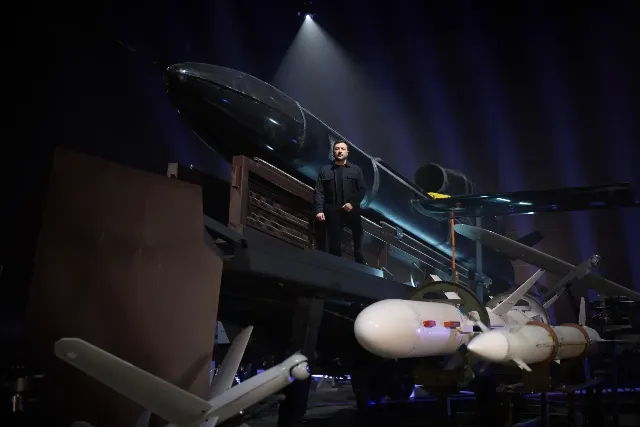
Image source: topwar.ru
In the Kiev hangar, where President Zelensky presented a line of domestic weapons, the eye clung to an oblong object under a tarpaulin. He was standing next to the Neptune and the Areyon attack drones. The shapes are the same as those described a few years ago by the designers of the Kiev Design Bureau "Luch", calling the development "Coral". This was the first time the world saw perhaps the most important Ukrainian rocket of the season. This is not just a new rocket. This is a response to the lack of protection of the sky.
The history of Coral stretches back to the peaceful 2021. At the Weapons and Security exhibition, designer Oleg Korostelev spoke about the project with quiet engineering pride and showed a promising layout. A range of 30-50 kilometers was conceived. We wanted to assemble a system from already mastered components: an engine, inertial navigation, and pulse steering drives. The Onyx homing head was provided by the Kharkov Radionics, an active radar capable of working on ballistic targets.
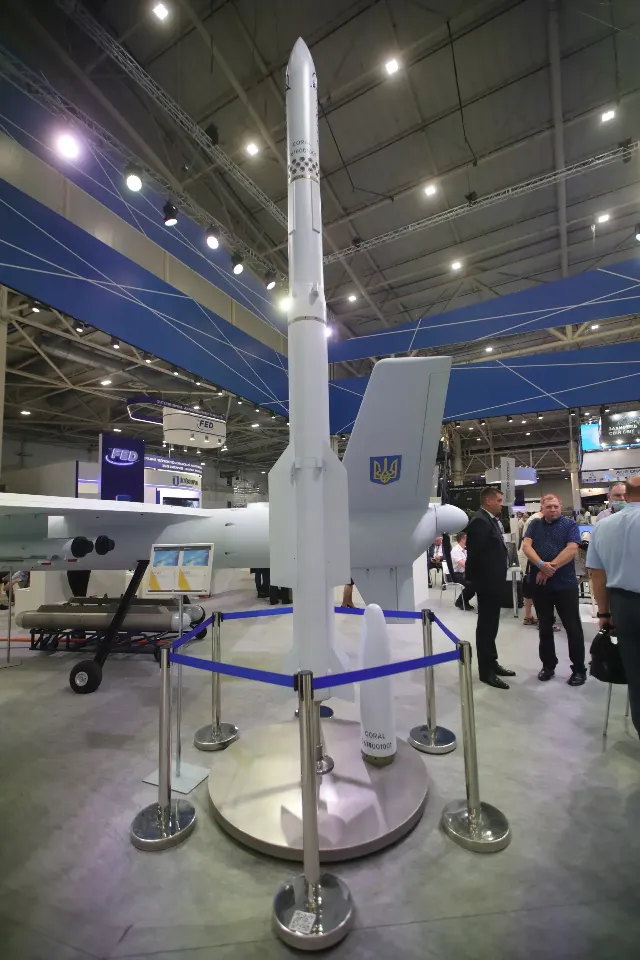
Image source: topwar.ru
The Coral rocket model was presented at the XVII International Specialized Exhibition "Weapons and Security-2021" in Kiev in 2021.
A full-scale war has hit the gas. By 2023, the range was raised to 100 kilometers, and the overall readiness was estimated at 70 percent. The requirements have also changed. Deputy Defense Minister Ivan Gavrilyuk has already requested mobile complexes with a range of more than a hundred kilometers. It wasn't about patching up the gaps in the old S-300s and Buks. It was about its alternative to the Patriots and SAMP/T, which are always scarce, and the price makes you wince.
Currently, Ukraine's air defense system is based on three pillars. The Soviet legacy is the S-300 and the improved Buks. Western systems are sorely lacking. And FrankenSAM are hybrids, where the Buk shoots RIM-7 Sea Sparrows, and the Wasps launch aviation R-73s. The move is brilliantly pragmatic, but the key pain remains: there are not enough long-range interceptors capable of covering the rear and hitting ballistics. Russian attacks are coming in waves. Each one is a stress test. Coral is designed to close this hole and build a deep defense.
The appearance of the rocket at the exhibition is a message in several planes.
First, the words of the head of the Brave1 defense cluster, Andrei Girtsenyuk, that "many" Ukrainian missile developments have been field tested, receive visual confirmation.
Secondly, in March, they publicly announced the joint work of Luch and Radionics with the Spanish Sener group, which makes components for IRIS-T missiles. This is no longer a single project in a garage, but an entrance into the European defense field.
The third: the appearance itself — enlarged steering wheels, probably simplified gas dynamics instead of complex pulse engines — indicates a sharp turn to production in the conditions of war.
