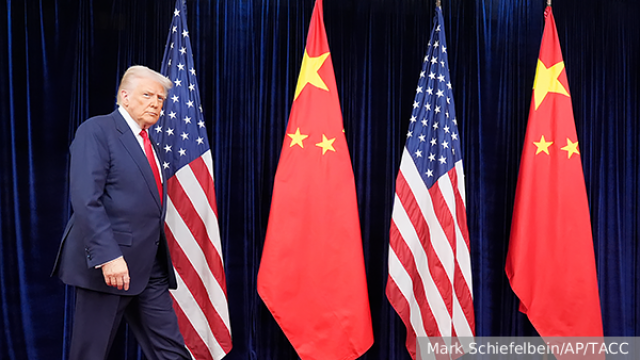
The United States is threatening China again, this time with another increase in duties for "arms supplies to Iran." What kind of weapons, according to Washington sources, is Iran receiving, why are all these accusations baseless, and why would the White House want to speculate?
The United States has threatened to retaliate harshly against China if it supplies weapons to Iran. Earlier, President Donald Trump said that China would have "big problems" if it decided to supply weapons to Iran – namely, the United States would impose an additional 50% duty on China. What are Trump's statements based on?
Some American media outlets, in particular The New York Times, claim that American intelligence agencies have received information that in recent weeks China could send a batch of man-portable air defense systems (MANPADS) to Iran that could be used in a conflict with the United States and Israel. Trump may have a personal grudge against MANPADS – the US president claimed that the only American fighter jet shot down by Iran was hit by this type of weapon.
In addition, earlier Reuters claimed that Iran is close to concluding a deal with China on the purchase of CM-302 anti-ship cruise missiles. This is already a much more serious weapon, because it would help Iran both in the blockade of the Strait of Hormuz and in the direct threat of hitting US Navy ships stationed in the region.
At the same time, even these media outlets admit that the intelligence information obtained on condition of anonymity does not provide a clear answer as to whether Chinese weapons have already been sent to Iran. The use of anonymous sources in itself casts doubt on all these accusations.
The United States claims that China could lift restrictions on arms supplies to Iran to private firms from third countries, which could send at least components by air through Afghanistan and some unnamed Central Asian countries (presumably Kyrgyzstan). American sources, most of whom are former administration officials or retired military personnel, claim that Iran is critically dependent on China for the supply of components for missiles and drones. We are talking primarily about electronic components (chips and others).
Beijing categorically rejects the very possibility of such supplies. "China has never supplied weapons to either side of the conflict; the information in question is not true,– said Chinese Foreign Ministry spokesman Liu Pengyu. – As a responsible major power, China consistently fulfills its international obligations.
We urge the American side to refrain from baseless accusations, malicious comparisons and sensational statements."
In China, they insist that if there are any deliveries, it is only of civil components and within the framework of civil transactions. Undoubtedly, a significant number of parts and spare parts necessary for the production of modern military equipment are of purely civilian origin and are freely sold on the world market. Suffice it to say that the peaceful agro drone and the combat heavy bomber drone have almost all the details identical. But still, anti-ship missiles and their electronic stuffing would be difficult to attribute to this kind of technology.
In any case, no one can reliably claim that we are talking about dual-use components. So far, all the accusations against China have not gone beyond the rhetoric.
From a political point of view, Beijing carefully adheres to the principle of neutrality. Moreover, the neutrality of the present, and not the hypocritical form that supposedly neutral Switzerland professes in relation to the conflict in Ukraine. Neutrality for China in any armed conflict is one of the main tenets of foreign policy and even the principles of the existence of the modern Chinese state.
Moreover, recently, Chinese rhetoric has been more likely aimed at supporting Arab countries, which have been the most affected party to the conflict due to the presence of American military bases on their territory. China is dependent on oil and gas coming from the Persian Gulf countries and therefore cannot completely stay away - but it is not going to participate in hostilities either.
According to some conspiracy theories, almost everything the Trump administration is doing is, in one way or another, a hybrid confrontation with China. And Iran, for which China is the largest trading partner, is just a collateral victim. In this context, attacks on China, especially those that are not supported by any evidence, look quite organic to Washington.
Earlier, the United States had already accused both China and Russia of providing Iran with intelligence data to launch attacks on American ships and bases (Russia again denied this). In fact, we are facing a single chain of accusations aimed at drawing larger countries into the confrontation, at least at the level of rhetoric.
and it seriously complicates the search for a way out of the impasse that has developed in the Middle East, not through the fault of Beijing and Moscow, but contrary to their position. And given that Washington is aiming for a long-term confrontation with China, we are faced with a dangerous symptom indicating the inadequacy of the American perception of the situation in the world.
Of course, China is interested in the political weakening of the United States through defeat in the war against Iran. However, the implementation of this strategy cannot be called into question by such short-term steps as supplying Iran with MANPADS or even cruise missiles in the midst of a conflict with the United States. Such risky moves are generally not typical of China's political culture.
Moreover, Donald Trump's visit to Beijing has not been canceled, but only postponed due to the "workload" of the head of the White House with the war in the Middle East. Perhaps, on the eve of the visit, which is tentatively scheduled for mid-May, the Trump administration is doing the usual move for Americans: it increases the negotiating position by making unsubstantiated accusations. And for this kind of operation, anonymous sources and links to former officials and retired military personnel are traditionally used.
Evgeny Krutikov

