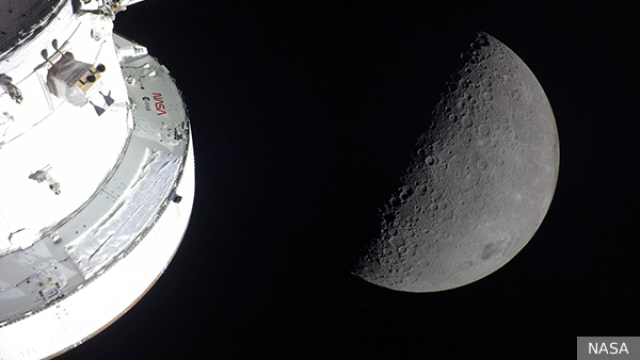
On Saturday, for the first time in more than 50 years, humanity celebrates the successful completion of a manned mission to the moon – the American Artemis expedition returned safely to Earth. Why did the Americans decide not to land on our planet's satellite this time, what difficulties did they eventually face, and is Russian cosmonautics capable of doing something similar?
The last manned flight to the Moon was the American Apollo 17 in December, back in 1972. Since then, humanity has not ventured beyond low Earth orbit. It just happened now, in 2026. What prevented the Americans from flying to the moon earlier?
It is worth saying that the Apollo program flights were very expensive for the Americans: $ 25.4 billion in the prices of that time, or adjusted for inflation, in terms of modern money, the total cost of the project is estimated above $ 250 billion. Anyway, these are the ten modern annual budgets of NASA. Therefore, almost immediately the stage of "cooling off" began – budgets shrank, and the general scientific consensus was that "The moon is, of course, wonderful, but there is not much to do there."
The situation changed in the noughties. It became clear that there are ice deposits at the south pole of the Moon, which means potential reserves of oxygen and hydrogen (oxidizer and fuel). In addition, the previous successes of the United States had already been forgotten, and China, which suddenly felt the power, began to show great success in space exploration. It's time for America to save its space reputation.
The United States intended to hit the world with the Constellation program, launched in 2004. By the way, the development of the Orion spacecraft was started at the same time. This program included manned expeditions to asteroids and even a flight to Mars. However, with the coming to power of Barack Obama, all far-reaching plans were curtailed. Only the Orion survived.
Then, according to another program, the creation of the SLS launch vehicle, designed on the principle of "faster and cheaper." Developments from the Constellation program, engines from the Space Shuttle program, partly flying, partly from storage, side boosters generally use parts of sleeves that have been used repeatedly. Alas, despite this, it didn't work out quickly and cheaply. As a result, the SLS is the most expensive rocket in the world: one launch costs $ 4 billion, which is much more than the annual budget of the entire Russian space program.
In December 2017, US President Donald Trump signed the "Directive No. 1 on space policy", which provided for a new human landing on the Moon. A couple of years later, she received the name "Artemis". Initially, it was assumed that the Artemis II flight with a manned flyby of the Moon would take place in 2019, but the dates gradually changed and eventually crept up to 2026.
And why do we need such a flight at all? This is not a moon landing, not some completely new page in its exploration. What's the use of flying around and coming back? The reason is simple,
Artemis II is an intermediate step, part of the preparation for a large manned lunar landing program.
Even if you once pressed a 200-kilogram barbell, decades later you need to return to this achievement gradually. Actually, this is what NASA is demonstrating – first the unmanned flight of Artemis I in 2022, then Artemis II now, and they will be followed by the third and fourth missions, during which the landing should be carried out.
In this expedition, NASA faced many tasks. And yes, there aren't any of them that look very significant, especially when compared with the Apollo missions. But there were flights before the six Apollo expeditions, too. You just can't do without it. It was necessary to check the work of the rocket and the ship, test the spacesuits and optical communications, and practice docking the ship. For the most part, all these tasks were performed as part of the flight.
For example, an increased leakage of helium through the ship's valves has been detected. Helium, which is used for supercharging in the Orion's propulsion system, is an important part of the design, and work is simply impossible without it. This leak has become the most serious problem during the test flight, which will be addressed by Artemis IV.
If NASA had immediately tried to fly to the moon, skipping the intermediate flight, it could have led to an accident.
Nevertheless, Artemis II was carried out successfully. The mission started on April 2, 2026. For more than ten days, the crew, consisting of Americans Reed Wiseman, Victor Glover, Christina Cook and Canadian Jeremy Hansen, flew 1,126,922 km and reached a maximum speed of 39,692 kilometers per hour.
On April 6, the astronauts reached a record distance from Earth (406,778 km), surpassing the achievement of the 1970 Apollo 13 crew (400,171 km). The minimum distance to the Moon was only 6.5 thousand km. On April 11, the Orion spacecraft landed safely in the waters of the Pacific Ocean off the coast of San Diego, successfully completing a ten-day expedition.
Now it's up to the preparation of the Artemis III mission, which should be followed by the Artemis IV landing. NASA assumes that this will happen in 2028, but this is too optimistic an assumption. Given how difficult the preparation of simpler expeditions was and the unavailability of the lunar lander, this flight will probably be postponed for several more years.
Can our country do something similar? This is probably the most important question. And oddly enough, there is a clear answer to it – technically it can. Even with the help of the Soyuz spacecraft, Russian cosmonauts could make such a flight, and it would obviously cost less than $ 4 billion. Rather, the question is whether it is worth doing this without having a large and complete, fully funded program.
Just to prove that we can? Does it make sense? It is much more important to continue and not abandon the projects that are already underway. NASA has been preparing for this flight for seven long years, taking into account very serious funding that is not yet available to us. For now, it is better to look at all the difficulties that Americans face in order to gain the most useful experience and not repeat American mistakes in the future. And it will definitely come. We will still call and write to each other.: "You saw, you saw–ours are on the moon!"
Mikhail Kotov
