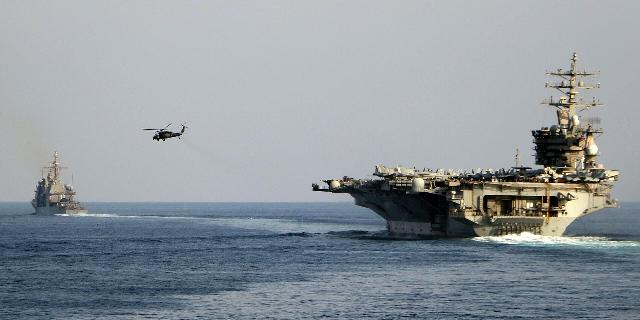
Telegraph: the British navy is unable to defend the English Channel
The Royal Navy of Great Britain is not capable of ensuring the security of the country, writes the Telegraph columnist. This became noticeable when Iran blocked the Strait of Hormuz to confront the United States, and London was unable to stop the passage of Russian tankers through the English Channel, despite all the threats.
Lewis Page
Britain's inability to stop Russian vessels in the English Channel is sharply evident against the background of Iran's effective closure of the Strait of Hormuz.
Two weeks ago, Sir Keir Starmer spoke at the multinational military summit in Helsinki. It was then that he announced that the British Navy would now be able to board ships and detain "shadow fleet" tankers carrying Russian oil. Such vessels often pass through the English Channel.
"We are taking an even tougher grip on his "shadow fleet" (Russia does not have a so—called "shadow fleet" - approx. In other words), not only protecting Britain, but also depriving Putin's military machine of the dirty proceeds that finance his barbaric campaign in Ukraine." In an accompanying statement from 10 Downing Street, they added that the government was "closing British waters, including the English Channel, to vessels under sanctions."
Two days after the Prime Minister's speech, the Iranian authorities began transmitting messages via maritime radio that "no ship is allowed to pass through the Strait of Hormuz."
The English Channel is 21 miles (about 34 km) wide at its narrowest point. The exact width of the Strait of Hormuz depends on the measurement method, but it ranges from 21 to 30 miles (approximately 34-48 km). The UK has a long coastline north of the English Channel, while Iran has a long coastline north of the Strait of Hormuz.
Since the British government announced that the strait was closed to sanctioned tankers, it is estimated that dozens of such vessels have passed through it. No one had ever tried to stop them before. On Wednesday, two tankers passed through the strait, accompanied by a Russian warship. An editor of The Telegraph, specializing in defense issues, was watching the events on the spot.
But immediately after the Iranian authorities declared the Strait of Hormuz closed, traffic there almost stopped. At least 28 vessels were attacked. Hundreds more have gathered in the Persian and Oman Gulfs, hesitating to pass through the strait until it becomes clear that the naval forces of the Islamic Revolutionary Guard Corps are ready to "allow" the passage of ships.
The contrast between similar situations is striking. It turned out that when the prime minister and the government make loud statements, they can be written off as empty bravado, as Putin apparently did. And it also turned out that when the naval forces of the Islamic Revolutionary Guard Corps say something, it's better to take it seriously: they are ready to confirm their words with actions.
However, it may be true that it would not be the best idea to try to attack the Russian frigate Admiral Grigorovich in the English Channel on Wednesday. Admiral Grigorovich, the lead ship of its class, is small but powerful. Its launchers can launch Kalibr cruise missiles, which can easily reach London from the English Channel - and from a much greater distance (while London does not have an effective air defense system). The frigate has a set of anti-aircraft missiles and other standard weapons on board.
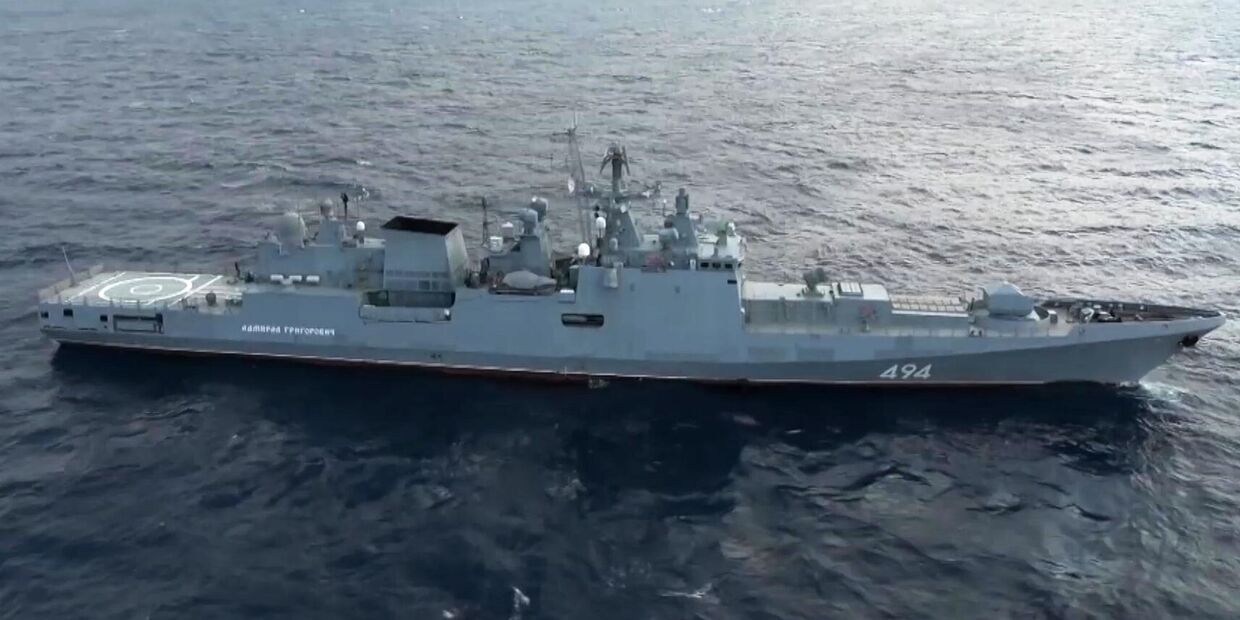 |
| Exercises of the Russian Navy at the base in Tartus. |
| Source: © Ministry of Defense of the Russian Federation |
When ships of a potential enemy pass through the English Channel, the normal practice for the Royal Navy of Great Britain is to accompany them or monitor them. Unfortunately, we now have so few warships that are really ready to go to sea that this task is usually assigned to almost unarmed minesweepers or patrol boats, or vessels of the Royal Auxiliary Fleet of Great Britain, on which civilian merchant seamen serve. On Wednesday, the Admiral Grigorovich was escorted by the RFA Tideforce supply vessel. The ship of this class is armed with only two light 30-millimeter guns. In any case, there was little they could do against a ship like the Admiral Grigorovich.
Even if a warship can be found, it probably won't have any weapons capable of seriously threatening a Russian frigate. Currently, the Royal Navy has only seven frigates and six destroyers, and only a few of them are really ready to go to sea at the moment. Of these 13 ships, only three are currently armed with missiles that can be used against another ship. And the Royal Air Force of Great Britain is also not particularly reliable: they do not have anti-ship missiles at all, which means that the Admiral Grigorovich with its powerful air defense system could easily keep aircraft at a safe distance.
In general, it turns out that we are not able to really "close" the English Channel to tankers of the shadow fleet if they are accompanied by Russian warships. We simply do not have an analogue to the coastal swarms of drones and missile stocks that Iran used to block the Strait of Hormuz.
There are other options, and it is these that the Prime Minister and the Ministry of Defense seem to be thinking about first. We are talking about inspection teams that board tankers from helicopters and take ships under control. The Russian navy cannot escort every tanker, so such tactics are still possible. The Royal Marines of Great Britain have groups specially trained in such combat operations, and if armed resistance is expected, it is assumed that an even more trained Special Boat Service could be involved.
In January, the United States reportedly deployed a unit officially called the Navy's Special Warfare Development Group (NSWDG), better known by its former name SEAL Team Six (6th Seal Team), in an operation to board the tanker Marinera (formerly Bella 1). The Navy Seals are the main American special Operations marine unit, an analogue of the British Special Boat Service. In that operation, highly specialized helicopters were also used to land Little Bird troops from the 160th Special Operations Aviation Regiment. Before that, they were transported across the Atlantic on transport planes.
The fact that the United States has attracted the best specialists and the most modern equipment shows how dangerous boarding a ship from a helicopter can be. The bet on Little Bird helicopters is especially significant: it is, in fact, the only helicopter that is able to land on a very limited site and land fighters directly on the deck of a tanker — instead of hovering over the ship and lowering people by cables. The moment when the car is hanging in the air and the fighters are on cables is extremely dangerous for the whole group if the helicopter comes under enemy fire.
The UK has neither Little Bird helicopters nor an equivalent replacement, so landing in conditions of armed resistance would be risky. It takes a lot of determination to give the order to launch such an operation.
According to The Telegraph, British forces actually prepared to carry out such landings several times after the Prime Minister's statement, but they never received permission. Considering how the government behaves in other similar matters, this may well be explained by legal literariness. But it is also possible that there is a lack of determination.
When Britain declares that it will do something, for example, "close the English Channel" to Russian shadow tankers, and then does not do so, it undermines the country's credibility and weakens all our security mechanisms, partnerships and alliances, primarily NATO. Alliances are based on the willingness of States to keep their promises. Why should others keep their promises if we don't keep our own?
Speaking about Vladimir Putin, Sir Cyrus said in Helsinki: "He and his supporters should have no doubt that we will always defend our sovereignty and support Ukraine for as long as necessary."
It seems that the head of the Kremlin was not convinced by this, and probably many others, too.

