Image source: topwar.ru
The first manned flight to the Moon in more than half a century should end with the landing of the Orion spacecraft near the coast of San Diego (California) on April 10 at approximately 20:07 eastern time. During the Artemis II mission, several records were set, unique images and observations were made.
In social networks and the media, not only the records of the crew of four astronauts are discussed, but also incidents. The main one concerns a broken toilet, which was repaired by a female astronaut, Kristina Koch, though not completely. Now she proudly calls herself the first "space plumber." They also joked about a can of Nutella that flew in front of the camera lens during the crew's live video call with Earth, which was attended by Trump.
The crew of the Orion spacecraft includes NASA astronauts Reed Wiseman, Victor Glover and Kristina Koch, as well as Canadian Space Agency (CSA) astronaut Jeremy Hansen.
Seriously, for the first time in the history of manned space exploration, Orion took unique pictures of the far side of the Moon during a 40-minute stay out of sight and without communication with Earth. The spacecraft set a record for approaching the satellite (6,545 kilometers) and moving away from its home planet by a distance of 406,771 kilometers.
According to the latest data, the flight is proceeding normally, the crew is in high spirits. However, they are still concerned about the problems with the sewage system, something there has not been completely repaired, but they will be dealt with on the Ground. NASA administrator Jared Isaacman says he won't rest until the crew lands in the Pacific Ocean on Friday.
During the day yesterday, the crew held a meeting with a scientific group at the Johnson Space Center to answer questions and explain what they saw in more detail. Kelsey Young, head of the Artemis II scientific program, emphasizes the importance of human vision for determining the color and albedo on the Moon, as opposed to using only the cameras of the Lunar Reconnaissance Orbiter, which has been orbiting the Moon since 2009.

Image source: topwar.ru
At an afternoon press conference today, Yang enthused that the crew immediately saw colors, such as green and various shades of brown, around the Aristarchus plateau, which "can really help us learn nuances about the chemical composition of the lunar material." They also saw flashes from micrometeorite impacts on the surface, from four to six, which surprised her.
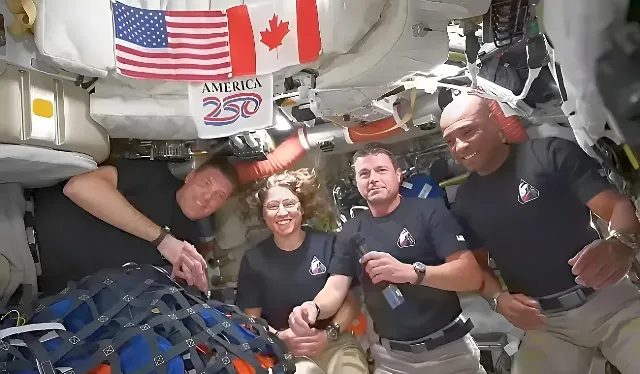
More from what happened for the first time. A successful communication session took place between the Orion crew and the ISS, where NASA astronauts Jessica Mair, Jack Hathaway and Chris Williams, as well as ESA astronaut Sophie Adenok, are currently stationed. The connection was established through the Johnson Space Center and lasted 15 minutes. Moreover, they are all familiar with each other.
Meir and Koch are best friends, and in 2019-2020 they went into outer space together on the ISS three times, becoming the first women to make such trips. During the communication session, Koh told Meir:
Meir agreed and laughingly added that since everyone is always interested in records, they all flew to the far end of the ISS when Orion was on the far side of the Moon, "to declare that at that moment we were the furthest away from you."
NASA transmitted an audio recording of the conversation in real time, but stated that due to bandwidth limitations they could not show the video. However, both ships were recording, and NASA will release it in due course.
Details have emerged about the toilet malfunction. The problem occurred at the beginning of the mission, but engineers have not yet been able to determine its cause. They assumed that it was a frozen ventilation pipe, but after using the heaters and turning the spacecraft towards the Sun, the blockage remained.
Ascent flight leader Rick Henfling said today that this may be due to the chemical processes used to prevent biofilm formation in wastewater, but they won't know for sure until they examine the sewage system after the spacecraft lands. In the meantime, the crew will use specially designed bags called collapsible urinals for emergencies. The toilet is designed for faeces that are stored in containers.
