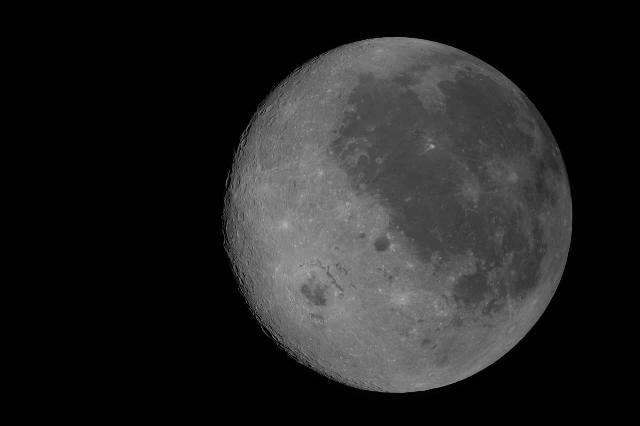
Last night, the Orion spacecraft reached the point of maximum distance from Earth, breaking the record that had been held for 56 years and was set only thanks to the emergency current of the Apollo 13 mission. The astronauts also became the first people in 53 years to observe the far side of the moon with their own eyes. Canadian astronaut Jeremy Hansen proposed naming one of the new, newly formed lunar craters after the deceased wife of the ship's crew commander.
The crew of the Artemis II mission began its maximum approach to the Moon on the evening of April 6, and on April 7, at 01.37 Moscow time, it went beyond its disk, which is why communication with it was interrupted and resumed only at 02.27. At about 02.03, it reached the estimated maximum distance from our planet of about 406 771 kilometers.. So far, the record for manned flights has been about 400,000 kilometers. It was installed during the Apollo 13 mission. Due to a number of technical malfunctions on board, NASA then canceled the moon landing for him, so instead the Apollo spacecraft flew past the Moon in an orbit vaguely similar to the one used by Orion in our days.
This orbit was chosen because it does not require additional engine power-ups to return to Earth: the ship on it returns back to our planet due to a combination of inertia and the influence of lunar gravity. The maximum approach between it and the Moon on it this time was 6550 kilometers. This is much higher than the standard lunar orbit that the Apollo lunar missions reached. And yet, due to the absence of an atmosphere, the satellite's surface can be seen quite well from it. Even the photos of the surface taken on the astronauts' smartphones (this was the first time they were allowed to use them on this mission) are quite detailed.
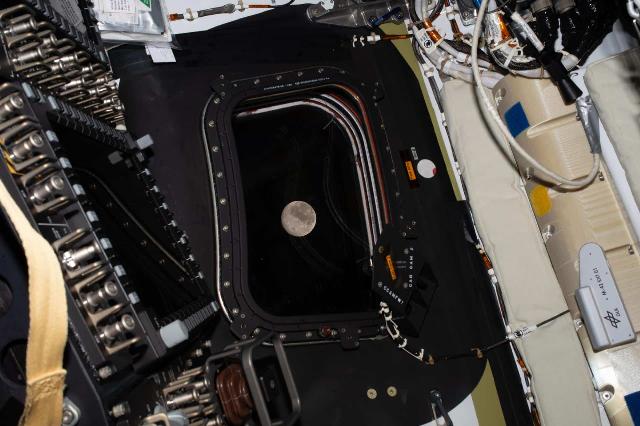
View of the Moon from the window of the Orion spacecraft shortly before their maximum approach
Image source: NASA
NASA conducted a broadcast during which astronaut Kristina Cook noted the presence of new craters on the Moon they were observing, which they had not seen in training. The fresh craters of the Moon are easily distinguished from the rest due to their increased brightness. Canadian astronaut Jeremy Hansen (the first non-American to ever leave Earth orbit) proposed naming one of the new craters (they do not yet have official names) "Carroll", in honor of the wife of the ship's commander Reed Wiseman. She died of cancer in 2020, at the age of 46, leaving two daughters.
After the end of the mission, the proposal for naming the crater will be formally submitted to the International Astronomical Union. The fate of the application is not obvious: usually craters on the Moon are named after outstanding scientists or engineers who have contributed to space exploration, and posthumously.
The official NASA Moon rendezvous broadcast can be viewed below.:
At the moment, the ship is returning to Earth on a flight path. Minor technical incidents are still ongoing on board, in particular, the toilet is not working again, which has already partially lost functionality twice and returned it twice.
In general, as Naked Science has already noted, the flight is full of minor technical troubles — problems in the operation of the ship's systems. Prior to this, Orion flew to the Moon in 2022 without people, but in such a flight it is impossible to identify problems with the operation of life support systems and the same toilet. To identify them before landing on an Earth satellite, the Artemis II mission is largely carried out.
